



 Published on : 05/05/2026
UK’s World-First Global Irregular Migration Sanctions Regime: New Designations (5 May 2026)
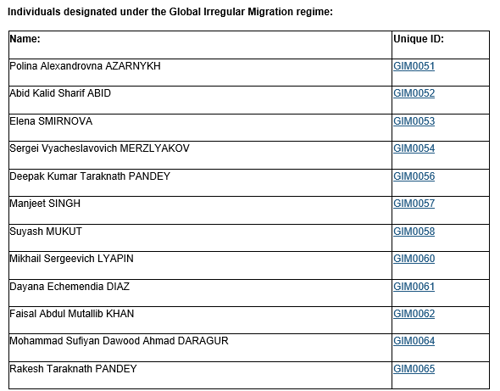
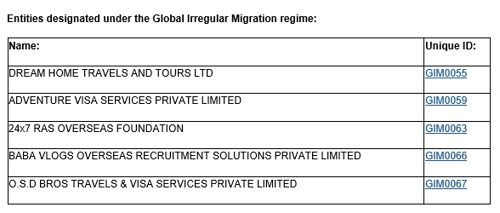
On Tuesday, 5th May, the UK Government, under the Global Irregular Migration sanctions regime, has designated the following
- 12 individuals and
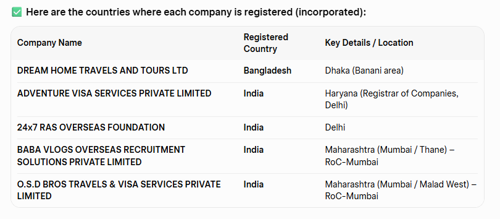
- 5 entities
The UK Global Irregular Migration sanctions regime is officially known as The Global Irregular Migration and Trafficking in Persons (Sanctions) Regulations 2025 (S.I. 2025/902).
- It entered into force on 23 July 2025 under the Sanctions and Anti-Money Laundering Act 2018.
- It is the world’s first dedicated standalone sanctions regime targeting organised immigration crime.
- Its purpose is to prevent and combat
- People smuggling, trafficking in persons, and
- The instrumentalisation of migration for destabilisation (e.g., using migration flows as a tool of hybrid warfare or state destabilisation).
"Instrumentalisation of migration for the purpose of destabilisation"
- Is a specific legal term in the UK Global Irregular Migration sanctions regime.
- It refers to situations where a government, or someone acting on behalf of or backed by a government, deliberately manipulates or weaponises migration flows not to help people, but to create chaos, pressure, or harm in another country.
- In other words: using human migration as a tool of hybrid warfare or state destabilisation (exactly as your example said).
Official legal definition (from the Regulations)
- The exact wording in The Global Irregular Migration and Trafficking in Persons (Sanctions) Regulations 2025 (Regulation 4) is:
o “instrumentalisation of migration for the purpose of destabilisation” occurs where
- The government of a country (“X”), or
- OTHER PERSON who is in control of X or
- Is otherwise responsible for ADMINISTERING THE AFFAIRS OF X, or
- A GROUP BACKED BY THE GOVERNMENT or
- A PERSON WHO IS IN CONTROL OF X,
- Facilitates, encourages or assists (in each case whether by an act or omission)—
- The movement of an individual in X towards the border of X,
- An individual in X to travel, whether directly or indirectly, to any country other than X,
- The movement of an individual in a country other than X (“Y”) towards the border of Y, or
- An individual in Y to travel, whether directly or indirectly, to any country other than X or Y, for the purpose of causing the destabilisation of any country other than X.
Key points:
- It must involve state or state-backed actors (not purely private criminal networks).
- It can be done by action or deliberate inaction (e.g., opening borders, providing transport, or failing to stop organised movements when they have the power to do so).
- The intent must be to destabilise another country (political pressure, border crisis, economic strain, hybrid attack, etc.).
Real-world context (why the UK included this)
- This concept first gained prominence in 2021–2022 when Belarus was accused of flying in migrants from the Middle East and deliberately pushing them toward the Polish, Lithuanian, and Latvian borders to create a crisis and pressure the EU.
- Similar tactics have been alleged elsewhere.
- The UK regime is designed to let the government sanction the organisers, enablers, and state officials behind such operations even if they are not directly involved in traditional people-smuggling for profit.
Compliance implications
- The sanctions regime treats this as one of the three core trigger activities (alongside people smuggling and trafficking in persons).
- Anyone (individual or entity) who is “involved” including by providing material support, financial services, logistics, or facilitation can be designated.
- Because it targets state-linked activity, compliance teams should watch for high-risk indicators such as unusual government-linked contracts, transport/logistics in politically sensitive border regions, or dealings with entities flagged in government advisories on hybrid threats.
Recommendation for organisations:
- Update your sanctions screening systems to the UK Sanctions List (not the old OFSI Consolidated List).
- Review policies for migration-related high-risk activities.
- Train staff on the broad “facilitation” and “benefit” tests.
- Consider including this regime in your annual sanctions risk assessment.
Long read
1. What sanctions does the regime impose?
The regime applies three main types of sanctions to designated persons (individuals or entities) and, in the case of financial sanctions, to entities they own or control:
- Financial sanctions (asset freeze):
- Immediate freeze of all funds and economic resources belonging to, owned, held, or controlled by a designated person.
- Prohibition on making funds or economic resources available (directly or indirectly) to, or for the benefit of, a designated person.
- These are the core prohibitions most relevant to financial institutions, businesses, and individuals (Regulations 13–18).
- Director disqualification sanctions:
- Designated persons are barred from being a director of a UK company or taking part in the promotion, formation, or management of any UK company (or foreign companies with a sufficient UK connection).
- Immigration sanctions (travel bans):
- Designated persons are “excluded persons” under the Immigration Act 1971.
- This results in refusal of entry/leave to remain in the UK, visa denials (including transit visas), cancellation of existing permission to stay, and potential removal from the UK. Carriers must refuse boarding.
2. Who can be designated?
The Foreign, Commonwealth & Development Office (FCDO) can designate any person (individual or entity) who is or has been “involved” in:
- People smuggling or trafficking in persons.
- Instrumentalisation of migration for destabilisation.
- Criminal or other activities that facilitate, promote, support, or are intended to facilitate the above (including profiting from them).
- “Involved” is broadly defined to include direct participation, facilitation, or provision of material/financial support.
- Designations are made by name or (rarely) by description and are published with a Statement of Reasons.
3. Who must comply?
The prohibitions apply to:
- Anyone in the UK (including the territorial sea).
- UK-incorporated or constituted entities (anywhere in the world).
- UK nationals (anywhere in the world).
This creates extra-territorial reach for UK persons and entities.
4. Compliance obligations (practical briefing)
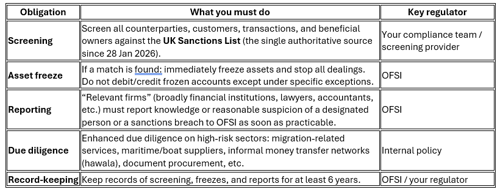
Circumvention prohibition (Regulation 19):
- It is an offence to intentionally participate in activities whose object or effect is to circumvent the sanctions.
5. Exceptions and licensing
- Automatic exceptions exist for certain payments to UK public bodies, crediting frozen accounts, and national security/serious crime prevention (with notification in some cases).
- OFSI licences (financial sanctions) can be granted on grounds including basic needs, legal fees, humanitarian assistance, prior obligations, etc. (see Schedule 2 to the Regulations). General licences may also be issued.
- Director disqualification licences are handled by the Insolvency Service.
- Immigration directions are case-by-case by the Home Office.
- Never assume an exception or licence applies obtain confirmation first.
6. Enforcement and penalties
- Breaches of financial sanctions: up to 7 years’ imprisonment and/or unlimited fine (on indictment).
- Director disqualification breaches: up to 2 years’ imprisonment and/or fine.
- Failure to report or provide information: criminal offence.
- OFSI can also impose civil monetary penalties (up to the statutory maximum) and publish enforcement actions.
- OFSI takes a risk-based approach but has a strong track record of enforcement.
7. Where to find the designations (as of 5 May 2026)
- UK Sanctions List (sole authoritative source): gov.uk/government/publications/the-uk-sanctions-list
- Regime-specific page with notices: Global irregular migration and trafficking in persons: list of designations and sanctions notices
- Latest sanctions notice (5 May 2026) added 17 new designations.
- The regime has already seen multiple designation packages targeting Balkan smuggling networks, boat suppliers, money service operators, and enablers in the Middle East, North Africa, and elsewhere.
8. Key official resources
- Statutory guidance (updated 25 March 2026): gov.uk guidance page
- Full Regulations: legislation.gov.uk/uksi/2025/902
- OFSI general guidance on financial sanctions
- UK Sanctions List search tool
This briefing is based on the official UK government guidance and legislation as of May 2026. Sanctions lists change frequently always verify against the latest UK Sanctions List.
The Team
Meet the team of industry experts behind Comsure
Find out moreLatest News
Keep up to date with the very latest news from Comsure
Find out moreGallery
View our latest imagery from our news and work
Find out moreNews Disclaimer
As well as owning and publishing Comsure's copyrighted works, Comsure wishes to use the copyright-protected works of others. To do so, Comsure is applying for exemptions in the UK copyright law. There are certain very specific situations where Comsure is permitted to do so without seeking permission from the owner. These exemptions are in the copyright sections of the Copyright, Designs and Patents Act 1988 (as amended)[www.gov.UK/government/publications/copyright-acts-and-related-laws]. Many situations allow for Comsure to apply for exemptions. These include 1] Non-commercial research and private study, 2] Criticism, review and reporting of current events, 3] the copying of works in any medium as long as the use is to illustrate a point. 4] no posting is for commercial purposes [payment]. (for a full list of exemptions, please read here www.gov.uk/guidance/exceptions-to-copyright]. Concerning the exceptions, Comsure will acknowledge the work of the source author by providing a link to the source material. Comsure claims no ownership of non-Comsure content. The non-Comsure articles posted on the Comsure website are deemed important, relevant, and newsworthy to a Comsure audience (e.g. regulated financial services and professional firms [DNFSBs]). Comsure does not wish to take any credit for the publication, and the publication can be read in full in its original form if you click the articles link that always accompanies the news item. Also, Comsure does not seek any payment for highlighting these important articles. If you want any article removed, Comsure will automatically do so on a reasonable request if you email info@comsuregroup.com.
Archived News
To find our older articles, please click here.
View archive

To find our older articles, please click here.