
The World Bank has banned PwC firms in Kenya, Rwanda, and Mauritius over fraud
25/03/2026
- Executive Summary
It has been reported that
- In March 2026, three PwC entities operating in KENYA, RWANDA, and Mauritius formally admitted to engaging in collusive and fraudulent practices connected to World Bank–financed projects.
- https://www.capitalfm.co.ke/business/2026/03/world-bank-bans-pwc-firms-in-kenya-rwanda-mauritius-over-fraud/
Following an investigation into misconduct involving the Eastern Electricity Highway Project,
- The World Bank imposed a 21‑month debarment on the firms and any affiliates they control.
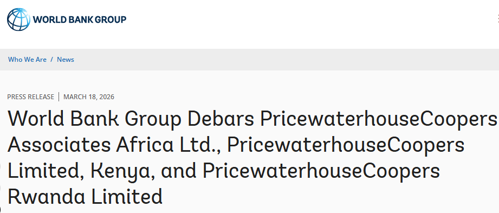
The sanctions include conditions for reinstatement and trigger cross‑debarment by other multilateral development banks.
This event highlights significant weaknesses in governance, procurement integrity, and quality control across the regional professional services sector.
- Nature of the Misconduct
2.1 Collusion Using Confidential Procurement Information
- The firms obtained confidential procurement information from project officials to influence the award of a consultancy contract to implement International Financial Reporting Standards (IFRS) for the Ethiopian Electric Power Corporation.
- This access provided an unfair competitive advantage and constituted collusive behaviour under World Bank Consultant Guidelines.
2.2 Manipulation Attempts in Additional Contract Awards
- The same entities attempted to influence the outcome of the Fixed Asset Inventory and Revaluation (FAIR) Contract for the Ethiopian Electric Utility.
- They intended to steer the contract award in favour of PwC Associates (Mauritius).
2.3 Fraudulent Misrepresentations
- PwC Associates Africa Ltd (Mauritius)
- Misrepresented key experts’ qualifications, availability, and employment status.
- Failed to disclose the full set of subconsultants involved in the project.
- These actions qualify as fraudulent practices under multilateral development bank integrity frameworks.
- The Settlement Agreement & Sanctions
3.1 Debarment
- All three firms received a 21‑month debarment with conditional release.
- They are prohibited from participating in World Bank–financed projects for the duration of the sanction period.
- The penalty applies to the firms and any affiliates under their control.
3.2 Conditions for Release
- The settlement requires all implicated PwC entities to implement or further develop an integrity compliance program consistent with the World Bank’s Integrity Compliance Guidelines.
- Successful completion is a prerequisite for early release from debarment.
3.3 Cross‑Debarment Exposure
- Under multilateral development bank harmonisation frameworks, the sanctions automatically extend to the African Development Bank, Asian Development Bank, European Bank for Reconstruction and Development, and Inter-American Development Bank.
- This significantly reduces PwC’s capacity to bid on donor-funded assignments.
- Mitigating Factors Recognised by the World Bank
- The reduced period of debarment reflects the firms’ cooperation with investigators, their admission of wrongdoing, their internal investigations, disciplinary actions taken against responsible staff, the cessation of relationships with implicated subconsultants, and their voluntary abstention from bidding on projects during the negotiations.
- The firms also introduced or enhanced staff training and internal controls as part of their remedial efforts.
- Impact Assessment
5.1 Regulatory Consequences
Regulators across East Africa and Mauritius should anticipate:
- Heightened scrutiny of audit and advisory sector governance
- Potential need for enhanced supervisory programs targeting conflicts of interest, subcontractor disclosure, and procurement‑integrity controls
- Increased expectations for regulated firms relying on PwC services to demonstrate risk assessment and mitigation
5.2 Impact on Mauritius
- Mauritius, as a financial and consulting hub, is likely to experience operational disruption and market uncertainty.
- Key advisory sectors—including audit, financial consulting, and compliance services—may face increased scrutiny, potential delays in project execution, and heightened regulatory expectations for assurance providers.
5.3 Regional Professional‑Services Integrity Concerns
- This case coincides with a broader integrity crisis affecting Big Four firms in East Africa, highlighted by multiple admissions of misconduct within the last two years.
- Systemic issues include bribery, collusion, falsified CVs, and misuse of insider procurement information.
- The situation collectively erodes trust in the independence and integrity controls traditionally associated with the global audit and advisory profession.
- Key Risk Areas for Boards and Regulators
6.1 Compliance Risk
- Engaging the debarred PwC entities during the sanction period may expose organisations to procurement‑integrity violations, donor‑funding breaches, regulatory non‑compliance, and elevated AML/CFT‑related risks.
6.2 Reputational Risk
- Association with firms formally sanctioned for collusion and fraud poses reputational hazards, potentially affecting investor confidence, donor relationships, and regulatory perceptions.
6.3 Operational Risk
- Clients may face delays, contract uncertainty, and repeated procurement processes due to the sanctions. Organisations relying heavily on PwC for advisory services may need contingency arrangements.
6.4 Supervisory & Regulatory Risk
- Regulators may require supervised entities to reassess reliance on PwC services. Increased regulatory inspections focusing on procurement practices, subcontracting arrangements, and staff credential verification are highly likely.
- Recommendations
For Boards
- Re‑evaluate or suspend engagements with PwC Kenya, PwC Rwanda, and PwC Associates (Mauritius) during the debarment period.
- Commission independent integrity due‑diligence reviews of ongoing PwC‑linked projects.
- Incorporate cross‑debarment checks into procurement and third‑party‑risk management frameworks.
- Strengthen internal controls concerning conflicts of interest, subcontractor oversight, and confidentiality of procurement information.
For Regulators
- Issue sector‑wide circulars advising on interactions with debarred professional‑services firms.
- Implement thematic reviews focusing on procurement integrity, subcontractor transparency, and expert‑credential verification.
- Require supervised firms to undertake written risk assessments when engaging any PwC affiliate linked to the sanction.
- Consider fit‑and‑proper assessments for implicated partners where legal frameworks permit.
- Clarification on Sub‑Saharan Operational Closure Claims
- No reliable evidence supports the assertion that PwC has shut down or suspended its operations across sub‑Saharan Africa.
- Available verified reporting concerns only the World Bank sanctions and their operational implications, not regional withdrawal or closure.
References
- World Bank Group Debars PwC Associates Africa Ltd, PwC Kenya, PwC Rwanda — Press Release, 18 March 2026. [worldbank.org] https://www.worldbank.org/en/news/press-release/2026/03/18/-world-bank-group-debars-pricewaterhousecoopers-associates-africa-ltd-pricewaterhousecoopers-limited-kenya-and-pricewate
- Kenya Insights: Big Shame: EY and PwC Found Guilty of Fraud and Corruption in Kenya, 23 March 2026. [kenyainsights.com] https://kenyainsights.com/big-shame-ey-and-pwc-found-guilty-of-fraud-and-corruption-in-kenya-as-world-bank-bans-lay-bare-scandal-inside-the-global-audit-elite/
- The Kenya Times: World Bank Debars PwC Firms in Kenya and Rwanda Over Fraudulent Projects, 18 March 2026. [thekenyatimes.com] https://thekenyatimes.com/business/world-bank-debars-pwc-firms-over-fraud-projects/
- Mauritius Civic Lens: PwC Ban: World Bank Suspends Projects in Mauritius, Kenya, Rwanda Over Fraud, 19 March 2026. [mauritiusc...iclens.com] https://mauritiusciviclens.com/2026/03/19/pwc-ban/
- Capital FM: World Bank Bans PwC Firms in Kenya, Rwanda, Mauritius Over Fraud, 18 March 2026. [capitalfm.co.ke] https://www.capitalfm.co.ke/business/2026/03/world-bank-bans-pwc-firms-in-kenya-rwanda-mauritius-over-fraud/
- People Daily: World Bank Suspends PwC Firms in Africa, Including Kenya — Claims Fraud and Collusion, 18 March 2026. [peopledaily.digital] https://peopledaily.digital/business/world-bank-suspends-pwc-firms-in-africa-including-kenya-claims-fraud-and-collusion
The Team
Meet the team of industry experts behind Comsure
Find out moreLatest News
Keep up to date with the very latest news from Comsure
Find out moreGallery
View our latest imagery from our news and work
Find out moreContact
Think we can help you and your business? Chat to us today
Get In TouchNews Disclaimer
As well as owning and publishing Comsure's copyrighted works, Comsure wishes to use the copyright-protected works of others. To do so, Comsure is applying for exemptions in the UK copyright law. There are certain very specific situations where Comsure is permitted to do so without seeking permission from the owner. These exemptions are in the copyright sections of the Copyright, Designs and Patents Act 1988 (as amended)[www.gov.UK/government/publications/copyright-acts-and-related-laws]. Many situations allow for Comsure to apply for exemptions. These include 1] Non-commercial research and private study, 2] Criticism, review and reporting of current events, 3] the copying of works in any medium as long as the use is to illustrate a point. 4] no posting is for commercial purposes [payment]. (for a full list of exemptions, please read here www.gov.uk/guidance/exceptions-to-copyright]. Concerning the exceptions, Comsure will acknowledge the work of the source author by providing a link to the source material. Comsure claims no ownership of non-Comsure content. The non-Comsure articles posted on the Comsure website are deemed important, relevant, and newsworthy to a Comsure audience (e.g. regulated financial services and professional firms [DNFSBs]). Comsure does not wish to take any credit for the publication, and the publication can be read in full in its original form if you click the articles link that always accompanies the news item. Also, Comsure does not seek any payment for highlighting these important articles. If you want any article removed, Comsure will automatically do so on a reasonable request if you email info@comsuregroup.com.


As well as owning and publishing Comsure's copyrighted works, Comsure wishes to use the copyright-protected works of others. To do so, Comsure is applying for exemptions in the UK copyright law. There are certain very specific situations where Comsure is permitted to do so without seeking permission from the owner. These exemptions are in the copyright sections of the Copyright, Designs and Patents Act 1988 (as amended)[www.gov.UK/government/publications/copyright-acts-and-related-laws]. Many situations allow for Comsure to apply for exemptions. These include 1] Non-commercial research and private study, 2] Criticism, review and reporting of current events, 3] the copying of works in any medium as long as the use is to illustrate a point. 4] no posting is for commercial purposes [payment]. (for a full list of exemptions, please read here www.gov.uk/guidance/exceptions-to-copyright]. Concerning the exceptions, Comsure will acknowledge the work of the source author by providing a link to the source material. Comsure claims no ownership of non-Comsure content. The non-Comsure articles posted on the Comsure website are deemed important, relevant, and newsworthy to a Comsure audience (e.g. regulated financial services and professional firms [DNFSBs]). Comsure does not wish to take any credit for the publication, and the publication can be read in full in its original form if you click the articles link that always accompanies the news item. Also, Comsure does not seek any payment for highlighting these important articles. If you want any article removed, Comsure will automatically do so on a reasonable request if you email info@comsuregroup.com.