

THE MINTY SAR FREEZE IS ALIVE AND KICKING AND DAMAGING JERSEY, says Sir Mark Boleat
12/12/2025
Sir Mark Boleat says in the JEP [1.01.2025]:-
- Jersey, for a jurisdiction that promotes itself as predictable, well-governed and anchored in the rule of law, this (AML SAR RULE) is a damaging inconsistency’
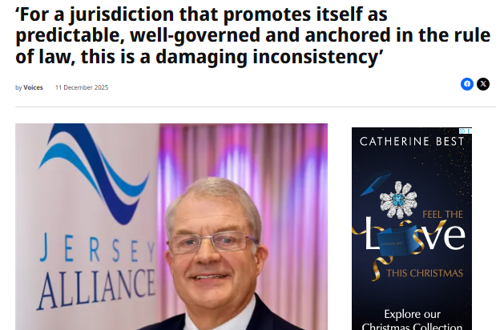
- https://jerseyeveningpost.com/voices/2025/12/11/for-a-jurisdiction-that-promotes-itself-as-predictable-well-governed-and-anchored-in-the-rule-of-law-this-is-a-damaging-inconsistency/
Sir Mark Boleat said on LinkedIn:
- The article argues that Jersey’s reputation as a predictable, well-governed jurisdiction anchored in the rule of law is undermined by weaknesses in its anti-money-laundering (AML) regime, particularly how Suspicious Activity Reports (SARs) are handled.
- The Government wants to make financial services more competitive, but Jersey has a significant problem in its anti-money laundering regime. Its arrangements for dealing with suspicious activity reports (SARs) are out of step with international standards, disproportionate and unfair.
- Once a SAR is submitted, the business will almost always freeze the account or halt the transaction in question.
- The customer is not told why and legally cannot be said.
- In the UK, authorities must respond within seven working days. If consent to carry out the activity or transaction is refused, the authorities have a further 31 days to investigate and decide whether to apply for a court-monitored freezing order. If nothing happens within that period, the freeze ends automatically. Similar arrangements apply in other jurisdictions.
- By contrast, Jersey has no statutory timeframe for the authorities to respond. This can mean that people are unable to access their own money for months or even years, without explanation or recourse.
- For a jurisdiction that promotes itself as predictable, well-governed, and anchored in the rule of law, this is an uncomfortable and increasingly damaging inconsistency.
- If Jersey is to be seen internationally as trusted, dependable and fair, then the rules governing SAR consent must reflect those values.
- https://www.linkedin.com/posts/boleat_financial-services-competitiveness-activity-7404437225356079104-l4UX?utm_source=share&utm_medium=member_desktop&rcm=ACoAAAA_6EIB0wPAWyjQcuq_XiD3asUV8xpMeZ0
Key issues raised:
- Importance of financial services: Jersey’s financial sector is vital to the economy (about 40 % of GDP and tax revenue), so regulatory credibility matters for competitiveness. Jersey Evening Post
- SAR process concerns:
- SARs can be filed on very low suspicion (e.g., algorithm alerts or minor discrepancies).
- Once a SAR is submitted, firms usually freeze accounts or transactions.
- Jersey has no fixed time limits or clear procedures for authorities to act after a SAR, meaning freezes can last months or even years without explanation. Jersey Evening Post
- Comparisons to other jurisdictions:
- In the UK, authorities must respond within seven working days and have 31 days to decide on action.
- In Switzerland and the EU, there are strict deadlines and automatic reviews.
- Jersey’s lack of deadlines and oversight makes it an outlier. Jersey Evening Post
- Consequences:
- Clients can’t access their own funds without a costly judicial review.
- Some businesses reportedly relocate because of the uncertainty.
- This undermines trust and Jersey’s positioning as a dependable finance centre. Jersey Evening Post
- Why it matters:
- If Jersey wants to be seen as credible and attractive internationally, its AML rules need clearer, fairer, and time-bound procedures, not just promotional campaigns. Jersey Evening Post
Observation
- Successive Governments have been asked to deal with this.
- To learn more, read the 2022 thoughts from William Redgrave. https://www.bakerandpartners.com/insights/indefinite-informal-asset-freezes-the-beginning-of-the-end/
- The telling paragraph in the article's conclusion is:
⚠️The Royal Court of Jersey has more than once encouraged the Jersey legislature to introduce time limits. Fifteen years ago, it said of the indefinite informal freeze. - And in 2025, nothing has changed
Source
- https://jerseyeveningpost.com/voices/2025/12/11/for-a-jurisdiction-that-promotes-itself-as-predictable-well-governed-and-anchored-in-the-rule-of-law-this-is-a-damaging-inconsistency/
- https://www.bakerandpartners.com/insights/indefinite-informal-asset-freezes-the-beginning-of-the-end/
- https://www.linkedin.com/posts/boleat_financial-services-competitiveness-activity-7404437225356079104-l4UX?utm_source=share&utm_medium=member_desktop&rcm=ACoAAAA_6EIB0wPAWyjQcuq_XiD3asUV8xpMeZ0
The Team
Meet the team of industry experts behind Comsure
Find out moreLatest News
Keep up to date with the very latest news from Comsure
Find out moreGallery
View our latest imagery from our news and work
Find out moreContact
Think we can help you and your business? Chat to us today
Get In TouchNews Disclaimer
As well as owning and publishing Comsure's copyrighted works, Comsure wishes to use the copyright-protected works of others. To do so, Comsure is applying for exemptions in the UK copyright law. There are certain very specific situations where Comsure is permitted to do so without seeking permission from the owner. These exemptions are in the copyright sections of the Copyright, Designs and Patents Act 1988 (as amended)[www.gov.UK/government/publications/copyright-acts-and-related-laws]. Many situations allow for Comsure to apply for exemptions. These include 1] Non-commercial research and private study, 2] Criticism, review and reporting of current events, 3] the copying of works in any medium as long as the use is to illustrate a point. 4] no posting is for commercial purposes [payment]. (for a full list of exemptions, please read here www.gov.uk/guidance/exceptions-to-copyright]. Concerning the exceptions, Comsure will acknowledge the work of the source author by providing a link to the source material. Comsure claims no ownership of non-Comsure content. The non-Comsure articles posted on the Comsure website are deemed important, relevant, and newsworthy to a Comsure audience (e.g. regulated financial services and professional firms [DNFSBs]). Comsure does not wish to take any credit for the publication, and the publication can be read in full in its original form if you click the articles link that always accompanies the news item. Also, Comsure does not seek any payment for highlighting these important articles. If you want any article removed, Comsure will automatically do so on a reasonable request if you email info@comsuregroup.com.


As well as owning and publishing Comsure's copyrighted works, Comsure wishes to use the copyright-protected works of others. To do so, Comsure is applying for exemptions in the UK copyright law. There are certain very specific situations where Comsure is permitted to do so without seeking permission from the owner. These exemptions are in the copyright sections of the Copyright, Designs and Patents Act 1988 (as amended)[www.gov.UK/government/publications/copyright-acts-and-related-laws]. Many situations allow for Comsure to apply for exemptions. These include 1] Non-commercial research and private study, 2] Criticism, review and reporting of current events, 3] the copying of works in any medium as long as the use is to illustrate a point. 4] no posting is for commercial purposes [payment]. (for a full list of exemptions, please read here www.gov.uk/guidance/exceptions-to-copyright]. Concerning the exceptions, Comsure will acknowledge the work of the source author by providing a link to the source material. Comsure claims no ownership of non-Comsure content. The non-Comsure articles posted on the Comsure website are deemed important, relevant, and newsworthy to a Comsure audience (e.g. regulated financial services and professional firms [DNFSBs]). Comsure does not wish to take any credit for the publication, and the publication can be read in full in its original form if you click the articles link that always accompanies the news item. Also, Comsure does not seek any payment for highlighting these important articles. If you want any article removed, Comsure will automatically do so on a reasonable request if you email info@comsuregroup.com.