

The JFSC Updated Travel Rule guidance for virtual asset service providers [NOV 2025]
18/11/2025
The Travel Rule is a critical global standard for transparency in virtual asset transfers.
The JFSC have updated the JFSC Travel Rule guidance note to
- Reflect maturing global standards and insights from the JFSC 2024 Travel Rule examinations with Jersey virtual asset service providers (VASPs).
- Help VASPs stay aligned with international best practices and local regulatory obligations to maintain Jersey's position as one of the most advanced jurisdictions for Travel Rule implementation..
What’s new?
- Additional definition and detail for intermediary VASPs, providing clarity under different service models,
- Reinforced expectations to keep Jersey among the most advanced jurisdictions for Travel Rule implementation
JFSC TRAVEL RULES
1. Context
The Financial Action Task Force (FATF) has called on jurisdictions to swiftly implement its ‘Travel Rule’, which requires transfers of virtual assets to be accompanied by accurate originator and beneficiary information.
The European Union (EU) Legislation (Information Accompanying Transfer of Funds) (Jersey) Regulations 2017 (Wire Transfer Regulations) [1] were amended on 1 September 2023 to include Virtual Asset Service Providers (VASPs).
- [1] to the EU Legislation (Information Accompanying Transfers of Funds) (Jersey) Regulations 2017 (jerseylaw.je = https://www.jerseylaw.je/laws/current/ro_57_2017
The Wire Transfer Regulations apply EU Regulation 2015/847 in Jersey. This regulation sets rules for including payer and payee information with fund transfers.
This guidance supplements Jersey’s AML/CFT/CPF regime and does not amend or replace it. It should be read alongside relevant legislation and regulatory requirements, including:
- The Proceeds of Crime (Jersey) Law 1999
- The Proceeds of Crime (Supervisory Bodies) (Jersey) Law 2008
- The Money Laundering (Jersey) Order 2008
- The JFSC Handbook for preventing money laundering, terrorist financing, and proliferation financing
JERSEY VIS-À-VIS EU LEGISLATION
- While Jersey’s current wire transfer regulations continue to implement Regulation (EU) 2015/847,
- It is essential to note that the European Union has adopted Regulation (EU) 2023/1113.
- Jersey may consider updating its legislation to reflect EU 2023/1113.
2. The JFSC guidance
- The JFSC acknowledge that VASPs in different jurisdictions are at varying stages of adopting and implementing the Travel Rule.
- After engaging with the industry to understand these challenges, this guidance sets out expectations for VASP compliance under different circumstances.
3. VASP to VASP
3.1 The JFSC expect VASPs to:
3.1.1 Demonstrate full compliance with the Travel Rule
3.1.2 Have a functioning Travel Rule solution in place, where applicable, and be able to demonstrate it working effectively
3.1.3 Maintain documented procedures that clearly outline how compliance is achieved and sustained
3.1.4 Comply with the Travel Rule for all virtual asset transfers involving VASPs in Jersey or jurisdictions where it applies, ensuring accurate transmission and retention of required originator and beneficiary information
3.2 When sending a virtual asset transfer to a jurisdiction without the Travel Rule, the JFSC expect VASPs to:
3.2.1 Take all reasonable steps to establish whether the recipient VASP can receive the required information
3.2.2 Collect and retain the transaction information and have it available upon request, even where the recipient VASP cannot receive the required information.
3.3 When receiving a virtual asset transfer from a jurisdiction without the Travel Rule, the JFSC expect VASPs to:
3.3.1 Consider whether there is missing or incomplete information, and that the Jersey VASP consider the jurisdiction in which the originator VASP operates and the status of the Travel Rule in that jurisdiction
3.3.2 Use the factors in 3.3.1 to inform a risk-based assessment as to whether these funds are made available to the intended beneficiary
3.3.3 Leverage blockchain analytics solutions to inform this risk-based assessment; however, the Jersey VASP remains fully responsible for achieving compliance with their AML/CFT/CPF obligations, including the raising of suspicious activity reports (SARs) where relevant
3.4 Required information to accompany an inter-VASP transfer
3.4.1 It is expected that the originator VASP ensure the following information accompanies transfers:
3.4.1.1 The name of the originator and the beneficiary
3.4.1.2 Where the originator or beneficiary is a legal entity, their registered or trading names
3.4.1.3 The account number of the originator and the beneficiary, or other unique transaction identifiers
3.4.1.4 The transaction hash number (every transaction that occurs on the blockchain is recorded as a block, and each block has a unique hash)
3.4.2 Additionally, where the originator is an individual, one of the following:
3.4.2.1 Customer identification number
3.4.2.2 Address
3.4.2.3 Birth certificate, passport number, or national ID card number (or individual's date and place of birth)
3.4.3 Where the originator is a legal entity, one of the following:
3.4.3.1 Customer identification number
3.4.3.2 Address of originator's registered office (or principal place of business)
3.4.4 It is the responsibility of the VASP to ensure that they have appropriate and effective procedures to detect missing or inaccurate information and to respond accordingly.
3.4.5 It is expected that the provision of the required information by the originator VASP occur before or at the moment the transaction is completed. The transaction is completed when the recipient VASP makes the virtual assets available to the beneficiary.
3.5 Transaction values
3.5.1 When assessing whether a transfer is equal to or exceeds the EUR 1,000, VASPs should take the Euro value recorded at the time the originator executes the transfer.
3.5.2 As per Regulation 2A of the Wire Transfer Regulations, and with specific application to the Travel Rule transfers of funds not exceeding EUR 1,000, the VASP does not need to verify the information on the payer unless there are reasonable grounds for suspecting that the funds to be transferred are connected to money laundering or the financing of terrorism.
3.5.3 Aggregated transactions from the same originator to the same beneficiary over a short period of time should be considered as linked transactions. It is expected that VASPs have controls, policies and procedures in place to detect potentially linked transactions.
3.5.4 As per UK Guidance [2], the characteristics of the transactions should be considered when identifying linked transactions. https://www.jmlsg.org.uk/guidance/current-guidance/
- For example, where several payments are made to the same recipient from one or more sources over a short period of time, or where a customer regularly transfers funds to one or more sources.
- For lower-risk situations, a three-month period for linking transactions might be appropriate, assuming this is not a regular occurrence.
3.6 In-scope transfers
3.6.1 Intragroup transfers (those transfers between different legal entities within the same group).
3.6.2 Transfer between VASPs where the originator and beneficiary are the same person (e.g. the same person has accounts with two different VASPs).
3.7 Out-of-scope transfers
3.7.1 Transfers where both the originator and beneficiary hold accounts with the same VASP.
3.7.2 Transfers between two VASPs acting on their own behalf.
3.7.3 Transfers between the same legal entity within the same VASP.
3.7.4 Transfers of funds not exceeding EUR 1,000 unless there are reasonable grounds for suspecting that the funds to be transferred are connected to money laundering or the financing of terrorism.
3.8 Guidance for intermediary VASPs
3.8.1 Definition: An intermediary VASP is a VASP that facilitates or participates in the processing of a virtual asset (VA) transfer between an originating and a beneficiary VASP, without having a direct business relationship with either the originator or the beneficiary.
3.8.2 Example scenarios:
3.8.3 First scenario: where VASP A offers 'safekeeping or administration of virtual assets' to customers, and has a sub-custody contract with VASP B, which initiates and receives virtual asset transfers on behalf of VASP A, the Travel Rule applies to both VASPs.
It is expected that VASP A collect and supply VASP B with the required information. VASP B likely ensures that the necessary information is received from VASP A and then passes it to a third party.
Exception: Custody for Collective Investment Vehicles
Where a VASP provides safekeeping or administration of virtual assets on behalf of a collective investment vehicle (such as a fund), and the fund is the direct customer of the VASP, the Travel Rule obligations apply in respect of the fund only. The unit holders or investors in the fund are not considered customers for the Travel Rule.
Appendix A sets out the expectations for a VASP (typically an exchange) that uses a third-party custodian to safeguard and transfer client assets on its behalf.
3.8.4 Second scenario: VASP A (intermediary VASP) operates an over-the-counter (OTC) trading desk and executes transactions using proprietary funds provided by other VASPs, without acting under instruction from a third-party customer. In such cases, where VASP A and its counterparties are each acting on their own behalf, the transaction is outside the scope of the Travel Rule. To support this determination, VASP A may rely on formal documentation, such as a service agreement or memorandum of understanding, confirming that the counterparty VASP is not acting on behalf of a customer.
Where a customer of VASP A initiates an OTC trade by sending virtual assets from a wallet hosted by VASP B, VASP B is acting on behalf of the customer and is therefore in scope of the Travel Rule. VASP B is expected to transmit the required originator information to VASP A. Following execution, when VASP A settles the traded assets back to the customer via VASP B, VASP A acts on behalf of the customer and must transmit the required beneficiary information to VASP B.
3.8.5 It is the responsibility of the intermediary VASP to check whether all information required has been received before completing the transfer of virtual assets. Where information is missing or incomplete, the intermediary VASP is expected to consider delaying the onward transfer until the information is received. This consideration should follow a risk-based approach and be sufficiently documented such that the JFSC can understand why the transfer of virtual assets was completed, delayed or refused.
3.8.6 It is expected that the intermediary VASP send on any requested information which is received after it has transferred the virtual asset as soon as is practicable.
3.8.7 It is the responsibility of the VASP to determine if they are acting in the capacity of an intermediary.
4. Jersey VASP to or from non-VASP
4.1 Transfers to or from unhosted wallets
4.1.1 Definition: a wallet not hosted by a VASP.
4.1.2 Jersey VASPs should adopt a risk-based approach when dealing with unhosted wallet transfers.
4.1.3 When determining the risk rating for an unhosted virtual asset transfer, VASPs may take into account:
4.1.3.1 The purpose and nature of the business relationship with the owner of the unhosted wallet
4.1.3.2 The jurisdiction (if known) of the unhosted wallet
4.1.3.3 The value and frequency of the transfer(s)/linked transfers to/from the unhosted wallet
4.1.3.4 Outputs from Blockchain Analytics solutions detailing any association of the unhosted wallet with illicit activities
4.1.4 In higher-risk cases, VASPs should also consider further steps to verify the ownership and control of the unhosted wallet.
4.1.5 Where a VASP does not obtain sufficient information to be comfortable with the ownership and control of the unhosted wallet, the transferred virtual assets should not be made available to the intended beneficiary.
Appendix A – intermediary VASPs
Travel rule expectations for custodian-exchange relationships
This appendix sets out expectations for Travel Rule compliance in scenarios where a third-party custodian (VASP B) provides services to a centralised exchange (VASP A). These examples are intended to clarify how the Travel Rule applies to virtual asset transfers processed between VASPs or involving unhosted wallets, particularly when VASP B acts as an intermediary on behalf of VASP A.
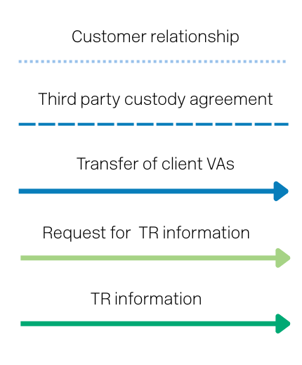
Below, the JFSC has set out three scenarios, where:
- VASP A = a centralised exchange
- VASP B = a third-party custodian
- VASP C = another centralised exchange
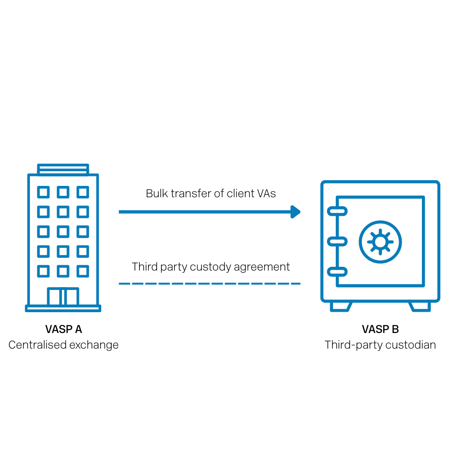
Scenario 1 – VASP A engages VASP B as a third-party custodian for the client's virtual assets
VASP A makes a bulk transfer of client VAs to VASP B
Travel Rule: Out of scope. The transfer from VASP A to VASP B is executed by and on behalf of VASP A.
(All scenarios below assume Scenario 1 has already played out, i.e. a custody contract is in place)
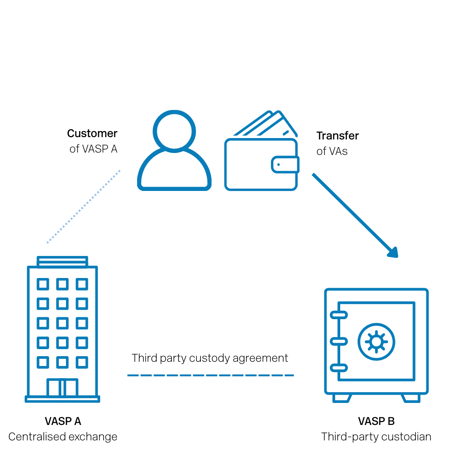
Scenario 2.1 – client of VASP A deposits VA into VASP B from an unhosted wallet*
VASP B receives VAs on behalf of VASP A for an existing client of VASP A from an unhosted wallet.
Travel Rule: Out of scope. TR only applies to VASP-to-VASP transfers.
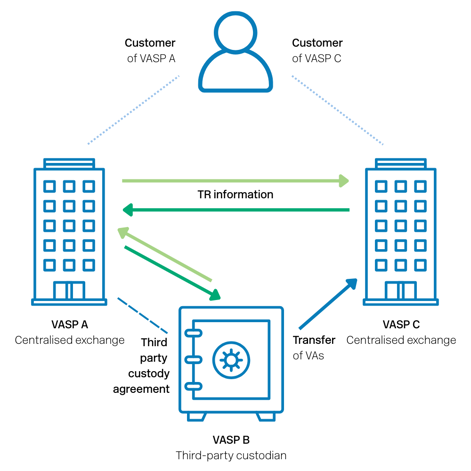
Scenario 2.2 – VASP C processes a client instruction to transfer VA from VASP C to VASP B (custody on behalf of VASP A)*
A client of both VASP C and VASP A requests a transfer of VAs from their hosted wallet at VASP C to VASP B. VASP B receives the assets on behalf of VASP A
Travel Rule: In scope, VASP A must request TR information from VASP C and share that information with VASP B. VASP B is responsible for ensuring it receives the information needed from VASP A.
Scenario 3.1 – client of VASP A requests to transfer VAs to an unhosted wallet**
VASP B executes the transaction on behalf of VASP A. VAs are sent to the client’s unhosted wallet
Travel Rule: Out of scope. TR only applies to VASP-to-VASP transfers.
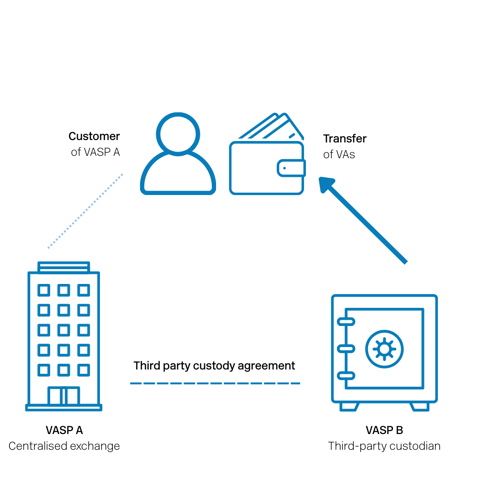
Scenario 3.2 – Client of VASP A requests to transfer VAs to the hosted wallet (VASP C)**
VASP B executes the transaction on behalf of VASP A. VAs are sent to VASP C
Travel Rule: In Scope. VASP A must provide the required Travel Rule information to VASP B, which, as the processing intermediary, is responsible for transmitting that information to VASP C.
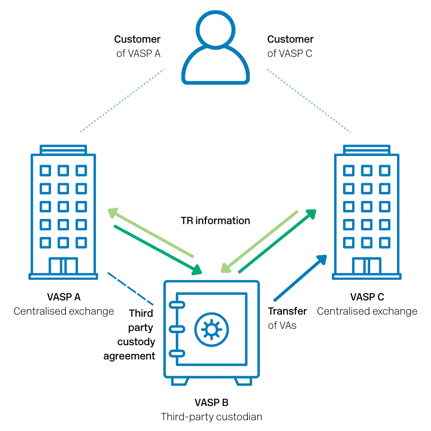
*In these Scenarios, the JFSC are assuming that the transfers are being sent directly to the custodian (VASP B)
**In these Scenarios, the JFSC are assuming the transfers are made directly from VASP B to the recipient
[1] EU Legislation (Information Accompanying Transfers of Funds) (Jersey) Regulations 2017 (jerseylaw.je = https://www.jerseylaw.je/laws/current/ro_57_2017
[2] JMLSG-Guidance-Part-I June-2023-version, para 5.3.7 - https://www.jmlsg.org.uk/guidance/current-guidance/
Please read the JFSC updated Travel Rule guidance note.
The Team
Meet the team of industry experts behind Comsure
Find out moreLatest News
Keep up to date with the very latest news from Comsure
Find out moreGallery
View our latest imagery from our news and work
Find out moreContact
Think we can help you and your business? Chat to us today
Get In TouchNews Disclaimer
As well as owning and publishing Comsure's copyrighted works, Comsure wishes to use the copyright-protected works of others. To do so, Comsure is applying for exemptions in the UK copyright law. There are certain very specific situations where Comsure is permitted to do so without seeking permission from the owner. These exemptions are in the copyright sections of the Copyright, Designs and Patents Act 1988 (as amended)[www.gov.UK/government/publications/copyright-acts-and-related-laws]. Many situations allow for Comsure to apply for exemptions. These include 1] Non-commercial research and private study, 2] Criticism, review and reporting of current events, 3] the copying of works in any medium as long as the use is to illustrate a point. 4] no posting is for commercial purposes [payment]. (for a full list of exemptions, please read here www.gov.uk/guidance/exceptions-to-copyright]. Concerning the exceptions, Comsure will acknowledge the work of the source author by providing a link to the source material. Comsure claims no ownership of non-Comsure content. The non-Comsure articles posted on the Comsure website are deemed important, relevant, and newsworthy to a Comsure audience (e.g. regulated financial services and professional firms [DNFSBs]). Comsure does not wish to take any credit for the publication, and the publication can be read in full in its original form if you click the articles link that always accompanies the news item. Also, Comsure does not seek any payment for highlighting these important articles. If you want any article removed, Comsure will automatically do so on a reasonable request if you email info@comsuregroup.com.


As well as owning and publishing Comsure's copyrighted works, Comsure wishes to use the copyright-protected works of others. To do so, Comsure is applying for exemptions in the UK copyright law. There are certain very specific situations where Comsure is permitted to do so without seeking permission from the owner. These exemptions are in the copyright sections of the Copyright, Designs and Patents Act 1988 (as amended)[www.gov.UK/government/publications/copyright-acts-and-related-laws]. Many situations allow for Comsure to apply for exemptions. These include 1] Non-commercial research and private study, 2] Criticism, review and reporting of current events, 3] the copying of works in any medium as long as the use is to illustrate a point. 4] no posting is for commercial purposes [payment]. (for a full list of exemptions, please read here www.gov.uk/guidance/exceptions-to-copyright]. Concerning the exceptions, Comsure will acknowledge the work of the source author by providing a link to the source material. Comsure claims no ownership of non-Comsure content. The non-Comsure articles posted on the Comsure website are deemed important, relevant, and newsworthy to a Comsure audience (e.g. regulated financial services and professional firms [DNFSBs]). Comsure does not wish to take any credit for the publication, and the publication can be read in full in its original form if you click the articles link that always accompanies the news item. Also, Comsure does not seek any payment for highlighting these important articles. If you want any article removed, Comsure will automatically do so on a reasonable request if you email info@comsuregroup.com.