




 Published on : 16/11/2026
The Jersey Connection as NCA Recovers £55m from Singapore-Linked Laundering Network

In brief:
According to the National Crime Agency (NCA), two individuals linked to one of Singapore’s largest-ever money laundering cases have agreed to hand over around £55m of UK assets following Unexplained Wealth Orders (UWOs).
The High Court approved the settlements on 12 November 2026.
The NCA states that it has now taken around £75m from the same organised crime group (OCG) in 12 months.
Separate public reporting and corporate records link one of the two individuals to a Jersey-incorporated company that acquired London property.
What happened
The NCA announced on 13 November 2026 that Haijin Su (43) and Haika Xu (44) have settled civil recovery proceedings brought against their UK assets.
According to the NCA, both are linked to the Singapore investigation that led to 10 convictions and a further 15 individuals forfeiting assets.
The NCA says the Singaporean authorities recovered around SGD 3 billion (c. £1.75bn) in criminal assets.
Haika Xu.
The NCA describes Xu as a suspected OCG member who remains wanted by Singaporean authorities. According to the NCA, he bought 16 new-build flats in a Soho development in 2023 for £24.7m, without a mortgage.
He did so through two UK companies, Rong Hai Development Ltd and Rong Fa Development Ltd, which were set up to acquire the properties and of which he is the ultimate beneficial owner.
The NCA states that when it obtained a UWO in June 2026 and asked about the source of funds, Xu chose to settle rather than answer.
A settlement is not an admission of wrongdoing. Under its terms, the NCA will sell the properties and keep 75% of the proceeds, plus £1.2m representing rental income. The settlement is worth £19,771,175 to the NCA.
These settlements follow last year’s agreement with Binghai Su (37), which, according to the NCA, recovered more than £20m of assets. The assets included three dinosaur fossils and London property that the NCA alleged were linked to the same OCG.
Gareth Jones, Branch Commander for Asset Denial at the NCA, said that the Agency is making increasing use of UWOs and that settlement avoids “protracted and costly High Court litigation”, freeing resources for new investigations.
Haijin Su.
The NCA describes Su as a member of the OCG and states that he was convicted in Singapore. It obtained UWOs against him in April and July 2025 and froze around £45m of his UK assets, comprising cash, real property and alcohol.
It did so on the basis that, in its view, they were the proceeds of money laundering derived from illegal gambling and overseas scam centres.
Under the settlement, Su surrenders assets worth £35,187,285, including:
two London properties, on Oxford Street and the adjacent Princes Street;
£2,607,700 of rental income; and
£300,000 held in a bank account.
The Jersey position
The NCA announcement does not state that any Jersey entity, Jersey asset or Jersey service provider is under investigation.
Nor does it identify the ownership structure of the properties recovered under the settlement.
The Jersey connection discussed below is drawn from separate public reporting [2024] and publicly available corporate records.
A Jersey link was reported in public sources.
Bailiwick Express reported this in INSIGHT: The balcony-jumping, toy bear-collecting money launderer’s Jersey connection (James Jeune, 24 June 2024, updated 6 March 2025).

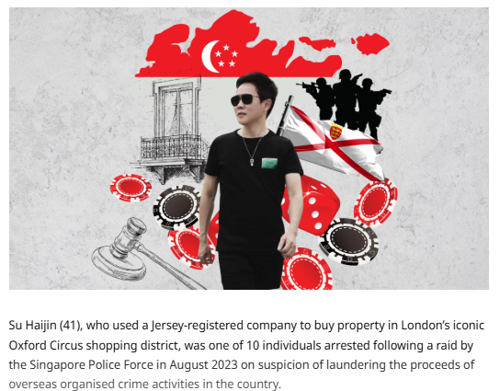
Drawing on reporting by OCCRP and Radio Free Asia, Bailiwick Express said that Haijin Su was connected to a Jersey-incorporated company, New Yihao,
which was used to acquire London property worth more than £43m in total, including 283 Oxford Street.
According to that report, New Yihao was incorporated in Jersey on 11 October 2021.
Bailiwick Express
also identified Fiduchi Trustees Limited, a Jersey financial services firm, as connected with the company’s administration.
reported that Fiduchi Nominees Limited subscribed to New Yihao’s Memorandum of Association and that New Yihao’s registered address at incorporation matched Fiduchi’s.
No wrongdoing has been alleged against Fiduchi.
In a statement to Bailiwick Express, a Fiduchi spokesperson said the firm strictly adheres to all applicable laws and regulations, performs comprehensive due diligence on each customer, and is “committed to supporting and fully cooperating with the authorities in any investigation”.
The spokesperson added that the firm’s commitment to confidentiality and professional integrity prevented it from discussing specific client affairs in more detail.
The Law Officers’ Department said it was unable to comment on individuals or entities that may or may not be under investigation.
The JFSC said that, where appropriate, it exchanges information with domestic and international regulators and law enforcement agencies, but that it was unable to comment on specific investigations.
The public register.
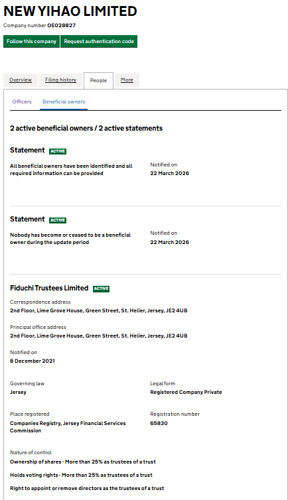
According to the UK Register of Overseas Entities at Companies House, New Yihao Limited (OE028827) lists two active registrable beneficial owners:
Fiduchi Trustees Limited (Jersey company 65830), notified on 8 December 2021.
It holds more than 25% of the shares and voting rights, and the right to appoint or remove directors, as trustees of a trust.
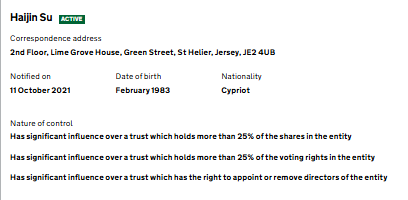
Haijin Su, notified on 11 October 2021. He is recorded as having significant influence over a trust that holds those interests.
No allegation has been made against Fiduchi or any other Jersey service provider.
The NCA announcement does not state whether 283 Oxford Street is among the properties in the settlement.
The structure appears to have some similarities to the arrangements considered in the Tantular litigation discussed below: a Jersey trust company acting as trustee within a wider ownership structure.
Why it matters
UWOs in practice.
This case illustrates how UWOs may operate as an effective investigative tool when followed by civil recovery proceedings.
A UWO requires the respondent to explain how the property was obtained.
Xu’s case illustrates the leverage that creates: on the NCA’s account, faced with source-of-funds questions, the respondent entered into a settlement under which the NCA will retain 75% of the proceeds.
The case is a useful reminder of the standard of source-of-funds and source-of-wealth evidence that law enforcement may expect to encounter.
Overseas predicate crime, UK assets.
The underlying criminality alleged by the NCA was illegal gambling and scam-centre fraud overseas. The UK assets were allegedly where the proceeds were held. Jersey structures are frequently used to hold UK property and other international assets.
As a result, UK investigations into overseas proceeds of crime can have implications for Jersey-administered companies, trusts and service providers, even where no Jersey wrongdoing is alleged.
Risk indicators.
A number of characteristics commonly associated with elevated financial crime risk were present:
Special purpose vehicles formed solely to hold property, with a single ultimate beneficial owner;
Large mortgage-free acquisitions, such as £24.7m of newbuild flats bought outright;
Bulk purchases of residential units in a single development;
High-value movable assets (alcohol, fossils) used as stores of value;
A connection to a jurisdiction where a major laundering investigation was public: the Singapore case was widely reported in 2023.
None of these indicators necessarily implies criminality. Their significance arises when several appear together and cannot be satisfactorily explained.
Transparency through the Register of Overseas Entities.
The case also illustrates the transparency provided by the UK’s Register of Overseas Entities, which has been in force since 1 August 2022 under the Economic Crime (Transparency and Enforcement) Act 2022.
Overseas entities that own UK land must register their beneficial owners with Companies House, and that information is publicly available. Since 31 August 2025, certain trust information held on the register, which was previously available only to law enforcement and specified agencies, may also be requested by members of the public, subject to the statutory access regime.
Ownership structures, overseas entities and UK property interests can therefore be connected far more readily than before. Jersey trust companies acting as trustees of structures holding UK land should assume that their role is visible through public registers and associated corporate records.
Jersey does not have Unexplained Wealth Orders.
UWOs are a UK tool, introduced by the Criminal Finances Act 2017 as amendments to the Proceeds of Crime Act 2002. Jersey has no order requiring a person to explain how they came to hold property that appears disproportionate to their known lawful income.
Jersey does have a non-conviction-based civil forfeiture regime under the Forfeiture of Assets (Civil Proceedings) (Jersey) Law 2018, in force since 20 August 2018. In practice, it is closer to UK civil recovery than to a UWO:
The trigger is tainted property, not unexplained wealth. Property is tainted where it is, or is reasonably suspected to be, used in or obtained through unlawful conduct (Art. 2).
Overseas crime is covered. Unlawful conduct includes conduct abroad that would be an offence if it happened in Jersey (Art. 1). The overseas illegal gambling and scam-centre offences alleged by the NCA would appear capable of falling within this definition.
The burden shifts to the respondent. Under both the summary procedure for bank accounts (Arts. 10–11) and the general procedure (Art. 15), the Royal Court must order forfeiture unless the respondent satisfies it that the property is not tainted.
There are investigative tools. These include production orders, customer information orders, account monitoring orders and disclosure orders (Part 4).
Forfeited assets go to the Criminal Offences Confiscations Fund.
The key limit.
Article 1 of the 2018 Law defines “property” as movable property situated in Jersey, including cash and bank balances. The Law, therefore, offers no direct mechanism for forfeiting immovable property such as real estate. Post-conviction confiscation under the Proceeds of Crime (Jersey) Law 1999 remains available upon conviction.
Jersey’s criminal route and overseas property: the Tantular case.
The Tantular litigation illustrates how Jersey’s criminal confiscation route has reached property held abroad. Robert Tantular settled the Jasmine Trust, a Jersey discretionary trust, in 2004. It owned a BVI company, which owned a Singapore apartment bought for S$7.1m in 2005. At Indonesia’s request, the Royal Court granted saisies judiciaires in 2013 and 2014 under the 1999 Law as applied by the 2008 Regulations, in anticipation of Indonesian confiscation orders.
In Tan Chi Fang and others v HM Attorney General [2023] UKPC 21, the Privy Council held that a saisie judiciaire can extend to property outside Jersey where the persons who can exercise ownership or control over it are subject to the jurisdiction of the Jersey courts. In that case, this meant the Jersey trustee. The Attorney General has noted that a Jersey trust holding overseas assets through a BVI company is a common structure. The decision concerned the criminal confiscation route and should not be assumed to apply in the same way to the civil routes described below.
Can the UK reach Jersey-connected assets? It can seek to, but not directly. A UK order is not enforced in Jersey as if it were a Jersey order. It requires a formal request and a local court process:
Civil (non-conviction-based) recovery. This is the route most relevant to UWO-led cases, which may lead to a civil recovery order under Part 5 of POCA. It runs under the Civil Asset Recovery (International Co-operation) (Jersey) Law 2007:
Freezing (Art. 6). The Attorney General may apply to the Royal Court, on behalf of the foreign government, for a property restraint order. The Court may grant one where external civil asset recovery proceedings relating to property in Jersey have been instituted and not concluded, or are to be instituted, and it has reasonable grounds to believe an order may be made. If proposed proceedings are not instituted within a reasonable time, the order must be discharged.
Evidence (Art. 3). The Attorney General can assist in obtaining evidence in Jersey for such proceedings or related investigations.
Registration (Art. 9). The Royal Court may register an external civil asset recovery order on an application made on behalf of the foreign government. It must be satisfied that the order is in force and not subject to appeal, and that an absent respondent had notice of the proceedings in time to defend them. It must also be of the opinion that enforcement would not be contrary to the interests of justice.
Recovery (Art. 10). Once an order is registered, the Royal Court may, on the Attorney General’s application, vest the property in the Viscount or authorise the Viscount to realise it.
Criminal confiscation. Where there are criminal proceedings, external confiscation orders are registered under Art. 39(1) of the Proceeds of Crime (Jersey) Law 1999, as applied by the Proceeds of Crime (Enforcement of Confiscation and Instrumentalities Forfeiture Orders) (Jersey) Regulations 2008 (R&O.77/2008). The application is made by the Attorney General. The Royal Court must be satisfied that the order is in force and not subject to appeal, and that an absent defendant had notice of the proceedings in time to defend them. It must also be of the opinion that enforcement would not be contrary to the interests of justice.
The process. The requesting authority sends a Letter of Request to HM Attorney General, who is Jersey’s Central Authority and applies to the Royal Court as appropriate.
Asset sharing. The UK and Jersey signed a Memorandum of Understanding on 15 March 2024 on sharing forfeited or confiscated assets. According to the Government of Jersey, £397,000 was transferred to the Home Office under it in July 2025.
A UWO is an investigative tool. Its practical relevance to Jersey is that the civil recovery proceedings that may follow it can be supported here through restraint, evidence-gathering and registration.
What does this mean for Jersey firms?
Jersey-administered companies and trusts that hold UK property are structures that may fall within the scope of overseas law enforcement enquiries.
Where a Letter of Request is received, the focus will be on the client and the firm’s records.
A regulated firm’s source-of-funds and source-of-wealth evidence is its first line of defence.
Lessons for regulated firms
Evidence of source of funds and source of wealth; don’t just record the client’s account. A client’s explanation is the start of CDD, not the end. Firms may wish to consider whether their files would withstand UWO-style questions from law enforcement. Such questions might ask for:
documentary evidence of the original source of wealth;
records showing how funds moved into the acquisition structure;
An explanation of why the ownership structure was used.
Look through the SPV. Where a company exists only to hold an asset, the risk sits with the individual behind it. Identifying the beneficial owner is necessary but not sufficient. The origin of the beneficial owner’s wealth remains the key due diligence consideration.
Treat mortgage-free, high-value property purchases as a trigger for enhanced scrutiny. No bank lending also means no second set of due diligence checks.
Ongoing monitoring and adverse media screening matter. A major public investigation overseas should prompt a review of any connected relationship and, where suspicion arises, a timely internal and external report.
Consider exit and reporting risk together. Where a client cannot or will not explain their wealth, firms should consider their suspicious activity reporting obligations and the risk of tipping off before taking action.
Assume transparency. Public registers such as the Register of Overseas Entities make ownership structures and the roles of service providers visible. Records should be kept so that the structure may be examined by others.
Comsure comment
Asset recovery is now a central tool of financial crime enforcement. This case shows how source-of-funds and source-of-wealth evidence can become central issues once law enforcement scrutiny begins.
For firms that administer companies and structures holding international assets, the quality and retention of that evidence may ultimately determine how effectively they can respond to regulatory or law enforcement enquiries.
If you would like support reviewing your SoF/SoW procedures, EDD triggers for property-holding structures, or staff training on these typologies, contact Comsure.
Editorial note:
This article is based on information contained in public law enforcement announcements, public corporate records, court judgments and media reporting available as at 13 November 2026.
Unless expressly stated, references to individuals, companies or structures are descriptive only and should not be taken as allegations of wrongdoing.
Any observations regarding compliance risk indicators, typologies or regulatory expectations represent the author’s analysis and commentary.
Sources
National Crime Agency – Two more suspected international money launderers lose £55m to the NCA (13 November 2026): https://www.nationalcrimeagency.gov.uk/news/two-more-suspected-international-money-launderers-lose-55m-to-the-nca
Bailiwick Express (James Jeune) – INSIGHT: The balcony-jumping, toy bear-collecting money launderer’s Jersey connection (24 June 2024, updated 6 March 2025): https://www.bailiwickexpress.com/news/focus-balcony-jumping-money-launderers-jersey-connection/
Companies House, Register of Overseas Entities – New Yihao Limited (OE028827), persons with significant control (accessed 13 November 2026): https://find-and-update.company-information.service.gov.uk/company/OE028827/persons-with-significant-control
Companies House – New Yihao Limited (OE028827), overview: https://find-and-update.company-information.service.gov.uk/company/OE028827
Companies House – New Yihao Limited (OE028827), filing history: https://find-and-update.company-information.service.gov.uk/company/OE028827/filing-history
UK Government – Register of Overseas Entities (changes to UK company law): https://changestoukcompanylaw.campaign.gov.uk/register-of-overseas-entities
The Register of Overseas Entities (Protection and Trusts) (Amendment) Regulations 2025 (SI 2025/231): https://www.legislation.gov.uk/uksi/2025/231/contents
Criminal Finances Act 2017: https://www.legislation.gov.uk/ukpga/2017/22/contents
Forfeiture of Assets (Civil Proceedings) (Jersey) Law 2018: https://www.jerseylaw.je/laws/current/l_26_2018
Proceeds of Crime (Jersey) Law 1999: https://www.jerseylaw.je/laws/current/l_8_1999
Proceeds of Crime (Enforcement of Confiscation and Instrumentalities Forfeiture Orders) (Jersey) Regulations 2008: https://www.jerseylaw.je/laws/current/ro_77_2008
Civil Asset Recovery (International Co-operation) (Jersey) Law 2007: https://www.jerseylaw.je/laws/current/l_39_2007
Judicial Committee of the Privy Council – Tan Chi Fang and others v HM Attorney General (Jersey) [2023] UKPC 21, judgment: https://jcpc.uk/uploads/jcpc_2020_0012_etc_judgment_86d1aa9804.pdf
Judicial Committee of the Privy Council – case summary JCPC 2021/0010: https://jcpc.uk/cases/jcpc-2021-0010
Basel Institute on Governance – Confiscating assets for Indonesia: Interview with Mark Temple KC, H.M. Attorney General of Jersey (20 July 2023): https://baselgovernance.org/news/confiscating-assets-indonesia-interview-mark-temple-kc-hm-attorney-general-jersey
Government of Jersey – Jersey’s Attorney General wins three appeals in the Privy Council in landmark financial crime case (6 June 2023): https://www.gov.je/News/2023/pages/jerseysattorneygeneralwinsthreeappealsintheprivycouncilinlandmarkfinancialcrimecase.aspx
Government of Jersey – Requests for mutual legal assistance: https://gov.je/Government/NonexecLegal/LawOfficers/Pages/InternationalAssistance.aspx
Memorandum of Understanding between the UK Government and the Bailiwick of Jersey regarding the sharing of forfeited or confiscated assets (15 March 2024): https://gov.je/SiteCollectionDocuments/Government%20and%20administration/MOU%20with%20UK.pdf
Government of Jersey – Confiscated funds shared with Home Office (2025): https://www.gov.je/News/2025/pages/confiscatedfundssharedwithhomeoffice.aspx
This article is for general information only and does not constitute legal advice.
The Team
Meet the team of industry experts behind Comsure
Find out moreLatest News
Keep up to date with the very latest news from Comsure
Find out moreGallery
View our latest imagery from our news and work
Find out moreNews Disclaimer
As well as owning and publishing Comsure's copyrighted works, Comsure wishes to use the copyright-protected works of others. To do so, Comsure is applying for exemptions in the UK copyright law. There are certain very specific situations where Comsure is permitted to do so without seeking permission from the owner. These exemptions are in the copyright sections of the Copyright, Designs and Patents Act 1988 (as amended)[www.gov.UK/government/publications/copyright-acts-and-related-laws]. Many situations allow for Comsure to apply for exemptions. These include 1] Non-commercial research and private study, 2] Criticism, review and reporting of current events, 3] the copying of works in any medium as long as the use is to illustrate a point. 4] no posting is for commercial purposes [payment]. (for a full list of exemptions, please read here www.gov.uk/guidance/exceptions-to-copyright]. Concerning the exceptions, Comsure will acknowledge the work of the source author by providing a link to the source material. Comsure claims no ownership of non-Comsure content. The non-Comsure articles posted on the Comsure website are deemed important, relevant, and newsworthy to a Comsure audience (e.g. regulated financial services and professional firms [DNFSBs]). Comsure does not wish to take any credit for the publication, and the publication can be read in full in its original form if you click the articles link that always accompanies the news item. Also, Comsure does not seek any payment for highlighting these important articles. If you want any article removed, Comsure will automatically do so on a reasonable request if you email info@comsuregroup.com.
Archived News
To find our older articles, please click here.
View archive

To find our older articles, please click here.