
The Corruption Perceptions Index 2025 Is Out — And the Results Are Alarming
10/02/2026
Transparency International has released the Corruption Perceptions Index (CPI) 2025, and the findings deliver a stark warning: global anti-corruption efforts have stalled, and in many places, they are slipping backwards.
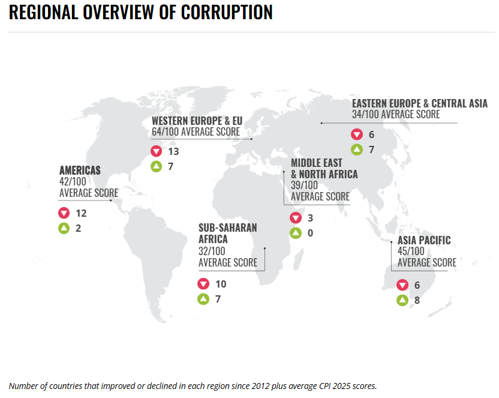
- This year’s CPI assessed 182 countries and territories, using 13 independent data sources to measure perceived levels of public‑sector corruption on a scale from 0 (highly corrupt) to 100 (very clean).
- The global average score has fallen to just 42, marking the first significant global decline in more than a decade.
- Many states have failed to strengthen checks and balances, protect civic freedoms, or maintain independent oversight—the result: stagnation, backsliding, and growing public frustration.
A Decade of Decline
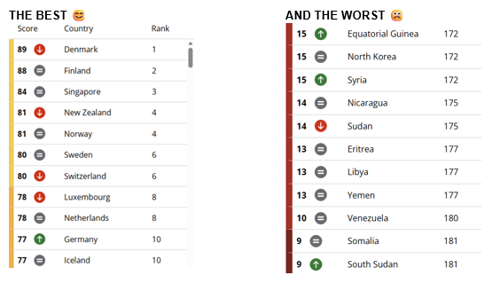
- Ten years ago, 12 countries scored above 80 — a threshold commonly associated with robust governance and low corruption.
- In 2025, that number had plummeted to just five.
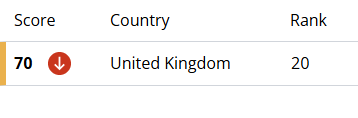
- Even long-standing democracies such as the United States (64), Canada (75), the United Kingdom (70), France (66) and Sweden (80) show notable deterioration.
- According to Transparency International, the world is experiencing a dangerous erosion of accountable leadership.
- Many governments appear to deprioritise transparency reforms, often citing economic, geopolitical, or security pressures as justification for sidelining anti-corruption measures.
Civic Space Under Pressure
- A critical pattern identified in CPI 2025 is the tightening of civic space.
- Since 2012, 36 of the 50 countries showing the largest CPI declines have also restricted freedom of expression, assembly, and association. When journalists, NGOs, and whistleblowers face intimidation, funding barriers, or legal obstacles, corruption thrives in the shadows.
- Across regions, countries such as Georgia, Indonesia, Peru, and Tunisia have introduced measures that limit civil society operations. Such environments make it increasingly difficult to expose wrongdoing and demand accountability.
Global Protests and the Rise of Gen Z Activism
- Despite the grim statistics, CPI 2025 highlights a powerful counterforce: youth-led accountability movements. In several low-scoring countries — notably
- Nepal (34), Madagascar (25), Serbia (33), and Peru (30) — young citizens have taken to the streets, demanding transparency, fairness, and better governance.
- In Nepal and Madagascar, this surge of activism even toppled national governments.
- These movements reflect growing public intolerance of leaders perceived as abusing power while failing to deliver essential services or economic opportunities.
National Snapshots
- Pakistan improved by one point to 28, ranking 136th globally. While small, this continues a four-year trend of steady enhancement driven by governance reforms.
- Ghana scored 43, a marginal one-point rise from last year — but still not enough to indicate meaningful progress. Concerns remain about judicial independence and executive interference.
- South Africa stagnated at 41, reflecting limited progress and persisting systemic weaknesses.
A Call for Renewed Leadership
- Across its global communications, Transparency International emphasises that corruption is not inevitable.
- Countries that improve do so by strengthening institutions, enforcing laws consistently, and protecting democratic freedoms.
CPI 2025 urges governments to:
- Reinforce political leadership on anti-corruption
- Protect civic space and independent journalism
- Implement stronger oversight and accountability frameworks
- Address cross-border corruption by increasing beneficial ownership transparency
The message is clear: without bold leadership and strong institutions, corruption will continue to erode public trust and weaken societies. CPI 2025 should be a wake-up call—not just a metric.
Web Sources
- https://www.transparency.org/en/news/cpi-2025-findings-insights-corruption
- https://www.transparency.org/en/press/corruption-perceptions-index-2025-decline-leadership-undermining-global-fight
- https://dunyanews.tv/en/Business/934528-transparency-international-releases-corruption-perceptions-index-2025
- https://www.myjoyonline.com/ghanas-anti-corruption-efforts-fail-to-yield-results-as-cpi-score-stagnates-at-43
- https://www.polity.org.za/article/corruption-perceptions-index-2025-2026-02-10
The Team
Meet the team of industry experts behind Comsure
Find out moreLatest News
Keep up to date with the very latest news from Comsure
Find out moreGallery
View our latest imagery from our news and work
Find out moreContact
Think we can help you and your business? Chat to us today
Get In TouchNews Disclaimer
As well as owning and publishing Comsure's copyrighted works, Comsure wishes to use the copyright-protected works of others. To do so, Comsure is applying for exemptions in the UK copyright law. There are certain very specific situations where Comsure is permitted to do so without seeking permission from the owner. These exemptions are in the copyright sections of the Copyright, Designs and Patents Act 1988 (as amended)[www.gov.UK/government/publications/copyright-acts-and-related-laws]. Many situations allow for Comsure to apply for exemptions. These include 1] Non-commercial research and private study, 2] Criticism, review and reporting of current events, 3] the copying of works in any medium as long as the use is to illustrate a point. 4] no posting is for commercial purposes [payment]. (for a full list of exemptions, please read here www.gov.uk/guidance/exceptions-to-copyright]. Concerning the exceptions, Comsure will acknowledge the work of the source author by providing a link to the source material. Comsure claims no ownership of non-Comsure content. The non-Comsure articles posted on the Comsure website are deemed important, relevant, and newsworthy to a Comsure audience (e.g. regulated financial services and professional firms [DNFSBs]). Comsure does not wish to take any credit for the publication, and the publication can be read in full in its original form if you click the articles link that always accompanies the news item. Also, Comsure does not seek any payment for highlighting these important articles. If you want any article removed, Comsure will automatically do so on a reasonable request if you email info@comsuregroup.com.


As well as owning and publishing Comsure's copyrighted works, Comsure wishes to use the copyright-protected works of others. To do so, Comsure is applying for exemptions in the UK copyright law. There are certain very specific situations where Comsure is permitted to do so without seeking permission from the owner. These exemptions are in the copyright sections of the Copyright, Designs and Patents Act 1988 (as amended)[www.gov.UK/government/publications/copyright-acts-and-related-laws]. Many situations allow for Comsure to apply for exemptions. These include 1] Non-commercial research and private study, 2] Criticism, review and reporting of current events, 3] the copying of works in any medium as long as the use is to illustrate a point. 4] no posting is for commercial purposes [payment]. (for a full list of exemptions, please read here www.gov.uk/guidance/exceptions-to-copyright]. Concerning the exceptions, Comsure will acknowledge the work of the source author by providing a link to the source material. Comsure claims no ownership of non-Comsure content. The non-Comsure articles posted on the Comsure website are deemed important, relevant, and newsworthy to a Comsure audience (e.g. regulated financial services and professional firms [DNFSBs]). Comsure does not wish to take any credit for the publication, and the publication can be read in full in its original form if you click the articles link that always accompanies the news item. Also, Comsure does not seek any payment for highlighting these important articles. If you want any article removed, Comsure will automatically do so on a reasonable request if you email info@comsuregroup.com.