




 Published on : 25/09/2026
Relying on the Government of Jersey Sanctions Guidance Page
This briefing is written on September 24th, 2026
Key message
The Government of Jersey's General guidance on sanctions page is a useful explanation of how sanctions work in Jersey.
It is not a reliable record of the current law. It shows no "last updated" date, parts of it are visibly out of date, and it does not reflect the latest amendment to Jersey's sanctions legislation.
Firms whose procedures, training or screening rely on the page alone may be operating on an incomplete picture of their obligations. That creates a risk of breaching sanctions law and of criticism from the JFSC during its review of systems and controls.
Why these matters
Sanctions obligations in Jersey are strict and immediate:
New UN and UK designations take effect in Jersey immediately.
Funds and economic resources must be frozen without notice and without delay.
Whether a firm had "reasonable cause to suspect" is judged objectively. The test is whether an honest and reasonable person would have formed the suspicion, not what the firm actually believed.
The maximum prison sentence for breaching financial sanctions is 7 years.
Beware
Relying on outdated government guidance is unlikely to be accepted as mitigation.
The page itself says that anyone unsure of their reporting obligations should take independent legal advice.
The JFSC is responsible for ensuring that firms have systems and controls in place to implement sanctions effectively, and a process built around a static web page is unlikely to meet that standard.
Where the page falls short, ranked by risk
These findings are based on our review of the page on 24 September 2026. They are listed from highest to lowest risk for a firm relying on the page.
▲ HIGHEST RISK: The latest change to the law is missing
What we found: The page does not mention the Sanctions and Asset-Freezing (Implementation of External Sanctions) (Jersey) Amendment Order 2026 (R&O.97/2026).
It was made on 21 September 2026 and comes into force on 29 September 2026.
It adds new Iran (Nuclear) rules on aircraft movement and ship detention to the 2021 Sanctions Order.
The page's shipping and aircraft section refers to the UK and Iran regimes only in general terms.
Why it matters: Firms with shipping, aviation or yacht-holding structures would get no warning from the page that the rules change in days.
HIGH RISK: Annual frozen assets guidance is out of date
What we found: The guidance still refers to assets held at 31 December 2025, the 5pm, 31 March 2026 deadline and a 2025 template. It does not mention the next reporting cycle.
Why it matters: Firms may treat the return as a one-off and miss the recurring 31 March deadline, or use the wrong template.
MODERATE RISK: No date, so firms can't show how current it is
What we found: The page shows no publication or review date. By contrast, the Jersey law.je page for R&O.97/2026 shows it was last updated on 21 September 2026.
Why it matters: Firms cannot tell which legal changes the page reflects and cannot use it to evidence when they last checked the position. Only the legislation provides that evidence.
▼ LOW RISK: The old unit’s name is still in circulation
What we found: The gov.je guidance refers to the Jersey Sanctions Implementation Unit (JSIU). Government notices used the unit's previous name, the Financial Sanctions Implementation Unit (FSIU), up to at least 27 February 2026, and had switched to JSIU by 12 March 2026. The JFSC's "About sanctions" guidance, last revised on 25 September 2025, still refers to the FSIU. https://www.jerseyfsc.org/industry/international-co-operation/sanctions/about-sanctions/
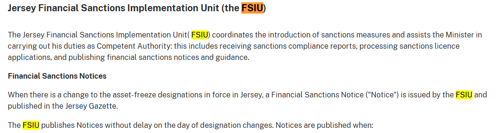
Why it matters: This is minor. However, readers moving between Government and JFSC sources will find two names for the same unit, and firms' own procedures may still use the old one.
Iran: a live example
On 21 September 2026, the Minister for External Relations, Senator I.J. Gorst, made the Sanctions and Asset-Freezing (Implementation of External Sanctions) (Jersey) Amendment Order 2026 (R&O.97/2026) under Article 3 of SAFL.
Under Article 5, the Order comes into force on the later of 29 September 2026 and 7 days after it was made.
That means it comes into force on 29 September 2026.
The Order amends only the 2021 Sanctions Order. It makes three changes:
It inserts a reference to "28A" after "Article 28" in Article 4(2)(b).
It deletes paragraph 1A(b) of Schedule 3.
It inserts a new Schedule 3 paragraph 1B for the Iran (Sanctions) (Nuclear) (EU Exit) Regulations 2019. This sets out who commits the offence of moving an aircraft in breach of those Regulations, and how references to ship detention under the UK Merchant Shipping Act 1995 apply in Jersey under the Shipping (Jersey) Law 2002.
The Order does not change the Article 32 reporting duties.
The UK's Iran (Sanctions) (Amendment) Regulations 2026 (SI 2026/983) also come into force on 29 September 2026 and include wider powers to sanction ships linked to Iran's nuclear programme. R&O.97/2026 appears to make the Jersey changes needed for those UK measures to work in Jersey.
A firm relying only on the gov.je guidance page would have no indication that either change is coming.
Who is most exposed
Trust and corporate service providers administering structures that own or charter vessels, yachts or aircraft.
Fund administrators and managers with investors, underlying assets or counterparties in regulated sectors.
Law firms and other DNFBPs, which fall within the definition of relevant financial institutions under SAFL. Since 18 March 2026, they must report knowledge or suspicion even where there is no client relationship.
Firms holding frozen assets must now meet both the immediate reporting duty and the recurring annual return.
Recommended actions
Rank your sources. Update sanctions procedures so the order of authority is clear. The legislation on jerseylaw.je and Jersey Gazette notices comes first. The gov.je guidance and JFSC materials explain the law but do not replace it.
Subscribe to alerts. Make sure at least two named people in the compliance function receive Jersey Gazette sanctions email alerts.
Keep a monitoring log. Record each legislative change or notice reviewed, the date it was reviewed, whether it affects the firm, and the action taken. This is your evidence for the JFSC.
Check before 29 September 2026. Identify any clients, structures or assets connected to ships or aircraft, including yachts held in trust or company structures. Review them against the Iran (Nuclear) aircraft-movement and ship-detention rules in R&O.97/2026 and the corresponding UK amendments.
Diarise the annual return. Make 31 March a standing annual deadline with a named owner, and check for an updated template before relying on the 2025 version.
Update names. Replace references to the FSIU with the JSIU in policies, procedures and training.
Board reporting. Tell the board about this reliance risk and the steps taken. Boards are ultimately responsible for sanctions systems and controls.
Sources
Government of Jersey, General guidance on sanctions, reviewed 24 September 2026
Jersey Gazette, Reminder: Annual frozen assets reporting Jersey, 27 February 2026
Jersey Gazette, Sanctions legislation update: Changes coming into force on 18 March 2026, 12 March 2026
Jersey Legislation, Sanctions and Asset-Freezing (Implementation of External Sanctions) (Jersey) Amendment Order 2026, R&O.97/2026 (made 21 September 2026; in force 29 September 2026) (PDF)
UK Iran (Sanctions) (Amendment) Regulations 2026, SI 2026/983
This briefing is for general information only and is not legal advice.
The Team
Meet the team of industry experts behind Comsure
Find out moreLatest News
Keep up to date with the very latest news from Comsure
Find out moreGallery
View our latest imagery from our news and work
Find out moreNews Disclaimer
As well as owning and publishing Comsure's copyrighted works, Comsure wishes to use the copyright-protected works of others. To do so, Comsure is applying for exemptions in the UK copyright law. There are certain very specific situations where Comsure is permitted to do so without seeking permission from the owner. These exemptions are in the copyright sections of the Copyright, Designs and Patents Act 1988 (as amended)[www.gov.UK/government/publications/copyright-acts-and-related-laws]. Many situations allow for Comsure to apply for exemptions. These include 1] Non-commercial research and private study, 2] Criticism, review and reporting of current events, 3] the copying of works in any medium as long as the use is to illustrate a point. 4] no posting is for commercial purposes [payment]. (for a full list of exemptions, please read here www.gov.uk/guidance/exceptions-to-copyright]. Concerning the exceptions, Comsure will acknowledge the work of the source author by providing a link to the source material. Comsure claims no ownership of non-Comsure content. The non-Comsure articles posted on the Comsure website are deemed important, relevant, and newsworthy to a Comsure audience (e.g. regulated financial services and professional firms [DNFSBs]). Comsure does not wish to take any credit for the publication, and the publication can be read in full in its original form if you click the articles link that always accompanies the news item. Also, Comsure does not seek any payment for highlighting these important articles. If you want any article removed, Comsure will automatically do so on a reasonable request if you email info@comsuregroup.com.
Archived News
To find our older articles, please click here.
View archive

To find our older articles, please click here.