




 Published on : 21/10/2026
Reliance in Jersey from 31 October: testing is out, but the rules get tighter
The JFSC published its consultation feedback today (21 Oct) on the reliance regime,
The feedback included tracked changes to Handbook Section 5 and the Appendix C written assurance template.
Every reliance change takes effect on 31 October 2026:
The amended Articles 16 and 16A of the Money Laundering (Jersey) Order 2008,
New Article 12A,
Revised Section 5 and
Revised Appendix C.
There is no transition period.
That gives firms ten days.
The JFSC presents this as a simplification. In part, it is.
But the statute also adds new obligations, and for some firms the overall burden may go up.
Here is what you need to know.
What you need to know
Your risk rating now drives everything.
Lower risk: adequate written assurance is enough.
Other than lower, you need one or more additional measures proportionate to the risk, with a written record of why they are adequate. Testing is one option among several; it's not required.
Higher risk: no reliance at all. Additional measures won't be able to rescue a higher-risk arrangement.
Mandatory testing is gone.
Articles 16(8) and (9) are repealed.
A new Code, COP53.2, replaces them. It requires
“Adequate steps”, based on your Article 16(3) risk assessment, to satisfy yourself that evidence will be available on request and without delay.
Five working days is the “without delay” benchmark.
It was proposed for two days. If evidence takes longer than five working days, you must record why the timing was still “without delay”. If it was not, reliance must stop immediately.
Seven statutory triggers end reliance immediately.
These include withdrawal of consent, failure to provide information immediately, and failure to provide evidence or a new assurance without delay.
Stopping reliance does not mean ending the customer relationship. You'll need to obtain the CDD yourself.
A new statutory duty to refresh assurances.
Under Article 16(6A), you must obtain new assurances at intervals you set based on your knowledge of the customer.
The JFSC has removed its frequency guidance while it talks to the Government, but the duty applies from 31 October.
Group reliance has narrowed and widened.
Article 16A now applies only where the group member is not an obliged person; otherwise, standard Article 16 applies.
DNFBP groups, such as law and accountancy groups, can now use group reliance.
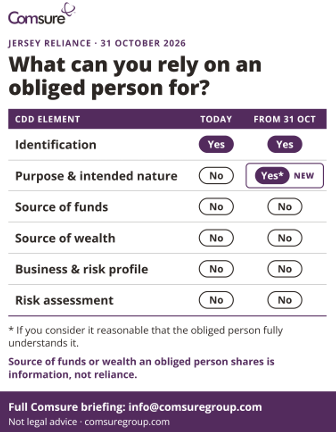
Reliance now covers purpose and intended nature.
It extends to all of Article 3(2), where you consider it reasonable that the obliged person fully understands this.
What to look out for
Follow the statute, not the summaries. In our reading, the published material contains drafting slips:
Section 5 lists six cessation triggers; the statute has seven.
Appendix C still cites the old, narrower scope.
The feedback paper suggests higher-risk arrangements need extra measures when the statute prohibits reliance in that case.
Don’t treat the Handbook’s “defence” as a safe harbour.
In our view, it corresponds to a defence in criminal proceedings. It does not displace your continuing liability under Article 16(10) or the JFSC’s regulatory powers.
Five days become a cliff edge without records.
If you don’t log request and response dates for every evidence call, you cannot show compliance either way.
“Lower risk” will be tested.
A lower-risk rating without documented reasoning against the Handbook’s risk factors is the obvious examination target.
Set your refresh intervals now.
The duty applies from 31 October with no guidance, so expect to justify whatever intervals you choose.
Key dates + What happens
31 Oct 2026 - All reliance changes take effect, with no transition period
2 Nov 2026 - Clean Handbook published; re-check every paragraph reference
Want the full briefing?
Our 11-page Comsure briefing covers:
Article 16 before and after 31 October
The six conditions and the new Codes
The “lower versus other” framework and illustrative additional measures
The five-day rules and the cessation triggers
The group's reliance changes
Our eight challenge points and the drafting issues
The questions are still awaiting JFSC clarification
An action checklist you can work through before 31 October
To request a copy, email info@comsuregroup.com or call +44 (0) 1534 626841.
Warning
This post is general information only, based on JFSC material published on 21 October 2026. It is not legal advice. Take advice from your own lawyers and, for regulatory clarity, contact the JFSC.
The Team
Meet the team of industry experts behind Comsure
Find out moreLatest News
Keep up to date with the very latest news from Comsure
Find out moreGallery
View our latest imagery from our news and work
Find out moreNews Disclaimer
As well as owning and publishing Comsure's copyrighted works, Comsure wishes to use the copyright-protected works of others. To do so, Comsure is applying for exemptions in the UK copyright law. There are certain very specific situations where Comsure is permitted to do so without seeking permission from the owner. These exemptions are in the copyright sections of the Copyright, Designs and Patents Act 1988 (as amended)[www.gov.UK/government/publications/copyright-acts-and-related-laws]. Many situations allow for Comsure to apply for exemptions. These include 1] Non-commercial research and private study, 2] Criticism, review and reporting of current events, 3] the copying of works in any medium as long as the use is to illustrate a point. 4] no posting is for commercial purposes [payment]. (for a full list of exemptions, please read here www.gov.uk/guidance/exceptions-to-copyright]. Concerning the exceptions, Comsure will acknowledge the work of the source author by providing a link to the source material. Comsure claims no ownership of non-Comsure content. The non-Comsure articles posted on the Comsure website are deemed important, relevant, and newsworthy to a Comsure audience (e.g. regulated financial services and professional firms [DNFSBs]). Comsure does not wish to take any credit for the publication, and the publication can be read in full in its original form if you click the articles link that always accompanies the news item. Also, Comsure does not seek any payment for highlighting these important articles. If you want any article removed, Comsure will automatically do so on a reasonable request if you email info@comsuregroup.com.
Archived News
To find our older articles, please click here.
View archive

To find our older articles, please click here.