



 Published on : 24/06/2026
"Relevant Code of Practice" – The Most Significant Conceptual Change in Jersey's 2026 AML Amendment
The Money Laundering (Jersey) Amendment Order 2026 introduces a seemingly small but conceptually important change that strengthens the legal architecture between Jersey's primary AML legislation and the JFSC's regulatory Codes of Practice.
What the Law Was Before (Pre-30 June 2026)
- The Money Laundering (Jersey) Order 2008 (MLJO) already contained the following wording in Article 7(3):
- "The compliance officer's function is to monitor whether the enactments in Jersey relating to money laundering and any relevant Code of Practice issued under Article 22 of the Proceeds of Crime (Supervisory Bodies) Law are being complied with…"

- However, the term "relevant Code of Practice" was never defined in the MLJO itself (it did not appear in the interpretation section — Article 1).
- The phrase was used but left undefined in the primary AML Order. It relied on the JFSC's own interpretation of which of its Codes applied to which firms.
- The detailed, practical requirements are set out in the JFSC AML/CFT/CPF Handbook (and any specific Codes of Practice), which are issued under a separate law — the Proceeds of Crime (Supervisory Bodies) (Jersey) Law.
- These JFSC Codes are regulatory instruments, not primary legislation.
- Breaches were enforceable mainly through the JFSC's supervisory and licensing powers.
- Result: There was a grey area or "soft link" between:
- The black-letter statutory duty in the MLJO, and
- The detailed, day-to-day expectations in the JFSC Handbook/Codes.
- Firms could (and sometimes did) argue that compliance with the Handbook was "guidance" or "regulatory expectation" rather than a direct statutory obligation under the MLJO.
- The JFSC could still act, but the legal bridge was less direct and less certain.
What the 2026 Amendment Order Changes (Effective 30 June 2026)
The Amendment Order does two key things:
- Inserts a formal definition into Article 1(1) of the MLJO:
- "Relevant Code of Practice", in relation to a relevant person, means a Code of Practice —
- (a) that is issued under Article 22 of the Proceeds of Crime (Supervisory Bodies) Law; and
- (b) that applies to the relevant person in the conduct of the relevant person's financial services business.
- "Relevant Code of Practice", in relation to a relevant person, means a Code of Practice —
- It updates Article 7(3) (slightly cleaned wording).
- It adds the new risk-based provisions in 7(1A) and 7(1B), which explicitly require that decisions on whether an MLCO is "appropriate" be made with reference to a relevant Code of Practice.
What Gap Has Been Filled? Why It Matters
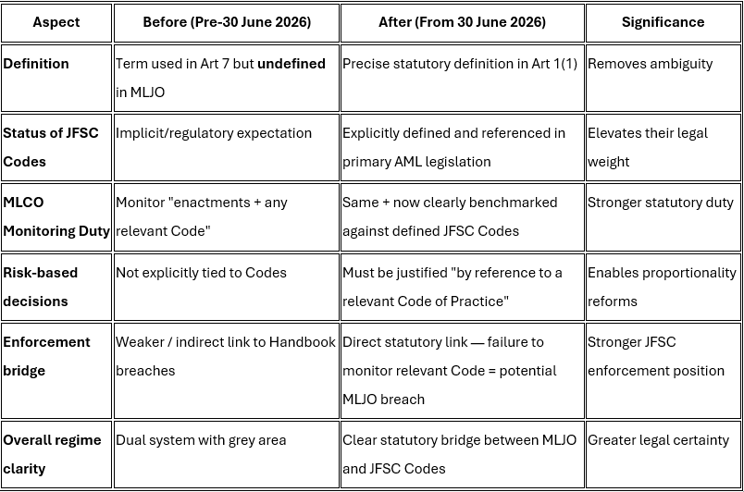
In plain English:
- This change turns something implicit and somewhat soft into something explicit, defined, and hard-wired into the primary money-laundering legislation.
- It gives the JFSC's detailed AML/CFT/CPF Codes of Practice (i.e. the Handbook) a much clearer and stronger statutory foundation inside the MLJO.
- This is particularly important because:
- It supports the new risk-based MLCO appointment rule (small/low-risk firms can potentially opt out, but only if they justify it properly against the JFSC Code).
- It makes it harder for firms to treat Handbook requirements as "mere guidance".
- It gives the JFSC cleaner, more direct grounds to take action when a firm fails to monitor or comply with the relevant parts of the JFSC Codes — because that failure can now be more straightforwardly framed as a breach of the MLCO's statutory responsibilities under the MLJO.
- This is a classic example of Jersey tightening up the relationship between its primary AML law and its regulatory rulebook — reducing interpretive risk and strengthening the overall supervisory framework without fundamentally changing the substance of what firms were already expected to do.
- It is conceptually significant, even though the practical day-to-day requirements in the Handbook have not changed dramatically overnight. The legal framework supporting those requirements has been significantly strengthened.
Official Sources
- Full text of the Money Laundering (Jersey) Amendment Order 2026: https://www.jerseylaw.je/laws/enacted/Pages/RO-077-2026.aspx
- Ministerial Decision (MD-ER-2026-448): https://www.gov.je/Government/PlanningPerformance/Pages/MinisterialDecisions.aspx?docid=5EACAC71-45FD-45B5-AD27-3927E06532DA
- Current consolidated Money Laundering (Jersey) Order 2008: https://www.jerseylaw.je/laws/current/ro_20_2008
- JFSC Updated AML/CFT/CPF Handbook & Upcoming Changes: https://www.jerseyfsc.org/news-and-events/updated-amlcftcpf-handbook-and-upcoming-changes/
Detailed Analysis & Consultation
- Comsure – Full breakdown of the Amendment Order: http://www.comsuregroup.com/news/jersey-money-laundering-jersey-amendment-order-2026-juneoctober-2026/
- Comsure – MLCO changes explained: http://www.comsuregroup.com/news/all-change-for-mlcos-in-jersey-after-the-money-laundering-jersey-amendment-order-2026/
- Government Consultation Paper – The MLCO Role (Jan 2026): https://www.gov.je/SiteCollectionDocuments/Industry%20and%20finance/Consultation%20Paper_The%20MLCO%20Role.pdf
The Team
Meet the team of industry experts behind Comsure
Find out moreLatest News
Keep up to date with the very latest news from Comsure
Find out moreGallery
View our latest imagery from our news and work
Find out moreNews Disclaimer
As well as owning and publishing Comsure's copyrighted works, Comsure wishes to use the copyright-protected works of others. To do so, Comsure is applying for exemptions in the UK copyright law. There are certain very specific situations where Comsure is permitted to do so without seeking permission from the owner. These exemptions are in the copyright sections of the Copyright, Designs and Patents Act 1988 (as amended)[www.gov.UK/government/publications/copyright-acts-and-related-laws]. Many situations allow for Comsure to apply for exemptions. These include 1] Non-commercial research and private study, 2] Criticism, review and reporting of current events, 3] the copying of works in any medium as long as the use is to illustrate a point. 4] no posting is for commercial purposes [payment]. (for a full list of exemptions, please read here www.gov.uk/guidance/exceptions-to-copyright]. Concerning the exceptions, Comsure will acknowledge the work of the source author by providing a link to the source material. Comsure claims no ownership of non-Comsure content. The non-Comsure articles posted on the Comsure website are deemed important, relevant, and newsworthy to a Comsure audience (e.g. regulated financial services and professional firms [DNFSBs]). Comsure does not wish to take any credit for the publication, and the publication can be read in full in its original form if you click the articles link that always accompanies the news item. Also, Comsure does not seek any payment for highlighting these important articles. If you want any article removed, Comsure will automatically do so on a reasonable request if you email info@comsuregroup.com.
Archived News
To find our older articles, please click here.
View archive

To find our older articles, please click here.