




 Published on : 21/06/2026
Proliferation Financing Risks Exposed: Turkish Intermediary Facilitates Defence Machinery to Russia
EU-Linked Turkish Intermediary Facilitates $6.3M+ in Sanctioned Metallurgical & Shipbuilding Equipment to Russian Defense-Industrial Complex
⚠ HIGH-PRIORITY COMPLIANCE ALERT
- This case
- Has Implications for Combating Proliferation Financing (CPF) and Sanctions Evasion Controls
- Exemplifies classic third-country circumvention of EU Russia sanctions and raises material CPF and export control risks.
- Has been sourced and reported by OCCRP.org
- Alisa Yurchenko, The Kyiv Independent, Lorenzo Bodrero and IrpiMedia (Italy, in Italian)
- https://www.occrp.org/en/scoop/eu-citizens-company-funneled-sanctioned-equipment-to-russian-defense-firms?utm_source=OCCRP&utm_campaign=bb8a9ed1fc-EMAIL_CAMPAIGN_2026_06_19_12_47&utm_medium=email&utm_term=0_bcc1d53473-bb8a9ed1fc-398764241
- Exposure to Turkish trading companies
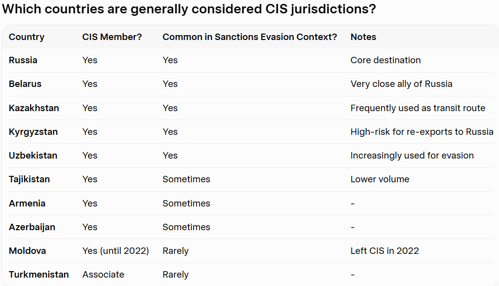
- Financial institutions and exporters with exposure to Turkish trading companies, EU-origin CNC/machine tools, metallurgical equipment, or shipbuilding components destined for CIS jurisdictions should conduct immediate portfolio reviews.
- Enforcement focus on circumvention networks is intensifying.
1. EXECUTIVE SUMMARY
- A Turkey-based trading company, Redwing Metal Uluslararasi Ticaret Anonim Sirketi (established 2022), exported over $5 million worth of EU-manufactured metalworking machinery and an additional $1.3 million in shipbuilding equipment to two Russian metallurgical plants, Aluminum Metallurg Rus (AMR) and Stupino Metallurgical Company (SMK), between 2023 and 2024.
- Both plants form part of Russia's defence-industrial base, producing specialised alloys and components for combat aircraft (e.g. Su-34), cruise missiles (including the Kh-101 used in the May 2026 Kyiv strike that killed 24 civilians), and naval vessels.
- The equipment originated from manufacturers in Italy (M.C.M. MADAR – CNC lathes), Germany (Wolter GmbH), Spain, the Czech Republic, Poland, and Austria.
- Redwing Metal is 40% owned by Dutch national Alexander Tattersall (resident in Switzerland), who also serves as CEO of related AMR trading entities. The shipments exploited Turkey's lack of Russia sanctions, allowing re-export of goods subject to EU export bans and restrictive measures.
- Manufacturers reported contractual prohibitions on re-export to sanctioned destinations but claimed no knowledge of the ultimate Russian end use. AMR and SMK are controlled by Nikolay Timokhin (the son-in-law of a senior Rostec executive) and have supplied more than 40 Russian defence manufacturers.
Key Compliance Takeaway:
- This investigation highlights persistent vulnerabilities in global supply chains for Common High Priority List (CHPL) items and other sensitive industrial goods.
- The control frameworks developed for Combating Proliferation Financing (CPF), particularly end-use verification, beneficial ownership transparency, route analysis, and transaction monitoring for sensitive goods, provide the precise toolkit needed to detect and mitigate sanctions-circumvention risks.
2. CASE FACTS & KEY ENTITIES

Shipment Summary:
- Metallurgical equipment (~$5M+): 4× Italian CNC lathes (M.C.M.), metal heat-treatment furnace, hydraulic press, aluminium disc pre-assembly machine, belt conveyors.
- Shipbuilding equipment (~$1.3M): Anchors, mooring winches, ventilation fans (Wolter GmbH), wastewater treatment systems, etc. Installed on Russian Navy vessels including the Mikhail Kalashnikov (completed mid-2025).
3. REGULATORY & SANCTIONS CONTEXT
- EU Framework: Council Regulation (EU) No 833/2014 (as amended) prohibits sale, supply, transfer or export of certain goods and technology to Russia, including many categories of machine tools and dual-use items. The Regulation explicitly bans knowing and intentional participation in circumvention activities.
- CHPL (Common High Priority List): Coordinated US/EU/UK/Japan list that specifically targets advanced manufacturing equipment such as CNC machine tools to degrade Russia's military-industrial base.
- Third-Country Circumvention: The European Commission has made tackling sanctions circumvention through third jurisdictions (Turkey, Central Asia, Hong Kong, UAE, etc.) a top priority. EU citizens who knowingly facilitate such flows face personal criminal liability under national law.
Current Status:
- As of 19 June 2026, Redwing Metal, AMR, SMK, and key individuals are not yet designated under EU or US sanctions, but open-source evidence from this investigation could support future designations or enforcement actions.
4. LINK TO COMBATING PROLIFERATION FINANCING (CPF) RISKS
- While traditional CPF focuses on WMD and their delivery systems, the risk-based controls and typologies developed under FATF Guidance on Countering Proliferation Financing are directly applicable and essential to detecting sanctions evasion involving advanced conventional weapons production capabilities and dual-use manufacturing equipment destined for sanctioned military end-users.
Why this case raises CPF-relevant risks:
- CNC lathes and precision metallurgical equipment are CHPL items and core enablers for high-tolerance alloys used in cruise missiles (Kh-101), combat aircraft, and naval platforms.
- Classic indirect export / third-country routing typology via a non-sanctioning jurisdiction (Turkey) with a newly established trading company.
- Direct links to the Rostec ecosystem and documented supply to 40+ Russian defence manufacturers.
- Complex beneficial ownership involving an EU national in the Turkish intermediary.
- Support to advanced strike capabilities (long-range cruise missiles and naval programs).
Strategic Implication: Institutions with mature CPF frameworks (sensitive goods scrutiny, end-use verification, route analysis, and intelligence-led monitoring) are significantly better protected against this type of circumvention risk.
5. KEY RED FLAGS FOR CPF, SANCTIONS EVASION & TBML
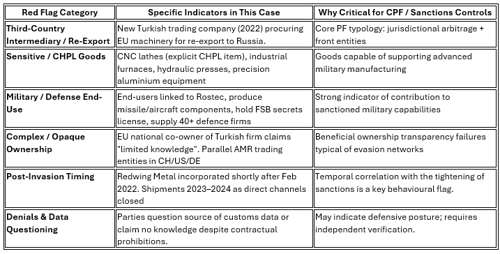
6. RECOMMENDED CPF & SANCTIONS CONTROLS TO APPLY
For Financial Institutions (Trade Finance, Payments, Correspondent Banking):
- Risk Assessment: Integrate Russia sanctions circumvention typologies and CHPL goods into Country/Product/Customer risk ratings. Treat CPF controls as the foundational framework for proliferation-sensitive trade.
- Enhanced Due Diligence: Full beneficial ownership verification (especially EU nationals in third-country entities), KYC, end-use verification, and screening against sanctions + adverse media.
- Transaction Monitoring:- Rules combining CHPL/sensitive machinery keywords + Turkey/Russia/CIS transit routes + new or unusual trading relationships post-2022.
- Trade Finance Specific Controls: Detailed goods description review, consistency checks with end-use, shipping document scrutiny, and post-shipment verification where possible.
- Training & Escalation: Targeted training using this case as a benchmark. Clear escalation protocols to Compliance/Financial Crime teams.
For Exporters & Manufacturers (especially EU-based):
- Strengthen and enforce contractual re-export prohibition clauses with audit rights.
- Conduct due diligence on distributors and traders in high-risk third countries (Turkey, Central Asia, Hong Kong, UAE).
- Monitor downstream sales using trade data analytics.
- Implement personal compliance attestations for EU nationals in senior roles or ownership of foreign trading entities.
- Consider enhanced restrictions or relationship exit where high-risk exposure is identified.
Governance Actions (recommended within 30–90 days):
- Board / Executive Risk Committee briefing on this case.
- Independent review of trade finance and sanctions screening effectiveness against third-country re-export scenarios.
- Update CPF / Sanctions risk appetite statements to explicitly address facilitation of military-industrial production for sanctioned states via indirect routes.
7. CONCLUSION & IMMEDIATE ACTIONS (within 14–30 days)
This case provides clear evidence of how EU export bans on sensitive machinery are being circumvented through Turkish intermediaries. The CPF control framework offers the most effective existing toolkit for detecting and disrupting these schemes.
Recommended Immediate Actions:
- Screen current portfolios for exposure to Redwing Metal, AMR, SMK, Timokhin-linked entities, or similar Turkish/CIS trading patterns in machinery & metals sectors.
- Review and enhance transaction monitoring rules for CHPL goods + Turkey/Russia transit combinations.
- Brief front-line trade finance and relationship managers with the red-flag indicators from this case.
- Assess any financed or processed transactions that match these patterns and determine escalation/disclosure requirements.
Sources
Primary: "How EU machinery keeps feeding Russian missile makers" – Kyiv Independent / OCCRP investigation (19 June 2026)
- https://kyivindependent.com/investigation-how-eu-machinery-keeps-feeding-russian-missile-makers/
- FATF Guidance on Countering
- FATF Guidance on Countering Proliferation Financing https://www.fatf-gafi.org/en/publications/Financingofproliferation/Guidance-counter-proliferation-financing.html
- EU Council Regulation (EU) No 833/2014 (as amended) – Consolidated version https://eur-lex.europa.eu/eli/reg/2014/833/2025-05-21/eng
- Common High Priority List (CHPL) https://www.bis.gov/licensing/country-guidance/common-high-priority-items-list-chpl
Additional: JFSC (Jersey Financial Services Commission) CPF Guidance
Here are the key official JFSC documents on Combating Proliferation Financing (CPF):
- Main Guidance Document (most relevant for compliance teams): Countering Proliferation of weapons of mass destruction and its financing. Issued: 1 October 2011 (last revised 2 October 2023). Direct PDF: https://www.jerseyfsc.org/media/6592/countering-proliferation-of-weapons-of-mass-destruction-and-its-financing.pdf
- JFSC Overview Page on Proliferation Financing: https://www.jerseyfsc.org/industry/financial-crime/proliferation-and-proliferation-financing-of-weapons-of-mass-destruction/
Disclaimer:
This briefing is for internal compliance, risk management, and executive awareness purposes only. It is based on publicly reported information and does not constitute legal advice. Institutions should conduct their own due diligence and consult legal counsel.
The Team
Meet the team of industry experts behind Comsure
Find out moreLatest News
Keep up to date with the very latest news from Comsure
Find out moreGallery
View our latest imagery from our news and work
Find out moreNews Disclaimer
As well as owning and publishing Comsure's copyrighted works, Comsure wishes to use the copyright-protected works of others. To do so, Comsure is applying for exemptions in the UK copyright law. There are certain very specific situations where Comsure is permitted to do so without seeking permission from the owner. These exemptions are in the copyright sections of the Copyright, Designs and Patents Act 1988 (as amended)[www.gov.UK/government/publications/copyright-acts-and-related-laws]. Many situations allow for Comsure to apply for exemptions. These include 1] Non-commercial research and private study, 2] Criticism, review and reporting of current events, 3] the copying of works in any medium as long as the use is to illustrate a point. 4] no posting is for commercial purposes [payment]. (for a full list of exemptions, please read here www.gov.uk/guidance/exceptions-to-copyright]. Concerning the exceptions, Comsure will acknowledge the work of the source author by providing a link to the source material. Comsure claims no ownership of non-Comsure content. The non-Comsure articles posted on the Comsure website are deemed important, relevant, and newsworthy to a Comsure audience (e.g. regulated financial services and professional firms [DNFSBs]). Comsure does not wish to take any credit for the publication, and the publication can be read in full in its original form if you click the articles link that always accompanies the news item. Also, Comsure does not seek any payment for highlighting these important articles. If you want any article removed, Comsure will automatically do so on a reasonable request if you email info@comsuregroup.com.
Archived News
To find our older articles, please click here.
View archive

To find our older articles, please click here.