




 Published on : 30/06/2026
OFSI Issues £1m+ Penalty for Russia Sanctions Breaches – Largest Since 2022 Invasion
On 17 June 2026, the UK's Office of Financial Sanctions Implementation (OFSI) imposed a monetary penalty of £1,000,920.59 on Sabre Global Technologies Limited (SGTL).
This is OFSI's largest penalty for breaches of the Russia sanctions regime since the 2022 invasion and marks the first significant case involving deliberate circumvention.
Key details of the Sabre case
- Between May and December 2022, SGTL continued providing services to a designated entity and explored alternative payment routes to receive funds after designation.
- OFSI assessed the breaches as “most serious,” citing deliberate circumvention, high breach value, repeated conduct, and substantial risk of harm to the objectives of the UK’s Russia sanctions.
- SGTL made a voluntary disclosure, cooperated fully, and undertook remediation. The final penalty reflects a discount under OFSI's new settlement framework introduced in early 2026.
- This amount remains significantly below the all-time record OFSI penalty of £20.47 million, which was imposed on Standard Chartered Bank in February 2020 for pre-Brexit sectoral sanctions breaches. That fine continues to stand as the largest ever issued by OFSI.
Sanctions fines issued in 2026 (complete list)
OFSI has imposed the following monetary penalties so far in 2026. All relate to Russia sanctions breaches. These are civil penalties (on a strict-liability basis in most cases).
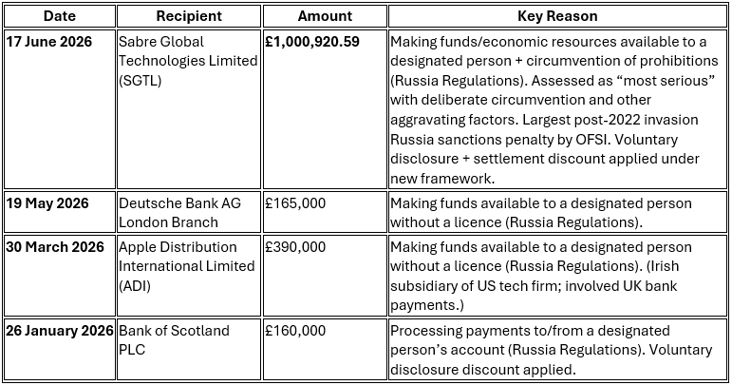
Notes on the 2026 fines
- The Sabre Global Technologies penalty is the clear standout — the first significant circumvention case and the largest OFSI Russia sanctions fine since the 2022 invasion.
- All other 2026 penalties are well under £400,000.
- No sanctions fines were issued to Standard Chartered in 2026 (or at any point since the 2020 case).
- OFSI introduced a new settlement policy/framework in early 2026, which includes discounts for voluntary disclosure and cooperation. Several of the above cases used transitional arrangements under it.
Compliance takeaway
- OFSI is showing greater willingness to penalise circumvention attempts and is actively using its updated enforcement tools.
- Firms should ensure sanctions screening covers digital services, software, and data tools as potential “economic resources,” maintain robust payment controls, and report suspected breaches promptly.
Official source
- Full details and penalty notices: https://www.gov.uk/government/collections/enforcement-of-financial-sanctions
This update highlights that while headline figures remain modest compared with historic cases, UK sanctions enforcement is becoming more targeted and sophisticated.
The Team
Meet the team of industry experts behind Comsure
Find out moreLatest News
Keep up to date with the very latest news from Comsure
Find out moreGallery
View our latest imagery from our news and work
Find out moreNews Disclaimer
As well as owning and publishing Comsure's copyrighted works, Comsure wishes to use the copyright-protected works of others. To do so, Comsure is applying for exemptions in the UK copyright law. There are certain very specific situations where Comsure is permitted to do so without seeking permission from the owner. These exemptions are in the copyright sections of the Copyright, Designs and Patents Act 1988 (as amended)[www.gov.UK/government/publications/copyright-acts-and-related-laws]. Many situations allow for Comsure to apply for exemptions. These include 1] Non-commercial research and private study, 2] Criticism, review and reporting of current events, 3] the copying of works in any medium as long as the use is to illustrate a point. 4] no posting is for commercial purposes [payment]. (for a full list of exemptions, please read here www.gov.uk/guidance/exceptions-to-copyright]. Concerning the exceptions, Comsure will acknowledge the work of the source author by providing a link to the source material. Comsure claims no ownership of non-Comsure content. The non-Comsure articles posted on the Comsure website are deemed important, relevant, and newsworthy to a Comsure audience (e.g. regulated financial services and professional firms [DNFSBs]). Comsure does not wish to take any credit for the publication, and the publication can be read in full in its original form if you click the articles link that always accompanies the news item. Also, Comsure does not seek any payment for highlighting these important articles. If you want any article removed, Comsure will automatically do so on a reasonable request if you email info@comsuregroup.com.
Archived News
To find our older articles, please click here.
View archive

To find our older articles, please click here.