




 Published on : 24/04/2026
Mauritius Money Laundering Crackdown Begins to Pay Real Dividends
It's been reported that:-
- Roughly ₨320 million (£5.1 million) of criminal assets is referenced across seizures, freezes, and attachment orders for the period and context described, of which only ₨15 million (£0.24 million) has so far been confirmed as redistributed to victims.
- Between December 10, 2025, and March 31, 2026, the Asset Recovery and Management Division secured ₨68,660,990 → £1,091,708 in assets in drug cases.
Summary of amounts referenced
- Assets secured in drug cases (10 Dec 2025 – 31 Mar 2026)
- ₨68,660,990 → £1,091,708
Breakdown:
- Vehicles & boats: ₨59,616,414 → £947,911
- Cash: ₨6,644,576 → £105,849
- Jewellery: ₨2,400,000 → £38,160
- Confirmed victim compensation (Maubank case)
- ₨15,000,000 → £238,500 (Only confirmed payout under the FCC to date)
- Assets frozen during investigations
- ₨160,000,000 → £2,544,000 (Assets restrained, not yet confiscated)
- New attachment orders obtained
- ₨91,339,010 → £1,451,295 (Additional assets secured, pending outcomes)
High‑level totals (non‑duplicative categories)
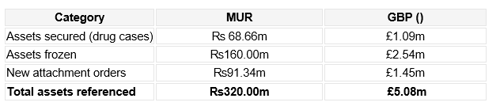
(Victim compensation of ₨15m / £0.24m is a distribution, not an additional recovery.)

The Recovered Asset Fund (RAF) has been in existence since the entry into force of the Asset Recovery Act of 2011, which allows for the confiscation, management and redistribution of criminal assets.
Several institutions have contributed to the recovery of assets derived from illicit activities, including the Office of the Director of Public Prosecutions (DPP), the Financial Intelligence Unit and, recently, the Financial Crimes Commission (FCC).
However, despite the mechanism's existence for more than a decade, there are no consolidated statistics on the total number of victims compensated by these entities.
Under the FCC, only one confirmed case has been recorded to date: that of Maubank,
- Which received Rs 15 million. This isolated case contrasts sharply with the scale of seizures and assets recovered over the years.
The RAF is one of the FCC's strategic instruments in the fight against financial crimes in Mauritius. This fund centralises funds from the sale of property confiscated in cases of drug trafficking, corruption, fraud, and money laundering. The objective is twofold: to hit criminals in the wallet and to return to victims sums lost in illegal activities.
Since the enactment of the FCC Act 2023, the mechanism for recovering criminal assets has been strengthened. Seized assets – vehicles, boats, cash, jewellery and other assets – are sold before confiscation or after a decision by the Supreme Court.
One of the fundamental pillars of the RAF is compensation for victims.
Once the assets are confiscated and sold, the funds are redistributed under section 152 of the FCC Act 2023.
- This allows victims to be compensated in proportion to the amounts recovered, depending on the losses suffered and court decisions.
- This mechanism gives a restorative dimension to the fight against financial crimes.
- Money from criminal activities does not disappear into the system, but is used to compensate those harmed. However, the final amount depends on several factors, including the volume of assets recovered, the number of victims identified, and the complexity of the ongoing court cases.
The FCC's Acting Director General, Sanjay Dawoodarry, recently underlined the importance of this mission, insisting on its collective dimension in the fight against financial crimes:
- "The war against financial crimes is a collective and civic mission that concerns every single one of us. I have full confidence in my commissioners, my team, organisations forming part of the National Coordination Committee, other international and national stakeholders, including the media, and I trust that we shall fulfil our oaths and our collective mission."
The FCC has recently strengthened its strategy by directly targeting the sources of financing of organised crime, including drug trafficking, which has been identified as one of the main sources of criminal profits in Mauritius.
Between December 10, 2025 and March 31, 2026, the FCC
- Conducted 70 searches, made 26 arrests and froze assets estimated at Rs 160 million.
- Brought 108 cases to court, including 18 related to drug offences.
- Held 31 operational meetings, reviewed 103 administrative files and handled 824 complaints, including 101 related to narcotics. These figures demonstrate an intensification of investigative efforts and a commitment to improving the efficiency of the asset recovery system.
The Asset Recovery and Management Division (ARMD) combines asset recovery, seized asset management, and investigations into unexplained wealth. It acts through two main tracks: civil and criminal.
- The first confiscates assets without a judicial conviction, on evidence of their illicit origin.
- The second occurs after the Supreme Court's conviction, allowing for permanent confiscation of the assets.
In both cases, these assets can be direct proceeds of crime or instrumentalities, such as a vehicle or boat used for illegal trafficking.
When an asset is suspected of being linked to criminal activity, the FCC obtains an Attachment Order from the Supreme Court to freeze the assets during the investigation, preventing any sale or transfer.
When the goods are at risk of losing value or preservation is costly, the FCC may proceed with an early sale.
- Once the Court has validated the confiscation, the goods are sold at auction or by submission of offers.
- The funds obtained are paid to the RAF.
- Between 10 December 2025 and 31 March 2026, the ARMD secured Rs 68,660,990 in assets in drug cases.
- The vehicles and boats represent Rs 59,616,414, Rs 6,644,576 in cash and Rs 2,400,000 in jewellery.
- Six new attachment orders have been obtained for other assets valued at Rs 91,339,010.
By depriving criminals of their earnings, the FCC is permanently weakening criminal networks.
At the same time, the redistribution of funds to victims reinforces the system's social and restorative dimensions.
SOURCE
- https://lexpress.mu/s/largent-du-crime-recupere-est-redistribue-aux-victimes-557143
- All Mauritian‑rupee (MUR) amounts referenced, with conversion into GBP using a **conservative mid‑market rate of ₨1 MUR £0.0159 GBP (average April 2026 rate). [eurochange.co.uk]
- Exchange rate used MUR → GBP: 0.0159 Method: mid‑market / interbank average (April 2026)
The Team
Meet the team of industry experts behind Comsure
Find out moreLatest News
Keep up to date with the very latest news from Comsure
Find out moreGallery
View our latest imagery from our news and work
Find out moreNews Disclaimer
As well as owning and publishing Comsure's copyrighted works, Comsure wishes to use the copyright-protected works of others. To do so, Comsure is applying for exemptions in the UK copyright law. There are certain very specific situations where Comsure is permitted to do so without seeking permission from the owner. These exemptions are in the copyright sections of the Copyright, Designs and Patents Act 1988 (as amended)[www.gov.UK/government/publications/copyright-acts-and-related-laws]. Many situations allow for Comsure to apply for exemptions. These include 1] Non-commercial research and private study, 2] Criticism, review and reporting of current events, 3] the copying of works in any medium as long as the use is to illustrate a point. 4] no posting is for commercial purposes [payment]. (for a full list of exemptions, please read here www.gov.uk/guidance/exceptions-to-copyright]. Concerning the exceptions, Comsure will acknowledge the work of the source author by providing a link to the source material. Comsure claims no ownership of non-Comsure content. The non-Comsure articles posted on the Comsure website are deemed important, relevant, and newsworthy to a Comsure audience (e.g. regulated financial services and professional firms [DNFSBs]). Comsure does not wish to take any credit for the publication, and the publication can be read in full in its original form if you click the articles link that always accompanies the news item. Also, Comsure does not seek any payment for highlighting these important articles. If you want any article removed, Comsure will automatically do so on a reasonable request if you email info@comsuregroup.com.
Archived News
To find our older articles, please click here.
View archive

To find our older articles, please click here.