

Mauritius AML/CTF/CPF legislative update – Don’t Let Your Training Become a Last-Minute Crisis
01/04/2026
Mauritius has just dropped another legislative twist. See Arion’s update below:
On 24 March 2026, the Anti-Money Laundering, Combating the Financing of Terrorism and Countering Proliferation Financing (Miscellaneous Provisions) Bill (No. III of 2026) was introduced in the National Assembly — 24 distinct AML/CTF/CPF amendments across multiple statutes.
This is not a minor tweak. It directly strengthens:
- Proliferation financing risk (new definitions + mandatory risk-based measures – FATF R.7)
- FIU operational independence and 72-hour transaction suspension powers
- Asset recovery (presumption of criminal origin, corresponding-value confiscation, unexplained wealth orders, 48-hour information demands)
- Beneficial ownership transparency (Companies, Trusts, Foundations, Co-operatives, Associations)
- Supervisory penalties and daily fines
- Domestic & international information sharing
- NPO/TF/PF oversight
- Faster judicial processes for confiscation and electronic evidence
All timed to feed into the next ESAAMLG evaluation and the National Strategy for Combating Money Laundering and Countering the Financing of Terrorism 2026–2029.
Box-ticking is officially dead.
- Fines, enforcement actions, and reputational damage are now far more likely if your compliance programme isn’t effective, practical, and fully risk-based.
That’s why forward-thinking Mauritian organisations — banks, fiduciaries, DNFBPs, corporates and trust companies — are already booking in-house AML/CTF/CPF training with the expert who knows Mauritius best.
From 1–6 June 2026, Mathew Beale (CEO of Comsure Group, 40+ years’ practitioner experience, 20+ years delivering training in Mauritius) returns to the island to deliver tailored 3-hour in-house workshops right in your office.
Why Mauritian businesses choose Mathew Beale & Comsure:
✅ He has worked with both public and private sectors to help shape Mauritius’ regulatory environment and stay ahead of every shift — including these latest 24 amendments
✅ Real-world scenarios tailored to your sector, not generic slides
✅ Practical takeaways your team can apply immediately on Day 1
✅ Proven track record with private sector and government bodies across Mauritius
✅ MQA/HRDC-approved sessions — convenient, cost-effective, and eligible for refund
👬 Sessions are co-delivered with a Mauritius-based AML/CTF/CPF specialist — international best practice + deep local insight.
⚠️ Urgent heads-up: Only 8 of 10 slots remain for the 1–6 June window. Once they’re gone, they’re gone until his next visit.
Secure your private in-house session today and turn these new legislative changes into a genuine competitive advantage — not a compliance headache.
📩 To lock in your date, DM me or email yes@comsuregroup.com or mathew@comsuregroup.com.
Let’s make sure your organisation doesn’t just comply — it leads.
#AML #CFT #CPF #Compliance #Mauritius #FinancialServices #RiskManagement #AntiMoneyLaundering #MauritiusFinance #BeneficialOwnership #AssetRecovery
Read more
Mauritius twist again and adds 24 distinct AML/CTF/CPF amendments across multiple statutes
Comsure Briefing: The Anti-Money Laundering, Combating the Financing of Terrorism and Countering Proliferation Financing (Miscellaneous Provisions) Bill (No. III of 2026)[THE BILL]
- The Bill was circulated on 20 March 2026 and introduced in the National Assembly on 24 March 2026.
- It forms part of Mauritius’ ongoing legislative updates to its AML/CFT/CPF framework, building on the National Strategy for Combating Money Laundering and Countering the Financing of Terrorism 2026–2029 and the findings of the second National Risk Assessment.
The Explanatory Memorandum and Cabinet decision (20 March 2026) state the core objective clearly:
- “The object of the Bill is to amend various enactments with a view to improving the country’s efficiency in combating criminality, including money laundering, terrorism financing and proliferation financing.
- Necessary measures and safeguards are being implemented to make it even more difficult for criminals to exploit the country’s administrative and financial systems and to combat these crimes more efficiently.
- Additionally, the Bill reflects the country’s determination to continuously adhere to international standards, including those of the Financial Action Task Force on anti-money laundering, combating the financing of terrorism and countering proliferation financing.”
The Bill introduces 24 distinct amendments across multiple statutes.
- It is not a standalone law but a “miscellaneous provisions” vehicle that strengthens the existing framework without creating new regulators.
- It directly addresses gaps identified in recent evaluations.
- It aligns Mauritius more closely with FATF Recommendations especially
- R.7 on proliferation financing,
- R.8 on NPOs,
- R.15 on new technologies, and
- IOS = effectiveness issues around asset recovery and information sharing
Effectiveness Issues Around Asset Recovery and Information Sharing
- These are effectiveness issues (not tied to a single Recommendation) and are primarily assessed under the FATF’s Immediate Outcomes (IOs) in mutual evaluations:
- Asset Recovery —
- Mainly Immediate Outcome 8 (IO8): “Proceeds and instrumentalities of crime are confiscated.”
- FATF assessments show more than 80% of jurisdictions achieve only low or moderate effectiveness in IO8.
- Actual confiscation/recovery rates of criminal proceeds globally remain very low (often <1–5%).
- Related technical Recommendations:
- R.4 (Confiscation and provisional measures — updated in 2023 to emphasise prioritisation, corresponding value confiscation, non-conviction-based tools, asset management, and national policy priority) and
- R.38 (Mutual legal assistance for freezing and confiscation). Common effectiveness gaps: delayed financial investigations, asset dissipation before confiscation, weak statistics, insufficient inter-agency coordination, and limited international asset sharing.
- Information Sharing —
- Cross-cutting requirement embedded in 25 Recommendations (notably R.2 for national cooperation/coordination, R.40 for international cooperation, and elements of R.29/FIU functions).
- It affects multiple IOs, especially IO2 (International cooperation), IO6 (Financial intelligence utilised), IO7 (ML/TF investigations and prosecutions), and elements of IO8 (asset tracing).
- Persistent effectiveness issues include delays in domestic/inter-agency or international sharing, legal barriers (e.g., privacy conflicts), under-use of FIU intelligence, and weak proactive/spontaneous exchange.
- The FATF maintains a Consolidated Standards on Information Sharing to address these.
Key Focus Areas and Specific Provisions
The Bill’s amendments map the eight priority areas. Below that is a structured overview based on the official Bill text:
- Proliferation Financing Risk Framework
- New definitions of “proliferation financing risk” and “proliferation” are inserted into the Financial Intelligence and Anti-Money Laundering Act (FIAMLA) and the United Nations (Financial Prohibitions, Arms Embargo and Travel Ban) Sanctions Act.
- In the Financial Intelligence and Anti-Money Laundering Act (FIAMLA)
- The Bill inserts a new definition in section 2 (Interpretation) in alphabetical order:
- “Proliferation financing risk” refers strictly and only to the potential breach, non-implementation or evasion of the targeted financial sanctions obligations under the United Nations (Financial Prohibitions, Arms Embargo and Travel Ban) Sanctions Act and Recommendation 7 of the Financial Action Task Force international standards on AML/CFT.
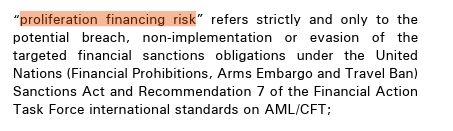
- This definition directly supports the integration of proliferation financing (PF) risk assessment into the risk-based approach required under FIAMLA (aligned with FATF R.1 and R.7 updates).
- Reporting persons must now identify, assess, monitor, and mitigate this specific risk as part of their overall ML/TF/PF risk profile.
- In the United Nations (Financial Prohibitions, Arms Embargo and Travel Ban) Sanctions Act
- The Bill does not insert a brand-new standalone definition of “proliferation” in this Act. Instead, it amends the interpretation section by providing that:
- “Proliferation has the same meaning as in the Financial Intelligence and Anti-Money Laundering Act”.
- Reporting persons must identify, assess, monitor and mitigate PF risks (integrated into existing targeted financial sanctions programmes).
- The Ministry and competent authorities gain explicit powers to conduct ad hoc sectoral risk assessments and to ensure mitigation measures.
- Immediate (24-hour) dissemination of UN sanctions designations via the FIU is mandated.
- New designation grounds include engagement in or support for proliferation financing or evasion of UNSCRs (e.g. 1718, 1737).
- Strengthening FIU Powers and Operational Independence.
- FIAMLA is amended to state explicitly that the FIU “is not subject to the direction or control of any person or authority in a manner that would compromise its operational independence.”
- The FIU’s functions now expressly cover proliferation financing.
- It gains the power to temporarily suspend suspicious transactions (up to 72 hours, extendable) linked to PF and must notify the Financial Crimes Commission.
- Statistics on PF investigations/prosecutions must be maintained at the national level.
- Enhanced Asset Recovery Mechanisms, Major overhaul of the Financial Crimes Commission Act 2023:
- Property of convicted persons is presumed to be derived from crime and subject to forfeiture.
- “Corresponding value” confiscation (lawfully acquired assets before/during/after the offence) is introduced.
- New powers for the Commission to obtain customer/account information within 48 hours (non-compliance fine up to Rs 1 million).
- Attachment orders, search powers (including electronic devices), realisation of property, unexplained wealth orders, and compensation provisions are strengthened.
- Proceeds flow to the Recovered Assets Fund.
- The Mauritius Revenue Authority Act has also been amended to support the Asset Recovery Unit with search/seizure and summons powers.
- Beneficial Ownership Transparency
- Companies Act: Refined definition of “beneficial owner” (natural person with ownership/control, including voting rights and indirect control).
- Co-operatives Act: Mandatory register of beneficial owners (open for inspection); new offences.
- Financial Services Act / Trusts Act / Foundations Act: Registers of trusts and foundations must hold and update beneficial ownership information; trustees must notify changes within 5 working days.
- Registration of Associations Act: Enhanced record-keeping for fundraising and beneficial ownership.
- Supervisory Enforcement and Penalties
- Enhanced administrative penalties and compounding mechanisms in the Bank of Mauritius Act, Banking Act, Financial Services Act, Gambling Regulatory Authority Act, National Payment Systems Act, and Financial Reporting Act.
- New inspection powers, daily fines for non-compliance, and criminal sanctions (up to Rs 5–10 million and/or imprisonment) for obstructing supervisors or destroying records.
- Cash transaction controls (e.g., bet limits and anti-structuring rules) are now in place for gambling operators.
- Information Sharing and Coordination Across Authorities
- New provisions in FIAMLA (s.22A) for domestic and international exchange of AML/CFT/CPF information under strict conditions.
- The National Sanctions Committee now includes the Registrar of Associations.
- FIU and supervisors must receive immediate notifications of sanctions designations.
- Inter-agency coordination is reinforced by the existing Interagency Coordination Committee (ICC) Amended Memorandum of Cooperation, signed on 18 March 2026.
- Oversight of the NPO/NPC Sector.
- The Registration of Associations Act and the United Nations Sanctions Act are amended to subject associations/NPOs to stronger risk-based supervision for TF/PF risks, including record-keeping on fundraising and coordination with competent authorities.
- Judicial and Prosecution Effectiveness
- Amendments to the Courts Act, Financial Crimes Commission Act and Mauritius Revenue Authority Act speed up processes: clearer search warrants, electronic evidence handling, judicial review procedures, and timelines for confiscation applications. Confiscation orders now explicitly cover terrorist/proliferation-related property.
Acts Amended (non-exhaustive list):
- FIAMLA, United Nations Sanctions Act, Financial Crimes Commission Act 2023, Companies Act, Co-operatives Act, Financial Services Act, Banking Act, Bank of Mauritius Act, Gambling Regulatory Authority Act, Registration of Associations Act, Trusts Act, Foundations Act, Mauritius Revenue Authority Act, Courts Act, Value Added Tax Act, and several regulations (e.g. Companies (Beneficial Owner) Regulations).
Current Status (as of 1 April 2026)
- The Bill is at the very early stage (first reading/introduction).
- Live parliamentary debates have begun, and the government has described it as a “great step forward” to avoid any return to grey-listing.
All WWW Sources for Direct Cut-and-Paste
- Official Bill PDF (full text)https://mauritiusassembly.govmu.org/mauritiusassembly/wp-content/uploads/2026/03/Anti-Money-Laundering-Combatting-the-Financing-of-Terrorism-and-Countering-Proliferation-Financing-Miscellaneous-Provisions-Bill-No.-III-of-2026.pdf
- National Assembly Bills Page (dates & link)https://mauritiusassembly.govmu.org/mauritiusassembly/index.php/bills/
- Cabinet Decision Highlights – 20 March 2026 (Explanatory text)https://pmo.govmu.org/CabinetDecision/2026/Highlights%20of%20Cabinet%20Meeting%20Friday%2020.03.2026.pdf
- News – “Mauritius Unveils 24 New Legal Amendments…” (31 March/1 April 2026 coverage)https://newsmoris.com/mauritius-unveils-24-new-legal-amendments-to-avoid-global-financial-grey-listing/
- Platform Africa – Cabinet nod article (25 March 2026)https://platformafrica.com/2026/03/25/cabinet-gives-nod-to-aml-bill-promulgation-of-income-tax-amendment-regulations-2026/
- Bank of Mauritius – ICC Amended MoC (18 March 2026)https://www.bom.mu/media/media-releases/strengthening-coordination-and-collaboration-amongst-members-interagency-coordination-committee
- Facebook live parliamentary debatehttps://www.facebook.com/ionnews/videos/parlement/1435483631650622/
These are the primary, authoritative, and most up-to-date public sources. The Bill itself is the definitive legal text; all other briefings flow from it and the Cabinet decision. No further secondary analysis or commentary has been added beyond what is directly extractable from the official documents.
The Team
Meet the team of industry experts behind Comsure
Find out moreLatest News
Keep up to date with the very latest news from Comsure
Find out moreGallery
View our latest imagery from our news and work
Find out moreContact
Think we can help you and your business? Chat to us today
Get In TouchNews Disclaimer
As well as owning and publishing Comsure's copyrighted works, Comsure wishes to use the copyright-protected works of others. To do so, Comsure is applying for exemptions in the UK copyright law. There are certain very specific situations where Comsure is permitted to do so without seeking permission from the owner. These exemptions are in the copyright sections of the Copyright, Designs and Patents Act 1988 (as amended)[www.gov.UK/government/publications/copyright-acts-and-related-laws]. Many situations allow for Comsure to apply for exemptions. These include 1] Non-commercial research and private study, 2] Criticism, review and reporting of current events, 3] the copying of works in any medium as long as the use is to illustrate a point. 4] no posting is for commercial purposes [payment]. (for a full list of exemptions, please read here www.gov.uk/guidance/exceptions-to-copyright]. Concerning the exceptions, Comsure will acknowledge the work of the source author by providing a link to the source material. Comsure claims no ownership of non-Comsure content. The non-Comsure articles posted on the Comsure website are deemed important, relevant, and newsworthy to a Comsure audience (e.g. regulated financial services and professional firms [DNFSBs]). Comsure does not wish to take any credit for the publication, and the publication can be read in full in its original form if you click the articles link that always accompanies the news item. Also, Comsure does not seek any payment for highlighting these important articles. If you want any article removed, Comsure will automatically do so on a reasonable request if you email info@comsuregroup.com.


As well as owning and publishing Comsure's copyrighted works, Comsure wishes to use the copyright-protected works of others. To do so, Comsure is applying for exemptions in the UK copyright law. There are certain very specific situations where Comsure is permitted to do so without seeking permission from the owner. These exemptions are in the copyright sections of the Copyright, Designs and Patents Act 1988 (as amended)[www.gov.UK/government/publications/copyright-acts-and-related-laws]. Many situations allow for Comsure to apply for exemptions. These include 1] Non-commercial research and private study, 2] Criticism, review and reporting of current events, 3] the copying of works in any medium as long as the use is to illustrate a point. 4] no posting is for commercial purposes [payment]. (for a full list of exemptions, please read here www.gov.uk/guidance/exceptions-to-copyright]. Concerning the exceptions, Comsure will acknowledge the work of the source author by providing a link to the source material. Comsure claims no ownership of non-Comsure content. The non-Comsure articles posted on the Comsure website are deemed important, relevant, and newsworthy to a Comsure audience (e.g. regulated financial services and professional firms [DNFSBs]). Comsure does not wish to take any credit for the publication, and the publication can be read in full in its original form if you click the articles link that always accompanies the news item. Also, Comsure does not seek any payment for highlighting these important articles. If you want any article removed, Comsure will automatically do so on a reasonable request if you email info@comsuregroup.com.