
Legal, Regulatory and Ethical Failures Drowned in Sewage Profits: The CEO Pay Parade Continues
08/03/2026
Imagine a fisherman on the River Thames, casting his line only to reel in plastic and pathogens. Or a Devon family boiling water for weeks during an outbreak.
- These are the human costs of ethical voids, where companies commit to £96 billion in investments by 2030 but drag their feet on delivery.
This isn't mere oversight;
- It's a deep-rooted collapse of accountability that has allowed privatised water companies to treat rivers and seas as open sewers.
- At the same time, regulators issued warnings, fines, and reports that rarely translated into meaningful change.
- Official reviews have repeatedly highlighted this.
In 2024, English water companies discharged raw sewage for a record 3.6 million hours across nearly 450,000 spills, a slight increase in duration from 2023, despite a small drop in spill counts.
- This prompted fines, criminal probes, and regulatory interventions, such as Ofwat's bonus bans for underperforming firms.
The UK water scandal
- Continues to centre on privatised English water companies' record sewage discharges into rivers and seas, inadequate infrastructure investment since 1989, high customer bills, and executive pay levels that many view as disproportionate to performance.
- Exposes a profound failure of regulation, a systemic breakdown in which regulators like Ofwat and the Environment Agency have been unable (or unwilling) to prevent decades of environmental harm, unchecked debt accumulation, and excessive profiteering.
- This profound regulatory failure stems from privatisation's original design:
- Fragmented oversight,
- Underfunding,
- Reliance on self-reporting, and
- A focus on bill caps over environmental enforcement.
This sewage saga isn't inevitable; it's the rotten fruit of flawed laws, lax regulators, and ethics eroded by greed.
PROFOUND ETHICAL FAILURE IN CORPORATE BOARDROOMS
- At the heart of this scandal is a profound ethical failure in corporate boardrooms.
- Water companies aren't faceless entities; they're led by executives who rake in millions while presiding over environmental catastrophes.
- Let's spotlight a few from the rogues' gallery:
- Susan Davy, Southwest Water (Pennon Group): Paid £803,000 in 2024-25, including £191,000 in share awards. Her company dumped sewage 56,173 times in 2024, totalling 544,439 hours. Amid a cryptosporidium outbreak that has sickened thousands in Devon, Davy forfeited a prior bonus but saw her base pay rise to £511,000. Ethics? More like optics.
- Liv Garfield, Severn Trent Water: The queen of compensation at £3.268 million, up 2% despite a £2 million fine for spilling 260 million litres into the River Trent. Over her decade-long tenure, she's pocketed over £30 million while spills rose 33% in 2023 alone, with 62,085 discharges in 2024. Garfield defends it as "performance-linked," but to locals wading through polluted waters, it's a slap in the face.
- Nicola Shaw, Yorkshire Water: £689,000 from the company plus £660,000 from parent Kelda Holdings, totalling £1.349 million. Bonus waived due to Ofwat's ban? Sure, but parent payouts filled the gap. Her firm: 68,164 spills in 2024 and a £40 million fine for treatment failures. Shaw's total earnings over recent years exceed £3 million, whether ethical leadership or clever accounting.
- And they're not alone.
- Thames Water's Chris Weston at £1 million (bonus banned, but retention perks abound), United Utilities'
- Louise Beardmore at £1.254 million (long-term incentives intact), Anglian Water's transitioning leadership dodging bonuses but not scrutiny,
- Southern Water's Lawrence Gosden nearly doubled to £1.4 million via pre-ban plans, and
- Wessex Water's Ruth Jefferson at £464,000 with parent top-ups.
- [Appendix 1 – shows more details on additional executives and firms]
- These aren't rewards for stewardship; they're symptoms of a culture where shareholder returns trump planetary health.
ALSO, A PROFOUND FAILURE IN REGULATION
- A 2025 National Audit Office (NAO) report bluntly stated that Defra and the water regulators
- "Have failed to deliver a trusted and resilient water sector," with regulatory gaps enabling overspending on infrastructure without improving sewage works and leaving only 1% of environmental actions inspected by the Environment Agency.
- The NAO criticised the lack of proactive asset inspections and poor understanding of infrastructure condition, allowing failures to "persist for far too long."
- An Independent Water Commission review (led by Sir Jon Cunliffe, final report July 2025)
- Described "deep-rooted, systemic and interlocking failures" across government strategy, regulation, and company behaviour, explicitly pointing to failures in regulation to protect both billpayers and the environment.
- This led to calls to scrap or radically reform Ofwat, with Environment Secretary Steve Reed
- Acknowledging the need for a "fundamental reset" and a single, powerful, integrated regulator to replace the fragmented, under-resourced system.
- The Environment Agency itself has labelled aspects of the industry's performance as
- "Continued systemic failure" in its 2025 reports on pollution incidents (up 60% in serious cases in 2024), while whistleblowers and investigations revealed self-monitoring loopholes and delayed enforcement.
- Critics, including MPs like Tim Farron,
- Have accused regulators of being "run rings around" by better-resourced companies,
- With a revolving door between Ofwat staff and industry, further eroding independence.
- Even Ofwat's own actions,
- Such as bonus bans for six companies in 2024-25 (blocking over £4 million in payouts due to pollution and poor performance), have been criticised as too little, too late.
- Executives often circumvented restrictions through parent company payments or long-term incentives, and total CEO pay still rose 5% to an average of £1.1 million (sector total: £15 million) amid the crisis.
- Fines, while record-breaking (e.g., Thames Water's £123 million in 2025 for sewage and dividend breaches), have been described as "built into the business model," with dividends continuing unchecked for years.
- This profound regulatory failure stems from privatisation's original design: fragmented oversight, underfunding, reliance on self-reporting, and a focus on bill caps over environmental enforcement.
The result?
- Record sewage spills (over 3.6 million hours in 2024), public health risks, and eroded trust while companies paid out billions in dividends and executives earned millions.
- The government has introduced new powers (e.g., the Water (Special Measures) Act 2025, which includes bonus bans, ring-fenced fines, and mandatory pollution-reduction plans).
- Still, many argue it's patching a fundamentally broken system.
- Calls for renationalisation, a unified regulator with real teeth, or stricter pay ties to zero spills persist.
- Until regulation matches the scale of the scandal, the sewage will keep flowing, and the profound failure will endure.
Conclusion
- This sewage saga isn't inevitable; it's the rotten fruit of flawed laws, lax regulators, and ethics eroded by greed.
- Solutions exist:
- Strengthen laws to criminalise dry spilling outright, empower regulators with real teeth (independent funding, stricter pay caps tied to zero spills), and
- Demand corporate ethics that embed environmental KPIs into every bonus.
- As the UK grapples with this mess, one thing's clear: Clean water shouldn't be a luxury.
- It's time to flush out the failures and rebuild a system that serves people and planet over profits.
- Public campaigns, such as those from Surfers Against Sewage, are pushing for renationalisation or, at a minimum, profit-sharing models that reinvest in pipes, not pockets.
- What do you think,
- Re-nationalise or
- Reform?
Appendix 1
Key Water Companies and Their Leadership, incorporating additional major English water and sewerage companies based on available 2024-25 data. This includes CEOs, their reported compensation (often total remuneration, including base salary, benefits, and any incentives/long-term awards were paid despite bans), 2024 sewage spill figures (where specified in prior context or aligned reports), and key notes. Note that bonus bans applied to several firms (Thames, Anglian, Southern, United Utilities, Wessex, Yorkshire) for 2024-25 due to serious pollution or other breaches, often shifting pay toward base/long-term elements or parent company payments. Spill data is approximate/monitored events for 2024; full national totals were record-high.
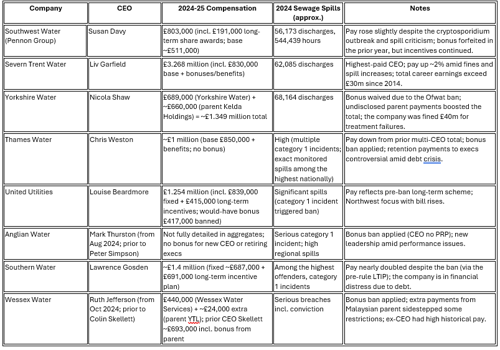
Other companies (e.g., Affinity Water: Keith Haslett, £1.6m, doubled despite no sewage role; smaller suppliers like Portsmouth or South East Water, lower at £456k-£754k) show similar patterns of high executive rewards amid sector scrutiny.
Overall, English/Welsh water CEOs averaged £1.1m in 2024-25 (total sector £15m), up 5% despite bans, often via long-term incentives, parent structures, or pre-ban awards. Critics highlight this against £72bn+ dividends since privatisation and £54bn debt, with calls for tighter caps or renationalisation. The government and Ofwat continue to enforce stricter measures, but public anger persists over pollution and perceived profiteering.
Sources
Here is a curated list of reliable web sources that support the key facts, statistics, and claims in your blog post on the UK water scandal (sewage spills, executive pay, regulatory failures, privatisation outcomes, etc.). I've focused on official government/regulator sites, reputable news outlets (e.g., BBC, Guardian), and reports from 2024–2025 where possible, given the current date of March 2026.
Official Government and Regulator Sources
- Environment Agency storm overflow spill data for 2024 (published March 2025, detailing 450,000 spills and 3.6 million hours duration): https://www.gov.uk/government/news/environment-agency-storm-overflow-spill-data-for-2024
- Environment Agency blog on 2024 EDM Annual Returns (spill trends, slight decrease in count but high levels persist): https://environmentagency.blog.gov.uk/2025/03/27/what-are-the-2024-edm-annual-returns
- Ofwat's Performance-related executive pay – 2024-25 assessment (bonus bans for six companies due to pollution incidents): https://www.ofwat.gov.uk/wp-content/uploads/2025/11/Performance-related-executive-pay-%E2%80%93-2024-25-assessment.pdf
- Ofwat announcement: New bonus rule blocks £4m in first year (details on compliance and blocked payouts for 2024/25): https://www.ofwat.gov.uk/potential-bonuses-blocked-by-new-rule
- Government news: Unfair bonuses banned for six water companies (Water (Special Measures) Act implementation, June 2025): https://www.gov.uk/government/news/governments-new-law-sees-unfair-bonuses-banned-for-six-water-companies-with-immediate-effect
News and Analysis on Executive Pay
- The Guardian: Water chiefs' pay rises to average of £1.1m despite ban on bonuses (total sector pay £15m in 2024-25, up 5%): https://www.theguardian.com/business/2025/jul/26/water-chiefs-pay-rises-england-wales-ban-bonuses-sewage
- BBC: Water bosses' bonuses blocked over pollution issues (Ofwat's £4m+ blocked payouts, six companies including Thames, Yorkshire): https://www.bbc.com/news/articles/c781v25e8xqo
- The Guardian: Yorkshire Water boss paid extra £1.3m by parent company (Nicola Shaw's undisclosed payments via Kelda Holdings): https://www.theguardian.com/business/2025/aug/03/yorkshire-water-boss-pay-offshore-parent-company
- BBC: Yorkshire Water boss 'mistaken' to keep £1.3m payment secret (Shaw's £660k extra from parent in 2023-25): https://www.bbc.com/news/articles/cp9kv0jlyn0o
- The Guardian: Severn Trent boss paid £3.2m despite firm's fine for sewage spills (Liv Garfield's pay details): https://www.theguardian.com/business/article/2024/jun/11/severn-trent-boss-paid-32m-despite-firms-fine-for-sewage-spills-in-river
- BBC: South West Water boss drops bonus for second year (Susan Davy's pay rise context): https://www.bbc.com/news/articles/c8vv06eqyvgo
- The Independent: Pennon water boss lands nearly £200,000 in share awards (Susan Davy's £803,000 total for relevant period): https://www.the-independent.com/news/business/mps-water-holly-williams-ceo-pay-brixham-b2777402.html
Broader Privatisation and Dividends/Debt Context
- The Guardian: England's privatised water firms paid £57bn in dividends (historical dividends vs investment since 1991): https://www.theguardian.com/environment/2020/jul/01/england-privatised-water-firms-dividends-shareholders
- BBC: Water investors have withdrawn billions (updated £72.8bn dividends since 1989, adjusted for inflation): https://www.bbc.com/news/articles/cw4478wnjdpo
These sources provide solid, citable backing for the blog's statistics (e.g., spill numbers, CEO pay figures such as £3.268m for Garfield or £803k for Davy), regulatory actions (bonus bans), and systemic issues (dividends/debt since privatisation).
The Team
Meet the team of industry experts behind Comsure
Find out moreLatest News
Keep up to date with the very latest news from Comsure
Find out moreGallery
View our latest imagery from our news and work
Find out moreContact
Think we can help you and your business? Chat to us today
Get In TouchNews Disclaimer
As well as owning and publishing Comsure's copyrighted works, Comsure wishes to use the copyright-protected works of others. To do so, Comsure is applying for exemptions in the UK copyright law. There are certain very specific situations where Comsure is permitted to do so without seeking permission from the owner. These exemptions are in the copyright sections of the Copyright, Designs and Patents Act 1988 (as amended)[www.gov.UK/government/publications/copyright-acts-and-related-laws]. Many situations allow for Comsure to apply for exemptions. These include 1] Non-commercial research and private study, 2] Criticism, review and reporting of current events, 3] the copying of works in any medium as long as the use is to illustrate a point. 4] no posting is for commercial purposes [payment]. (for a full list of exemptions, please read here www.gov.uk/guidance/exceptions-to-copyright]. Concerning the exceptions, Comsure will acknowledge the work of the source author by providing a link to the source material. Comsure claims no ownership of non-Comsure content. The non-Comsure articles posted on the Comsure website are deemed important, relevant, and newsworthy to a Comsure audience (e.g. regulated financial services and professional firms [DNFSBs]). Comsure does not wish to take any credit for the publication, and the publication can be read in full in its original form if you click the articles link that always accompanies the news item. Also, Comsure does not seek any payment for highlighting these important articles. If you want any article removed, Comsure will automatically do so on a reasonable request if you email info@comsuregroup.com.


As well as owning and publishing Comsure's copyrighted works, Comsure wishes to use the copyright-protected works of others. To do so, Comsure is applying for exemptions in the UK copyright law. There are certain very specific situations where Comsure is permitted to do so without seeking permission from the owner. These exemptions are in the copyright sections of the Copyright, Designs and Patents Act 1988 (as amended)[www.gov.UK/government/publications/copyright-acts-and-related-laws]. Many situations allow for Comsure to apply for exemptions. These include 1] Non-commercial research and private study, 2] Criticism, review and reporting of current events, 3] the copying of works in any medium as long as the use is to illustrate a point. 4] no posting is for commercial purposes [payment]. (for a full list of exemptions, please read here www.gov.uk/guidance/exceptions-to-copyright]. Concerning the exceptions, Comsure will acknowledge the work of the source author by providing a link to the source material. Comsure claims no ownership of non-Comsure content. The non-Comsure articles posted on the Comsure website are deemed important, relevant, and newsworthy to a Comsure audience (e.g. regulated financial services and professional firms [DNFSBs]). Comsure does not wish to take any credit for the publication, and the publication can be read in full in its original form if you click the articles link that always accompanies the news item. Also, Comsure does not seek any payment for highlighting these important articles. If you want any article removed, Comsure will automatically do so on a reasonable request if you email info@comsuregroup.com.