

JFSC unresolved Terminology Issue: “CUSTOMER” vs “LINKED [surrounding] ARRANGEMENTS” & “THREE-TIER TEST” and DATA SUBMISSIONS
27/03/2026
EXECUTIVE SUMMARY
In November 2025, the JFSC published a follow-up consultation seeking industry feedback on proposals to split the complex structures guidance in the AML/CFT/CPF handbook into two parts.
The result of this consultation is the publication of the following handbook updates [31 May 2026 effective date]:-
- Assessing Complex Structures https://www.jerseyfsc.org/media/cevnoqcr/section-48.pdf
- Complex high-risk structures = https://www.jerseyfsc.org/media/vovjnu3a/section-78.pdf
In these two parts, the JFSC has deliberately left one definitional matter UNRESOLVED in the otherwise finalised and industry-friendly revisions to the complex-structures guidance.
- The precise boundary of a “linked arrangement” (a new formulation introduced to capture vehicles in the ownership/control chain that are material to understanding the overall structure).
- Both sections now use the phrase “a customer or a linked arrangement relevant to beneficial ownership, control, or purpose” (4.8 para 249; 7.8 para 81).
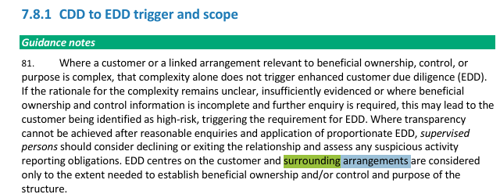
- Section 7.8.1 also refers to “surrounding arrangements.”
INCONSISTENT TERMINOLOGY
- The JFSC explicitly acknowledged industry concerns about inconsistent terminology (“customer”, “customer structure”, “structure”) in its March 2026 Feedback Paper (Section 2.3).
- It confirmed this is a broader issue with implications beyond complex structures and will be addressed in a later, wider Handbook review.
ISSUE AND IMPACT
- The unresolved “linked arrangement” boundary in Sections 4.8 and 7.8 of the AML/CFT/CPF Handbook (effective 31 May 2026) creates ongoing practical ambiguity, even though the three-tier controllers test itself is clear when applied to a single direct “customer”.
- This terminology gap, the inconsistent use of “CUSTOMER” (primarily in Section 4.8 for Standard Due Diligence) versus “LINKED ARRANGEMENTS” (emphasised in Section 7.8 for high-risk complex structures), forces firms to exercise additional judgment and maintain enhanced documentation when applying the test across multi-layered or interconnected structures common in Jersey.
- This ambiguity is significantly magnified when feeding AML-derived controller information into three key areas:
- Application of the three-tier controller test
- Requires firms to determine the precise scope and chaining of the test
- However, AML analysis requires the answer to:- how far to drill down through material vehicles in the ownership/control chain that qualify as linked arrangements.
- Annual entity-centric Registry confirmations via myRegistry
- Here, the obligation focuses on accurate beneficial owners and controllers of the registered entity.
- However, AML analysis may extend to linked arrangements that do not map neatly onto Registry disclosure requirements.
- Annual aggregated Supervisory Risk Data Collection (SRDC)
- Returns where statistical metrics on complex structures, high-risk customers, PEP involvement, and geographic BO/UBO links depend on consistent scoping decisions that the current wording does not fully resolve.
CONCLUSION
- Firms should treat the 31 May 2026 effective date as a timely prompt to strengthen their overall beneficial owner and controller identification framework. This includes
- Updating policies, procedures, and training;
- Documenting clear rationales for scoping decisions; and
- Ensuring robust reconciliation between
- The three-tier controllers' application of CDD
- The Annual myRegistry confirmation statements, and
- The Annual Aggregated Supervisory Risk Data Collection (SRDC) returns.
- Proactive alignment will reduce compliance risk, examination exposure, and operational inefficiency while the JFSC completes its wider review of “customer” scope and terminology across the Handbook.
- In the interim, firms that build explicit, risk-based approaches to the customer/linked arrangements distinction will be best placed to demonstrate proportionate and defensible application of the revised guidance.
LONGER READ.
JFSC TERMINOLOGY ISSUE: “CUSTOMER” VS “LINKED [SURROUNDING] ARRANGEMENTS” & “THREE-TIER TEST” AND DATA SUBMISSIONS
THE ISSUE
- The JFSC revised sections [4.8 Assessing Complex Structures / 7.8 Complex high-risk structures] now use the phrase
- “A customer or a linked arrangement relevant to beneficial ownership, control, or purpose” (Section 4.8 para 249 and Section 7.8 para 81)
- With the added term “surrounding arrangements.” (Section 7.8.1)
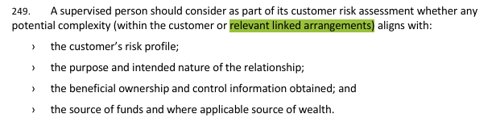
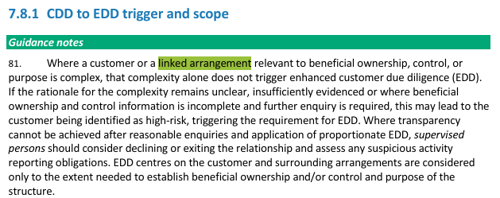
For this briefing, it is assumed that a LINKED ARRANGEMENT is the same as a SURROUNDING ARRANGEMENT, as also highlighted in 7.8.1, paragraph 8
- The JFSC explicitly acknowledged industry feedback on inconsistent terminology (“customer”, “customer structure”, “structure”) in its March 2026 Feedback Paper (Section 2.3).
- It confirmed that the scope of “customer” is a broader issue that has implications beyond the complex-structures workstream and will be addressed separately in the wider Handbook framework at a later date.
- Section 2.2 “Section 4: - Sub-heading: “What we did not change and why” Point 2
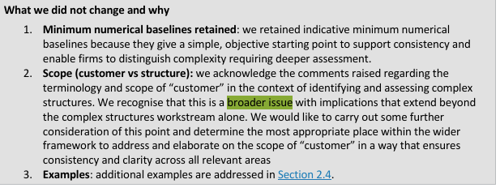
- JFSC SAYS:
- WE [THE JFSC] ACKNOWLEDGE
- The comments raised regarding the terminology and scope of ‘customer’ in the context of identifying and assessing complex structures.
- WE [THE JFSC] RECOGNISE
- that this is a broader issue with implications that extend beyond the complex structures workstream alone.
- WE [THE JFSC] WOULD LIKE TO
- Carry out some further consideration of this point and determine the most appropriate place within the wider framework to address and ELABORATE ON THE SCOPE OF ‘CUSTOMER’ in a way that ensures consistency and clarity across all relevant areas.”
- WE [THE JFSC] ACKNOWLEDGE
A PROBLEM OF AMBIGUITIES AND COMPLIANCE CHALLENGES
- The JFSC Terminology Issue in Sections 4.8 and 7.8 of the AML/CFT/CPF Handbook (effective 31 May 2026) creates practical ambiguities and compliance challenges when firms apply
- The JFSC three-tier controllers test (the FATF-derived sequential test from Handbook Section 4 for identifying beneficial owners/controllers of legal persons/arrangements).
- Annual Registry Confirmations, and
- Annual Supervisory Risk Data Collection [SRDC] Submissions
IMPACT ON THE THREE-TIER CONTROLLERS TEST, ANNUAL REGISTRY CONFIRMATIONS, AND SRDC SUBMISSIONS
JFSC Three-Tier Controllers Test Quick Context
- The test (Handbook Section 4) is applied to the customer (legal person/arrangement entering the relationship) to identify natural-person controllers:
- Tier 1 Material ownership/control (shares/voting or other ownership means).
- Tier 2 Control through other (non-ownership) means.
- Tier 3 Control via positions held (e.g., senior management with strategic/executive powers).
- Firms must “drill down” until natural persons are identified; the test is risk-based and evidence-driven.
- Focuses on identifying complex structures and applying proportionate mitigating measures where the structure is not high-risk; it primarily uses “CUSTOMER” language.
- Applies only where complexity contributes to a high-risk assessment (e.g., remaining opaque or lacking a legitimate purpose after SDD);
- It introduces/cross-references “LINKED ARRANGEMENTS” (interconnected entities, sub-structures, trusts, SPVs, pooled relationships, etc.).
- The 2026 updates split the guidance, clarified that complexity alone does not trigger high risk/EDD, and adjusted wording for Jersey-typical structures. Yet, the inconsistent terminology remains the highlighted gap.
- Section 4.8 (SDD)
- Section 7.8 (EDD)
SPECIFIC DIFFICULTIES WHEN APPLYING THE THREE-TIER TEST
The mismatch forces firms to interpret whether (and how far) the test extends beyond the direct “customer”:
- Scope/Definition Ambiguity
- Firms must decide if the test applies only to the named customer or must also extend [chain] to “linked arrangements.”
- This is unclear in multi-layered Jersey structures (e.g., trust as customer with underlying SPVs or pooled vehicles).
- Over- or under-application risks incomplete BO identification or unnecessary work.
- Chaining/Drill-Down Challenges
- How many layers require separate testing?
- Whether controllers identified in one part automatically cover linked parts. Especially problematic for funds, trusts, and wealth structures.
- The sequential test (“drill down until individuals are identified”) encounters extra layers in linked arrangements.
- Firms struggle to determine:
- Inconsistent Risk Assessment & SDD vs EDD Boundary
- Uncertainty on when the test must be refreshed and whether linked arrangements automatically elevate risk (they do not, but proving this requires clear scoping).
- Firms risk either disproportionate EDD or missing risks in opaque linked parts.
- Compliance, Operational & Examination Risks
- JFSC examinations and Registry notifications expect consistent application.
- Extra documentation burden for TCSPs/fund administrators.
- Impacts sanctions screening and ongoing monitoring.
- Undermines the intended risk-based proportionality.
DIFFICULTIES FOR ANNUAL REGISTRY DATA SUBMISSIONS (MYREGISTRY CONFIRMATION)
- Jersey entities must submit an annual confirmation statement confirming accurate BOs, controllers, and significant persons for the registered entity (under the Financial Services (Disclosure and Provision of Information) (Jersey) Law 2020 and related laws). Changes must be notified within 21 days.
- The three-tier test is the common methodology for both AML CDD and Registry disclosure. However, the terminology split exposes gaps when mapping AML-derived information (customer-centric) into Registry obligations (entity-centric):
- Registry expects data only for the registered entity, yet AML guidance may require linked-arrangement analysis to identify ultimate controllers.
- Doubt arises on which controllers to confirm.
- Firms struggle to determine how far to drill down across linked entities before confirming Registry data.
- EDD involving linked arrangements may produce more nuanced controller information, yet the confirmation is a binary “accurate/up-to-date” statement.
- This creates documentation challenges and inconsistencies between AML files and Registry data.
- Reconciliation burden, resource strain (especially for TCSPs), change-notification pressure, and examination/penalty exposure increase post-31 May 2026.
- Scope Ambiguity
- Chaining Inconsistencies in Multi-Layered Structures
- SDD/EDD Boundary Issues Affecting Disclosure
- Operational & Timing Risks
DIFFICULTIES FOR SRDC DATA SUBMISSIONS
- The SRDC is an aggregated, statistical, non-identifying return used for supervisory risk modelling and NRAs. It requests quantitative metrics on the customer base (e.g., number of high-risk customers with complex BO/UBO structures, PEP-involved structures, higher-risk geographic links), not individual names.
- The terminology issue amplifies interpretation challenges when translating detailed CDD analysis into clean aggregated metrics:
- When counting customers with complex BO/UBO structures, firms must decide whether to assess complexity only at the direct customer level (4.8) or include linked arrangements (7.8). This risks inflating/understating high-risk tallies.
- The gap affects drill-down depth for geographic/PEP risk data points, leading to portfolio-wide variability and potential JFSC questions.
- The decision on whether linked arrangements trigger high-risk classification directly drives SRDC “high-risk bucket” numbers.
- Inconsistent Scoping of “Complex Structures”
- Three-Tier Test Application for Risk Categorisation –
- SDD vs EDD Boundary Affecting High-Risk Counts
- Operational, Consistency & Examination Risks
- Data reconciliation burden and extra policy decisions.
- Potential distortion of JFSC risk models/NRAs.
- Cross-check exposure during supervisory reviews.
- Transitional errors in 2027+ cycles.
PRACTICAL RECOMMENDATIONS FOR FIRMS
- Update policies/procedures before 31 May 2026 to explicitly document scoping of “customer” vs “linked arrangements” for
- The three-tier test,
- Registry confirmations, and
- SRDC aggregation.
- Conduct a gap analysis of complex-structure portfolios.
- Ensure robust rationales and audit trails for all scoping decisions.
- Align AML CDD records with Registry data and SRDC logic.
- Monitor JFSC FAQs, drop-in sessions, and the forthcoming wider Handbook review on “customer” scope.
- Test processes with sample data using the new wording.
CONCLUSION
- While the three-tier test is clear for a single “customer,” the unresolved “linked arrangement” boundary in Sections 4.8 and 7.8 forces extra firm-specific judgment and documentation when applying it across complex structures.
- This ambiguity is magnified when feeding AML-derived controller information into entity-centric Registry confirmations and aggregated SRDC risk statistics.
- Firms should treat the 31 May 2026 effective date as a prompt to strengthen their overall BO/controller identification framework.
- Proactive alignment will reduce compliance risk, examination exposure, and operational inefficiency while awaiting the JFSC’s wider terminology clarification.
SOURCES
- Please review the full feedback on the follow-up consultation: AML/CFT/CPF Handbook enhancements to complex structures.
- https://www.jerseyfsc.org/industry/consultations/feedback-on-follow-on-consultation-amlcftcpf-handbook-enhancements-to-complex-structures/
- 4.8 Assessing Complex Structures https://www.jerseyfsc.org/media/cevnoqcr/section-48.pdf
- 7.8 Complex high-risk structures = https://www.jerseyfsc.org/media/vovjnu3a/section-78.pdf
The Team
Meet the team of industry experts behind Comsure
Find out moreLatest News
Keep up to date with the very latest news from Comsure
Find out moreGallery
View our latest imagery from our news and work
Find out moreContact
Think we can help you and your business? Chat to us today
Get In TouchNews Disclaimer
As well as owning and publishing Comsure's copyrighted works, Comsure wishes to use the copyright-protected works of others. To do so, Comsure is applying for exemptions in the UK copyright law. There are certain very specific situations where Comsure is permitted to do so without seeking permission from the owner. These exemptions are in the copyright sections of the Copyright, Designs and Patents Act 1988 (as amended)[www.gov.UK/government/publications/copyright-acts-and-related-laws]. Many situations allow for Comsure to apply for exemptions. These include 1] Non-commercial research and private study, 2] Criticism, review and reporting of current events, 3] the copying of works in any medium as long as the use is to illustrate a point. 4] no posting is for commercial purposes [payment]. (for a full list of exemptions, please read here www.gov.uk/guidance/exceptions-to-copyright]. Concerning the exceptions, Comsure will acknowledge the work of the source author by providing a link to the source material. Comsure claims no ownership of non-Comsure content. The non-Comsure articles posted on the Comsure website are deemed important, relevant, and newsworthy to a Comsure audience (e.g. regulated financial services and professional firms [DNFSBs]). Comsure does not wish to take any credit for the publication, and the publication can be read in full in its original form if you click the articles link that always accompanies the news item. Also, Comsure does not seek any payment for highlighting these important articles. If you want any article removed, Comsure will automatically do so on a reasonable request if you email info@comsuregroup.com.


As well as owning and publishing Comsure's copyrighted works, Comsure wishes to use the copyright-protected works of others. To do so, Comsure is applying for exemptions in the UK copyright law. There are certain very specific situations where Comsure is permitted to do so without seeking permission from the owner. These exemptions are in the copyright sections of the Copyright, Designs and Patents Act 1988 (as amended)[www.gov.UK/government/publications/copyright-acts-and-related-laws]. Many situations allow for Comsure to apply for exemptions. These include 1] Non-commercial research and private study, 2] Criticism, review and reporting of current events, 3] the copying of works in any medium as long as the use is to illustrate a point. 4] no posting is for commercial purposes [payment]. (for a full list of exemptions, please read here www.gov.uk/guidance/exceptions-to-copyright]. Concerning the exceptions, Comsure will acknowledge the work of the source author by providing a link to the source material. Comsure claims no ownership of non-Comsure content. The non-Comsure articles posted on the Comsure website are deemed important, relevant, and newsworthy to a Comsure audience (e.g. regulated financial services and professional firms [DNFSBs]). Comsure does not wish to take any credit for the publication, and the publication can be read in full in its original form if you click the articles link that always accompanies the news item. Also, Comsure does not seek any payment for highlighting these important articles. If you want any article removed, Comsure will automatically do so on a reasonable request if you email info@comsuregroup.com.