




 Published on : 10/06/2026
JFSC - Two important updates - Period: May 27 – June 4/5, 2026
Two important updates
- MAY 27 =
- Publication of detailed feedback from the 2025 thematic examination on Suspicious Activity Reporting (SAR).
- This is a significant compliance output responding to the 2024 MONEYVAL evaluation.
- Overall findings were positive (4 of 9 firms had zero findings), but clear areas for improvement were identified across the supervised population.
- JUNE 4/5 =
- Regulatory simplification programme launches (5 June). On 5 June 2026, the Jersey Financial Services Commission (JFSC) launched its Regulatory Simplification Programme.
- This is a key initiative under the JFSC's 2026/27 business plan and marks a deliberate shift to make the regulatory framework easier to access, understand, and apply consistently.
- The programme supports the JFSC's objective of helping the industry grow through a more risk-based, proportionate approach. It does not reduce regulatory standards; rather, it aims to remove unnecessary complexity and improve usability. In this update, 7 guidance notes were updated, and 3 were retired.
- The most notable update in the 7 guidance notes was:-
- Compliance Monitoring – the 2013 guidance has been updated and enhanced to help firms better design and contextualise their compliance monitoring plans, including practical examples drawn from recent JFSC thematic examinations.
These matters are highlighted below.
NO1 - important updates - Feedback from 2025 Suspicious Activity Reporting (SAR) Thematic Examination (27 May 2026) – Key Compliance Update
- Overview: This industry update provides the formal feedback from the JFSC's 2025 thematic examination of SAR obligations. It directly addresses a Recommended Action from Jersey's 2024 MONEYVAL Mutual Evaluation Report to strengthen the identification and timely reporting of suspicious activity to the FIU Jersey.
- Scope: Nine supervised persons were examined against their obligations under the Money Laundering (Jersey) Order 2008 and the AML/CFT/CPF Handbook.
- Overall Results: Good level of compliance overall. Four out of nine firms received no findings. The remaining five firms had findings and have been required to submit formal remediation plans (with actions and timescales) to their supervisors.
- Sources
Main Areas of Deficiency Identified:
- Policies and procedures not kept up to date with current requirements (one of the most common issues).
- Weaknesses in SAR registers and record-keeping.
- Shortcomings in the MLRO's role, independence, and resources.
- Inadequate board oversight of the timeliness of MLRO reporting.
- Gaps in ongoing training for the MLRO.
- Insufficient compliance monitoring and testing of SAR systems and controls.
Good Practices Highlighted (for firms to adopt):
- Regular, detailed MLRO reports to the Board on SAR volumes, timeliness, and trends, with clearly documented scrutiny in Board minutes and a feedback loop.
- Up-to-date, comprehensive policies covering internal SAR (iSAR) processes, tipping-off controls, and escalation.
- Complete and easily retrievable SAR registers and supporting records (including dates, rationale for decisions, and customer/transaction details).
- Clear MLRO job descriptions, regular oversight meetings, documented conflict management, and sufficient authority/resources for the MLRO.
- Tailored, role-specific training for all staff on suspicion identification and for MLROs on iSAR handling, FIU liaison, and production orders.
- Regular testing of SAR systems/controls with results and remediation plans reported to the Board.
Key Reminders:
- Failing to report knowledge or suspicion of money laundering or terrorist financing is a criminal offence.
- Internal SARs must be raised as soon as practicable, with the MLRO assessing and filing external SARs promptly.
- Robust controls to prevent tipping-off are essential.
NO2 - IMPORTANT UPDATE - Regulatory Simplification Initiative (5 June 2026)
- https://www.jerseyfsc.org/news-and-events/we-re-simplifying-our-regulatory-framework-to-support-growth/
- https://www.jerseyfsc.org/industry/simplifying-our-regulatory-framework/
2A – FOUR REGULATORY SIMPLIFICATION INITIATIVE (5 JUNE 2026)
- New Principles for Regulatory Materials ("HOW THE JFSC WRITE ITS RULES")
- The JFSC has introduced clear standards for drafting all future regulatory publications.
- These standards will apply going forward to guidance notes, codes, and other regulatory documents.
- https://www.jerseyfsc.org/industry/simplifying-our-regulatory-framework/how-we-write-our-rules/
- New Consultation Charter
- A dedicated charter has been published that sets out what industry and stakeholders can expect when the JFSC consults on regulatory proposals.
- This aims to improve transparency, consistency, and the quality of engagement during consultations.
- https://www.jerseyfsc.org/industry/simplifying-our-regulatory-framework/consultation-charter/
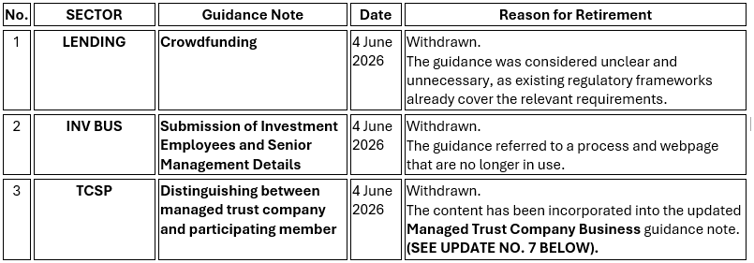
- Retirement of Three Guidance Notes
- Three guidance notes that are no longer relevant have been formally retired and removed from the framework.
https://www.jerseyfsc.org/industry/simplifying-our-regulatory-framework/guidance-note-changes/
- Updates to Seven Guidance Notes
- The JFSC has revised seven existing guidance notes. These updates do not introduce any new code requirements or obligations.
- They are purely clarification and housekeeping exercises.
- https://www.jerseyfsc.org/industry/simplifying-our-regulatory-framework/guidance-note-changes/
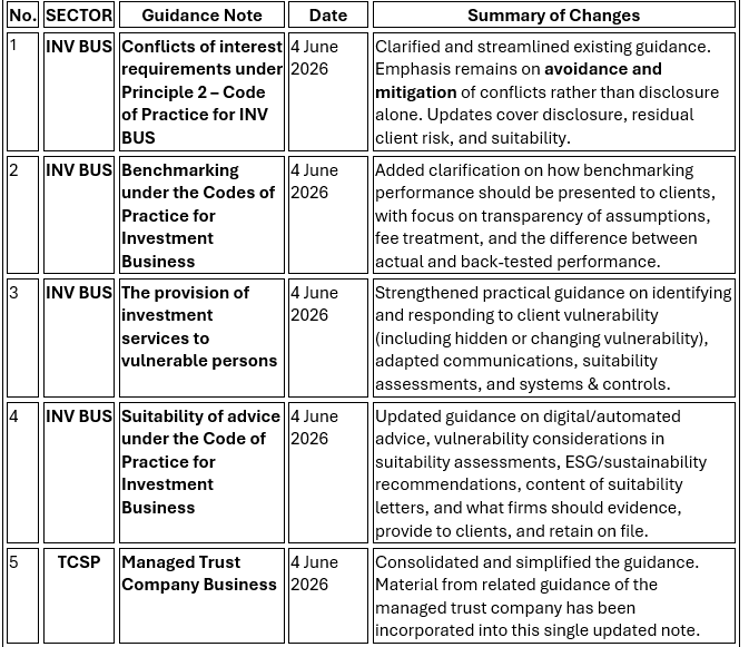
SOURCE FOR
- Conflicts of interest requirements under Principle 2 of the Code of Practice for investment business =
- Benchmarking under the Codes of Practice for investment business =
- The provision of investment services to vulnerable persons =
- Suitability of advice under the Code of Practice for investment business =
- Distinguishing between managed trust company and participating member =
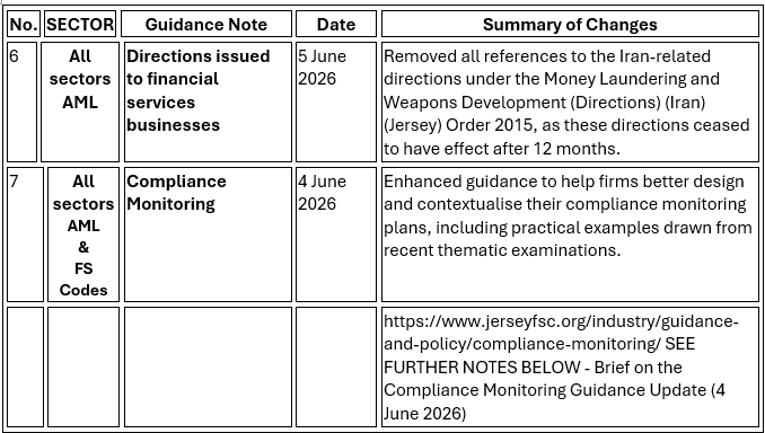
SOURCES FOR
- WMD Directions issued to financial services businesses =
- Compliance Monitoring guidance on 4 June 2026 =
2B = BRIEF ON THE COMPLIANCE MONITORING GUIDANCE UPDATE (4 JUNE 2026)
- The JFSC updated its Compliance Monitoring guidance on 4 June 2026. This is the main guidance note for Jersey-regulated firms on designing and maintaining a Compliance Monitoring Plan (CMP).
- https://www.jerseyfsc.org/industry/guidance-and-policy/compliance-monitoring/
- It is an enhancement (not a brand-new document). The original guidance dated back to 2013; the 2026 version makes it significantly more practical.
Why the Update Was Made
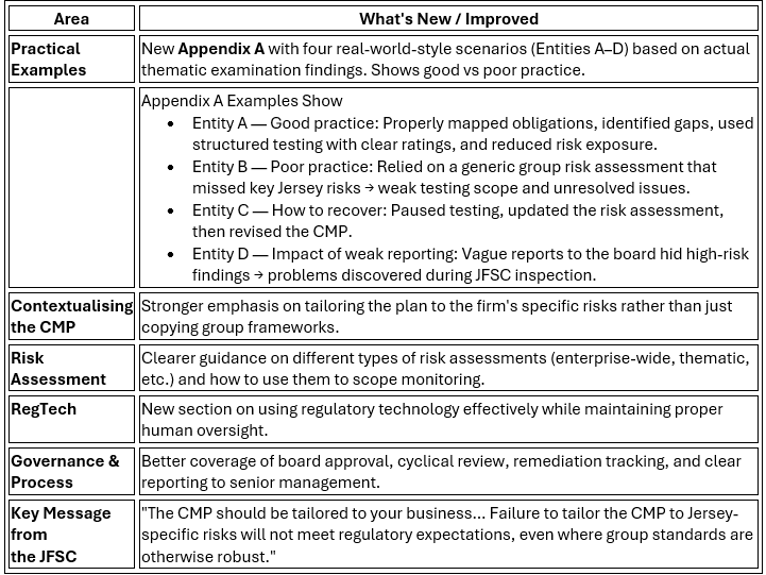
- The JFSC wanted to help firms better design and contextualise their compliance monitoring plans.
- Many firms (especially those in groups) were using generic or group-level plans that did not properly reflect Jersey-specific risks.
- The JFSC's recent thematic reviews identified recurring weaknesses in this area.
Key Changes & Enhancements
END
The Team
Meet the team of industry experts behind Comsure
Find out moreLatest News
Keep up to date with the very latest news from Comsure
Find out moreGallery
View our latest imagery from our news and work
Find out moreNews Disclaimer
As well as owning and publishing Comsure's copyrighted works, Comsure wishes to use the copyright-protected works of others. To do so, Comsure is applying for exemptions in the UK copyright law. There are certain very specific situations where Comsure is permitted to do so without seeking permission from the owner. These exemptions are in the copyright sections of the Copyright, Designs and Patents Act 1988 (as amended)[www.gov.UK/government/publications/copyright-acts-and-related-laws]. Many situations allow for Comsure to apply for exemptions. These include 1] Non-commercial research and private study, 2] Criticism, review and reporting of current events, 3] the copying of works in any medium as long as the use is to illustrate a point. 4] no posting is for commercial purposes [payment]. (for a full list of exemptions, please read here www.gov.uk/guidance/exceptions-to-copyright]. Concerning the exceptions, Comsure will acknowledge the work of the source author by providing a link to the source material. Comsure claims no ownership of non-Comsure content. The non-Comsure articles posted on the Comsure website are deemed important, relevant, and newsworthy to a Comsure audience (e.g. regulated financial services and professional firms [DNFSBs]). Comsure does not wish to take any credit for the publication, and the publication can be read in full in its original form if you click the articles link that always accompanies the news item. Also, Comsure does not seek any payment for highlighting these important articles. If you want any article removed, Comsure will automatically do so on a reasonable request if you email info@comsuregroup.com.
Archived News
To find our older articles, please click here.
View archive

To find our older articles, please click here.