




 Published on : 07/09/2026
JFSC Our approach to enforcement — 3 September 2026 revision (numbering issue may change this update!!)
On 3 September 2026, the JFSC revised our approach to enforcement so that, when it fines a firm, the public statement will show the Steps 1–8 intermediate figure, say whether Step 9 reduced it to the legal maximum, explain any later adjustment or settlement where relevant, and then state the final penalty. Investigation, sanction selection, appeal and settlement policy are otherwise the same. The change is about how the number is explained, not how the power is exercised.
The 3 September revision inserts new paragraphs 31–33. Subsequent paragraphs on criminal referrals, assistance to other agencies, and DPAs are renumbered 34–40. The rest of the note is unchanged in substance.
This is a disclosure change in public statements about the firm's civil financial penalties. It is not a rewrite of investigation powers, the decision-making process, settlement policy, or the penalty methodology itself.
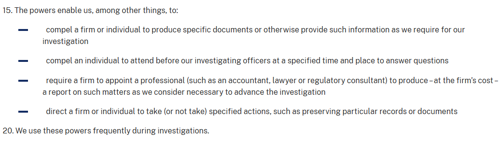
Please note that there is a numbering oddity in the powers section (items after paragraph 15 jump to “20”).
What was added
Paragraphs 30–33 now sit together as follows.
Paragraph 30 (unchanged policy): When the JFSC imposes a civil financial penalty, restricts an individual, or revokes a licence, it issues a public statement setting out the reasons. Purpose: transparency, so others can evaluate their own conduct.
Paragraph 31 (new): Where a civil financial penalty is imposed on a firm, the accompanying public statement will give a concise explanation of how the final penalty was reached.
Paragraph 32 (new): The calculation path is described as:
Steps 1–8 — average annual turnover, seriousness of the contraventions, and other relevant matters → an intermediate figure
Step 9 — that figure is checked against the maximum permitted by law
Later methodology steps and the effect of settlement are then applied
Only then is the final penalty determined
Paragraph 33 (new): The public statement will:
Disclose the Steps 1–8 intermediate figure
Explain whether it was reduced at Step 9
Where relevant, explain how any later adjustment or settlement affected the final amount
State the final civil financial penalty
Details will depend on the circumstances of the case.
Scope — read the wording tightly
The new disclosure duty is expressly limited to a penalty on a firm.
Paragraph 30 still covers public statements for penalties, individual restrictions and licence revocations.
Paragraphs 31–33 do not say that the same step-by-step penalty arithmetic will be published for individuals. Do not assume it will be, unless a later revision or the natural-persons methodology says so.
Paragraph 29 is unchanged: the amount is still determined using the published methodology. This note does not replace that methodology.
What has not changed
The rest of the note remains the existing enforcement architecture:
Guiding principles: public financial-loss risk, Jersey’s reputation and integrity, countering financial crime.
Objectives: deterrence, control or removal of unacceptable risk, raising standards, preventing gain from non-compliance.
Supervision-led remediation first; Enforcement referral where serious misconduct appears.
Opening an investigation is not a finding of misconduct.
Parallel investigation of firms and relevant individuals “in the round”.
Statutory investigation powers (information, compelled interviews, skilled-person reports, directions).
The decision-making process applies unless the matter is in settlement.
Appeal to the Royal Court on unreasonableness having regard to all the circumstances.
Settlement only where misconduct is acknowledged and settlement is consistent with guiding principles and enforcement objectives.
Sanctions: public censure, civil financial penalty (firm or individual), restriction/prohibition of an individual, licence revocation.
Criminal referrals and cross-border assistance unchanged.
DPA point unchanged: a DPA, judgment or statement of facts is not, by itself, a substitute for a JFSC investigation.
How to read a future public statement
From this revision, a firm penalty statement should allow a reader to separate four things:
Steps 1–8 intermediate figure — working number after turnover, seriousness and other Step 1–8 factors. Not the legal penalty.
Step 9 cap — whether the working number was cut because it exceeded the statutory maximum.
Later adjustment and/or settlement — only “where relevant”.
Final penalty imposed — the figure that matters legally.
If the intermediate figure is much higher than the final figure, that will now be visible. That is the main practical change.
The JFSC has not promised a fully worked annex, every percentage at every step, or the same depth in every case.
Implications
Boards and communications. Treat the intermediate figure as an assessed-seriousness signal, not as “the fine the JFSC wanted and then watered down”. Step 9 is a legal ceiling check. Settlement and later steps are separate.
Settlement strategy. More of the path to the number may become public. That can cut both ways: early settlement may still reduce the payable amount, but the pre-settlement working figure may still appear. Parties should assume less ability to keep the calculation path opaque.
Benchmarking. Peer comparison should become slightly more useful, provided users do not compare a Steps 1–8 figure in one case with a final settled figure in another.
Individuals. No equivalent disclosure commitment is stated here. Do not brief as if individual penalties will be unpacked the same way.
Separate workstream. Earlier in 2026, the JFSC consulted on amendments to the registered persons methodology (including statutory maxima for Bands 1, 2 and 2A; Band 3 uncapped). That is not this revision. Do not conflate methodology reform with this public-statement wording.
END – SOURCES
Document: Our approach to enforcement
Issued: 16 April 2024
Last revised: 3 September 2026
Trigger notice: Industry update, 4 September 2026 — “Update to how we describe civil financial penalties”
Primary sources to verify:
https://www.jerseyfsc.org/news-and-events/update-to-how-we-describe-civil-financial-penalties/
https://www.jerseyfsc.org/industry/guidance-and-policy/our-approach-to-enforcement/
https://www.jerseyfsc.org/news-and-events/update-to-how-we-describe-civil-financial-penalties/
https://www.jerseyfsc.org/industry/guidance-and-policy/our-approach-to-enforcement/
The Team
Meet the team of industry experts behind Comsure
Find out moreLatest News
Keep up to date with the very latest news from Comsure
Find out moreGallery
View our latest imagery from our news and work
Find out moreNews Disclaimer
As well as owning and publishing Comsure's copyrighted works, Comsure wishes to use the copyright-protected works of others. To do so, Comsure is applying for exemptions in the UK copyright law. There are certain very specific situations where Comsure is permitted to do so without seeking permission from the owner. These exemptions are in the copyright sections of the Copyright, Designs and Patents Act 1988 (as amended)[www.gov.UK/government/publications/copyright-acts-and-related-laws]. Many situations allow for Comsure to apply for exemptions. These include 1] Non-commercial research and private study, 2] Criticism, review and reporting of current events, 3] the copying of works in any medium as long as the use is to illustrate a point. 4] no posting is for commercial purposes [payment]. (for a full list of exemptions, please read here www.gov.uk/guidance/exceptions-to-copyright]. Concerning the exceptions, Comsure will acknowledge the work of the source author by providing a link to the source material. Comsure claims no ownership of non-Comsure content. The non-Comsure articles posted on the Comsure website are deemed important, relevant, and newsworthy to a Comsure audience (e.g. regulated financial services and professional firms [DNFSBs]). Comsure does not wish to take any credit for the publication, and the publication can be read in full in its original form if you click the articles link that always accompanies the news item. Also, Comsure does not seek any payment for highlighting these important articles. If you want any article removed, Comsure will automatically do so on a reasonable request if you email info@comsuregroup.com.
Archived News
To find our older articles, please click here.
View archive

To find our older articles, please click here.