




 Published on : 15/06/2026
JFSC Issue 10: Red Flags Every Estate Agent (and other AML-regulated firms) Should Know
The JFSC has issued 10 Key Warning Signs for Anti-Money Laundering Compliance in Jersey.
This is a practical summary briefing based on guidance issued by the Jersey Financial Services Commission (JFSC).
For full regulatory requirements, refer to the JFSC AML/CFT Handbook and applicable legislation.
- This briefing summarises 10 critical red flags that Estate Agents (and other AML-regulated firms, eh lawyers, TCSPs, accountants) in Jersey must be alert to when conducting property transactions.
- Recognising these warning signs helps fulfil your AML/CFT/CPF obligations and protects both your firm and Jersey's reputation as a well-regulated jurisdiction.
- If something feels off, escalate immediately to your Money Laundering Reporting Officer (MLRO).


10 Red Flags Every Estate Agent Should Know
- Pressure to complete quickly — Watch out for unnecessary urgency, especially when there's resistance to standard AML checks or documentation.
- Pushback on routine AML questions — Comments like "this is Jersey, everyone knows everyone" or "my lawyer already has this" are used to discourage questioning.
- Source of funds explanations that change — Be aware of different explanations over time or inconsistencies between what is said and what is documented.
- Third-party funds with no clear connection — Question funds coming from family members, business partners, trusts, or companies without a clear and logical link to the buyer.
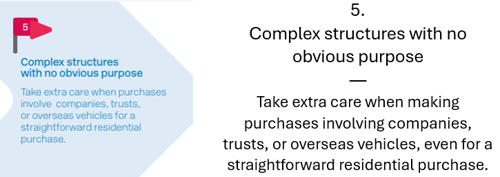
- Complex structures with no obvious purpose — Take extra care when purchases involve companies, trusts, or overseas vehicles for a straightforward residential purchase.
- Property value does not align with the buyer profile — Be aware. The value of the property should be consistent with the buyer's income, occupation, or stated wealth.
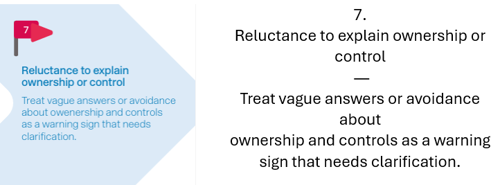
- Reluctance to explain ownership or control — Treat vague answers or avoidance about ownership and control as a warning sign that needs clarification.
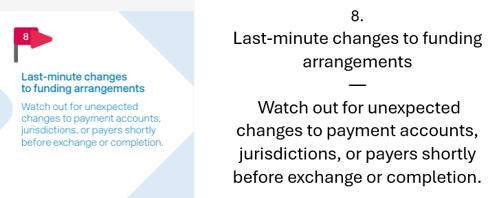
- Last-minute changes to funding arrangements — Watch out for unexpected changes to payment accounts, jurisdictions, or payers shortly before exchange or completion.
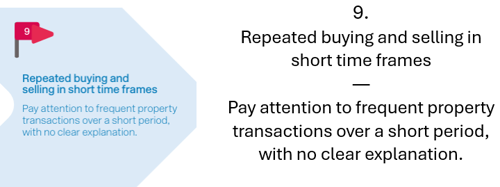
- Repeated buying and selling in short time frames — Pay attention to frequent property transactions over a short period, with no clear explanation.
- Attempts to avoid internal escalation — Be cautious if someone insists on dealing with only one staff member or avoids compliance teams, managers, or MLROs.
IF IN DOUBT, ESCALATE! If something feels off, don't hesitate. Report it immediately to your Money Laundering Reporting Officer (MLRO).
This is a practical summary briefing based on guidance issued by the Jersey Financial Services Commission (JFSC).
For full regulatory requirements, refer to the JFSC AML/CFT Handbook and applicable legislation.
Source
The Team
Meet the team of industry experts behind Comsure
Find out moreLatest News
Keep up to date with the very latest news from Comsure
Find out moreGallery
View our latest imagery from our news and work
Find out moreNews Disclaimer
As well as owning and publishing Comsure's copyrighted works, Comsure wishes to use the copyright-protected works of others. To do so, Comsure is applying for exemptions in the UK copyright law. There are certain very specific situations where Comsure is permitted to do so without seeking permission from the owner. These exemptions are in the copyright sections of the Copyright, Designs and Patents Act 1988 (as amended)[www.gov.UK/government/publications/copyright-acts-and-related-laws]. Many situations allow for Comsure to apply for exemptions. These include 1] Non-commercial research and private study, 2] Criticism, review and reporting of current events, 3] the copying of works in any medium as long as the use is to illustrate a point. 4] no posting is for commercial purposes [payment]. (for a full list of exemptions, please read here www.gov.uk/guidance/exceptions-to-copyright]. Concerning the exceptions, Comsure will acknowledge the work of the source author by providing a link to the source material. Comsure claims no ownership of non-Comsure content. The non-Comsure articles posted on the Comsure website are deemed important, relevant, and newsworthy to a Comsure audience (e.g. regulated financial services and professional firms [DNFSBs]). Comsure does not wish to take any credit for the publication, and the publication can be read in full in its original form if you click the articles link that always accompanies the news item. Also, Comsure does not seek any payment for highlighting these important articles. If you want any article removed, Comsure will automatically do so on a reasonable request if you email info@comsuregroup.com.
Archived News
To find our older articles, please click here.
View archive

To find our older articles, please click here.