




 Published on : 30/06/2026
JFSC Handbook update: changes to Section 2.6 (MLCO)
The JFSC has updated Section 2.6 of the AML/CFT/CPF Handbook to
- Reflect recent changes to this chapter, which we recently communicated, in line with updates to the Money Laundering (Jersey) Order 2008.
THE JFSC SAYS
- The live version of the Handbook now includes these changes, which take effect immediately.
- Reggie, the regulatory chatbot, has also been updated to reflect the new requirements.
- They have fixed editing errors flagged within the Handbook.
- Added the archived version of the Handbook to our website.
Some additional changes to the Order are not yet reflected in the Handbook, including:
- The introduction of a risk-based approach to appointing an MLCO – this will be available from 31 October 2026, once the Handbook is updated
- Changes to the Reliance framework – these are already in the Order and will also take effect from 31 October 2026
These further updates will be subject to consultation, details of which will be published in early July.
Summary of Substantive (Not Just Stylistic) Changes
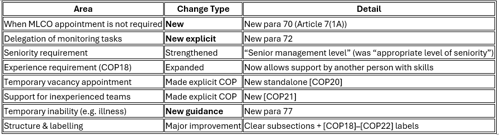
To support the above, here are substantive Legal and Operational Changes
(New version effective 30 June 2026 vs archived version effective 1 September 2023)
Only changes that alter legal obligations, create new duties, raise standards, or provide new operational flexibility are listed below.
- New exception to the obligation to appoint an MLCO (new paragraph 70 – Article 7(1A))
- The new version introduces a statutory exception:
- a supervised person is not required to appoint an MLCO if,
- Based on the size of the financial services business and
- Its money laundering risk,
- Such an appointment is considered inappropriate.
- Any such determination must be made by reference to the relevant Code of Practice. This provision did not exist in the archived version.
- However, there is no size threshold
- The absence of a bright-line threshold is intentional — it gives flexibility but requires firms to think carefully and document their position.
- If your firm is considering relying on this exception, the key document to review alongside section 2.6 is your own business risk assessment and the governance expectations in the rest of the Handbook.
- Explicit permission to delegate monitoring tasks (new paragraph 72 – Article 7(3) and (3A))
- The MLCO remains responsible for monitoring compliance. Still, the new version expressly states that this responsibility may be fulfilled by delegating the monitoring tasks to another person for support or execution.
- The archived version did not contain this explicit delegation provision.
- Raised seniority requirement for the MLCO (new paragraph 71)
- The individual appointed as MLCO must now be at senior management level.
- The archived version only required "an appropriate level of seniority". This is a higher and more prescriptive threshold.
- Increased flexibility in the MLCO experience requirement (COP18)
- A supervised person may now appoint an MLCO who has sufficient experience and skills or is supported by a person with sufficient experience and skills.
- The archived version required the MLCO personally to "have sufficient experience and skills" with no alternative of support. This widens the options available, particularly for smaller or lower-risk entities.
- New standalone obligation to make temporary MLCO appointments ([COP20])
- Where the position of MLCO is expected to fall vacant, the supervised person must take action to appoint a member of the board (or other appropriate senior manager) temporarily to ensure the office is never vacant.
- While similar wording existed in the archived version, it is now a distinct, labelled Code of Practice requirement with clear mandatory language.
- New duty to support limited or inexperienced compliance resources ([COP21])
- Where temporary circumstances mean the supervised person has limited or inexperienced money laundering, terrorist financing or proliferation financing compliance resources, it must ensure that this resource is supported as necessary.
- This positive operational duty is new as a standalone Code of Practice.
- Extension of temporary appointment rules to cover temporary inability to act (new guidance note 77)
- The temporary appointment provisions in COP20 now expressly apply where the MLCO is temporarily unable to fulfil their responsibilities (for example, due to medical leave). The clarification and extension weren't in the archived version and have direct implications for business continuity and succession planning.
These are the only substantive legal or operational changes. All other differences are presentational, structural, or minor wording clarifications that do not alter obligations or requirements.
Here is a clear, direct comparison of the changes between the two versions.
- New version: Effective 30 June 2026 (paragraphs 65–77). Archived version: Effective 1 September 2023 (paragraphs 82–96)
- I have compared the full text of both. Below are the material changes, grouped for clarity.
1. Structural and Organisational Changes
- Complete renumbering of paragraphs (82–96 → 65–77).
- New version introduces clear, consistent subsection headings that the old version lacks:
- Statutory requirements (paraphrased wording)
- AML/CFT/CPF Codes of Practice (with explicit labels [COP18] to [COP22])
- Guidance notes
- The new version is much better organised and easier to navigate. The old version had fragmented numbering and repeated handbook header/footer text, which cluttered the extraction.
- New version references section 15 of the Handbook (para 65); old version references section 18 (para 82). The Handbook itself has been restructured.
2. Introductory Section (new 65–68 vs old 82, 83, 85)
- Core content is similar, but the new version is cleaner and more concise.
- New 68 combines and sharpens the conflict-of-interest / independent assessment point that was buried in old 85.
- Old version has a missing/garbled paragraph 84 and an empty-looking 91.
3. Statutory Requirements – Significant Expansion (new 69–74 vs old 86–89)
This is one of the biggest areas of change. The new version adds two entirely new paragraphs and strengthens others:
- New 70 (completely new): Introduces Article 7(1A) — the obligation to appoint an MLCO does not apply if, based on the size of the business and its money laundering risk, such an appointment is considered inappropriate. Any decision must be made by reference to the relevant Code of Practice.
- New 72 (new explicit provision): Article 7(3) and (3A) — the MLCO remains responsible for monitoring compliance but may delegate the actual monitoring tasks to another person for support or execution.
- New 71: Upgraded wording from old 87's "of an appropriate level of seniority" to the stronger and clearer "at senior management level".
- Notification rules (new 73–74) are broadly similar to old 88–89 but now sit in a clearer statutory context.
- Overall, the new version gives a much fuller picture of the statutory framework under the Money Laundering Order.
4. AML/CFT/CPF Codes of Practice (new [COP18]–[COP22] vs old 90, 92–94)
- New version explicitly labels the requirements as [COP18] to [COP22] (old version has no labels).
- [COP18] (new): Added the words "or be supported by a person with sufficient experience and skills" at the end. The old version (90) only said the MLCO must "have sufficient experience and skills".
- [COP19] (new): Same four requirements as old 92, but presented as a clean, properly introduced bulleted list.
- New [COP20] (standalone): Requires a supervised person to appoint a board member (or other appropriate senior manager) temporarily if the MLCO position is expected to fall vacant. (This text existed in old 92 but is now a distinct, labelled COP.)
- New [COP21]: Requirement to support a limited or inexperienced compliance resource (similar to old 93).
- New [COP22]: Considerations when the same person is appointed as both MLCO and MLRO (similar to old 94).
- The new structure makes the Codes of Practice far easier to reference and apply.
5. Guidance Notes (new 75–77 vs old 95–96)
- New 75 and 76 are very similar to old 95 and 96.
- New 77 (added): New guidance clarifying that the vacancy provisions in COP20 also apply where the MLCO is temporarily unable to fulfil their responsibilities (for example, due to medical leave). This practical point did not exist in the archived version.
6. Other Wording and Presentational Improvements (new version)
- More precise and modern language in several places (e.g. "senior management level", clearer bullet structure, better flow).
- Consistent and prominent references to deputy MLCO and compliance support staff in COP19.
- Removal of the repeated "Handbook for the prevention and detection…" header/footer lines that appeared throughout the old extraction.
- Slightly tighter and more professional drafting overall.
The 30 June 2026 version is a meaningful update.
It provides greater statutory clarity, introduces new practical requirements regarding temporary appointments and support for smaller teams, and significantly improves the readability and ease of reference of the Codes of Practice.
NEW 2.6 The MLCO Overview
65. The Money Laundering Order requires a supervised person or the supervised persons AMLSP, where applicable (see section 15 of this Handbook), to appoint an individual as MLCO, and tasks that individual with the responsibility for monitoring its compliance with Jersey legislation relating to money laundering, the financing of terrorism, and the financing of proliferation and AML/CFT/CPF Codes of Practice issued under the Supervisory Bodies Law. The objective of this requirement is to require supervised persons to clearly demonstrate how they ensure compliance with these requirements.
66. The Money Laundering Order also requires a supervised person to maintain adequate procedures for:
a. monitoring compliance with, and testing the effectiveness of, policies and procedures; and b. monitoring and testing the effectiveness of measures to raise awareness and training.
When considering the type and extent of compliance testing to be carried out, a supervised person shall have regard to the risk of money laundering, the financing of terrorism, and the financing of proliferation, and to matters that impact risk, such as the size and structure of the supervised person's business.
67. The MLCO may have a functional reporting line, e.g., to a group compliance function.
68. The Money Laundering Order does not rule out the possibility that the MLCO may also have other responsibilities. To the extent that the MLCO is also responsible for the development of systems and controls (and policies and procedures), as well as monitoring subsequent compliance with those systems and controls (and policies and procedures), some additional independent assessment of compliance will be needed from time to time to address this conflict of interest. Such an independent assessment is unlikely to be needed where the role of the MLCO is limited to actively monitoring the development and implementation of such systems and controls.
Corporate Governance This version is effective: 30 June 2026 (PUBLIC)
Statutory requirements (paraphrased wording)
69. Article 7 of the Money Laundering Order requires a relevant person or the relevant person's AMLSP, where applicable, to appoint a MLCO to monitor whether the enactments in Jersey relating to money laundering and the financing of terrorism and AML/CFT/CPF Codes of Practice are being complied with. The same person may be appointed as both MLCO and MLRO.
70. Article 7 (1A) of the Money Laundering Order requires that the obligation to appoint a compliance officer applies unless, based on the size of the financial services business and its money laundering risk, such an appointment is considered inappropriate. Any determination of appropriateness must be made by reference to the relevant Code of Practice.
71. Article 7(2A) of the Money Laundering Order requires a relevant person to ensure that the individual appointed is at senior management level and has timely access to all records that are necessary or expedient for the MLCO to carry out their monitoring responsibilities.
72. Article 7 (3) and (3A) of the Money Laundering Order require the MLCO to be responsible for monitoring compliance with Jersey’s anti-money laundering legislation and relevant Codes of Practice. This responsibility may be fulfilled by delegating the monitoring tasks to another person for support or execution.
73. Article 7(6) of the Money Laundering Order requires a relevant person to notify the JFSC in writing within one month when a person is appointed as, or ceases to be, a MLCO. However, Article 10 of the Money Laundering Order provides that the JFSC may grant exemptions from this notification requirement, by way of notice.
74. Article 7(9) of the Money Laundering Order recognises that a relevant person that is also a regulated person may have notified the JFSC of the appointment or cessation of a MLCO under other legislation. If so, a duplicate notification is not required under the Money Laundering Order.
AML/CFT/CPF Codes of Practice
[COP18] A supervised person must appoint an MLCO that:
- Subject to Article 9A (Appointment of AMLSP to fulfil obligations of relevant person) is employed by the supervised person or an enterprise in the same financial group as the supervised person;
- In the case of a supervised person that: carries on the business of being a functionary, recognized fund, or unclassified fund or is a Category B insurance permit holder, a managed bank, or managed entity (meaning a person carrying on regulated business that includes a managed trust company and an entity that is managed by a manager of a managed entity registered to carry on class ZK of fund services business); has no employees of its own; and is administered by a person carrying on a regulated business, it is acceptable for an employee of the administrator to be appointed by the supervised person as its MLCO;
- Is based in Jersey;
- In the case of a supervised person that is a Category A insurance business permit holder with no employees of its own in Jersey, it is acceptable to appoint an employee outside Jersey. In the case of a supervised person that is carrying on MVTS activity and has no employees of its own in Jersey, it is acceptable for the supervised person to appoint an employee outside Jersey as its MLCO, provided the employee is based in an equivalent jurisdiction; and
- Has sufficient experience and skills or be supported by a person with sufficient experience and skills.
[COP19] A supervised person must ensure that the MLCO:
- Has appropriate independence, in particular from customer-facing, business development and systems and controls development roles;
- Reports regularly and directly to the board and has a sufficient level of authority within the supervised person so that the board reacts to and acts upon reports made by the MLCO;
- Has sufficient resources, including sufficient time and (if appropriate) a deputy MLCO and compliance support staff;
- Is fully aware of both their and the supervised person’s obligations under the Anti-Money laundering and Counter-Terrorism Legislation and AML/CFT/CPF Codes of Practice issued under the Supervisory Bodies Law.
[COP20] If the position of MLCO is expected to fall vacant, to comply with the statutory requirement to have an individual appointed to the office of MLCO at all times, a supervised person must take action to appoint a member of the board (or other appropriate member of senior management) to the position on a temporary basis.
[COP21] If temporary circumstances arise where the supervised person has a limited or inexperienced money laundering, terrorist financing, proliferation financing compliance resource, it must ensure that this resource is supported as necessary.
[COP22] When considering whether it is appropriate to appoint the same person as MLCO and MLRO, a supervised person must have regard to:
- The respective demands of the two roles, taking into account the size and nature of the supervised person’s activities; and
- Whether the individual will have sufficient time and resources to fulfil both roles effectively.
Guidance notes
75. A supervised person may demonstrate that its MLCO is monitoring whether enactments and AML/CFT/CPF Codes of Practice issued under the Supervisory Bodies Law are being complied with where they:
- Regularly monitor and test compliance with systems and controls (including policies and procedures) in place to prevent and detect money laundering, counter the financing of terrorism, and counter the financing of proliferation – supported as necessary by a compliance or internal audit function, or any other person;
- Report periodically, as appropriate, to the board on compliance with the supervised person’s systems and controls (including policies and procedures) and issues that need to be brought to its attention;
- Respond promptly to requests for information made by the JFSC and the FIU.
76. In a case where the MLCO is also responsible for the development of systems and controls (including policies and procedures) in line with evolving requirements, a supervised person may demonstrate that the MLCO has appropriate independence where such systems and controls are subject to periodic independent scrutiny.
77. Vacancy of MLCO as referred to in COP20 above may also apply in the event the MLCO is temporarily unable to fulfil his or her responsibilities, for example due to medical leave.
The Team
Meet the team of industry experts behind Comsure
Find out moreLatest News
Keep up to date with the very latest news from Comsure
Find out moreGallery
View our latest imagery from our news and work
Find out moreNews Disclaimer
As well as owning and publishing Comsure's copyrighted works, Comsure wishes to use the copyright-protected works of others. To do so, Comsure is applying for exemptions in the UK copyright law. There are certain very specific situations where Comsure is permitted to do so without seeking permission from the owner. These exemptions are in the copyright sections of the Copyright, Designs and Patents Act 1988 (as amended)[www.gov.UK/government/publications/copyright-acts-and-related-laws]. Many situations allow for Comsure to apply for exemptions. These include 1] Non-commercial research and private study, 2] Criticism, review and reporting of current events, 3] the copying of works in any medium as long as the use is to illustrate a point. 4] no posting is for commercial purposes [payment]. (for a full list of exemptions, please read here www.gov.uk/guidance/exceptions-to-copyright]. Concerning the exceptions, Comsure will acknowledge the work of the source author by providing a link to the source material. Comsure claims no ownership of non-Comsure content. The non-Comsure articles posted on the Comsure website are deemed important, relevant, and newsworthy to a Comsure audience (e.g. regulated financial services and professional firms [DNFSBs]). Comsure does not wish to take any credit for the publication, and the publication can be read in full in its original form if you click the articles link that always accompanies the news item. Also, Comsure does not seek any payment for highlighting these important articles. If you want any article removed, Comsure will automatically do so on a reasonable request if you email info@comsuregroup.com.
Archived News
To find our older articles, please click here.
View archive

To find our older articles, please click here.