




 Published on : 27/09/2026
JFSC Guidance for non-profit organisations and charities in Jersey
SEPTEMBER 25, 2026 - THE JFSC HAS PUBLISHED THE FOLLOWING GUIDANCE
What is the difference between an NPO and a charity?
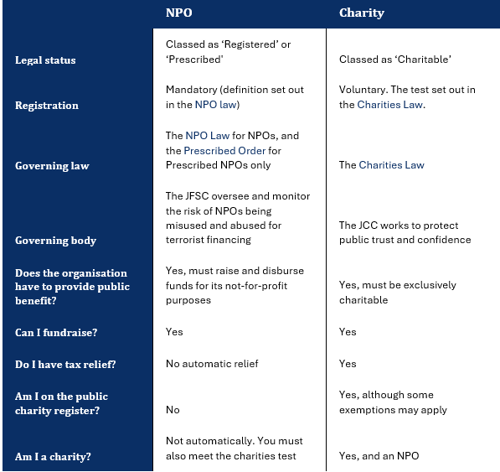
In Jersey, a non-profit organisation (NPO) and a charity are not the same in law, although the terms can overlap. All Charities are registered as NPOs, but not all NPOs are charities. The main differences lie in their purpose, legal status, and oversight.
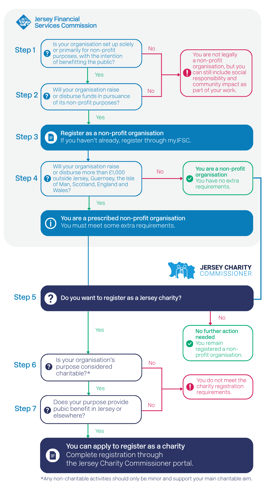
Follow the steps below to determine:
If your organisation is an NPO
If your NPO is classed as a Prescribed NPO
If you can register separately as a charity
Key differences
My organisation meets the definition of an NPO. What does this mean in practice?
You will need to register with us. Registration can be completed through myJFSC.
You will need to keep a financial record, provide certain information on request and notify us of any material changes to your NPO since registration.
Please then review step 4 of the flowchart to see if your NPO is also classed as a Prescribed NPO. If so, there are a few additional obligations to be aware of, as outlined in the next section.
My organisation is classed as a Prescribed NPO. What does this mean in practice?
If your NPO is classified as a Prescribed NPO, you have additional obligations set out in the Prescribed Order. These requirements are designed to formalise good governance practices that your organisation may already follow.
Here is a summary of the additional obligations:
Article 2: Prepare an annual financial statement. You do not need to send us a copy unless we ask. The level of detail should match the size and complexity of your NPO. For example, a large NPO may have a full audited statement, while a small NPO may only keep a list of income and spending.
Article 3: have suitable accounting systems and controls. The level of controls should match the size and complexity of your NPO. For example, a large NPO may use accounting software, while a small NPO may use a spreadsheet or written records.
Article 4: keep a record of owners and controllers so that you can identify and contact them (such as full name and address). You do not need to collect “due diligence” documents such as passports.
Article 5: keep a record of significant donors. This means anyone who has given £10,000 or more, or over 50% of their total donations in the last 12 months. Again, keep enough details to identify and contact them.
Article 6: Take reasonable steps to identify other NPOs and beneficiaries that you are working with and understand the nature of the relationship and any activities that they are carrying out on your behalf. This is about taking reasonable steps to verify their identity and ensure that your funds are being used as intended.
The only additional requirement is outlined in our NPO Handbook: your NPO must also have a risk appetite statement (RAS).
A RAS is a short document that explains the level and types of risks your NPO is willing to accept. You can find more details in Paragraph 26 of our NPO Handbook.
Prescribed NPOs are supervised by the JFSC on a risk-based approach, with more focus on those that may be at higher risk of being abused or misused for terrorist financing.
If you have any concerns about the above obligations, please get in touch with the NPO team at npoenquiries@jerseyfsc.org. We want to support your good work and are happy to discuss any questions that you may have.
My NPO would like to register as a charity. What should I consider?
If your NPO wants to register as a charity and meets the test under the Charities Law, it will obtain charitable status.
As a Jersey Charity, you will need to:
Have a written constitution
Submit an annual return, including providing copies of your financial statements
Follow the governance duties for charity governors
Meet the transparency and safeguarding requirements
Jersey charities are overseen by the Jersey Charities Commissioner (JCC), and details of all charities are available in the public register on the JCC's website.
Key considerations
The JFSC and JCC do not set rules about which legal form an NPO or Charity should take, but you may want to get legal advice before changing or setting up a new structure.
The NPO and charity registration processes are separate. Being an NPO does not mean your organisation can automatically register as a charity.
Registering as a charity is voluntary. However, you must register if you want to call your organisation a charity. It is an offence for a Jersey organisation to describe itself as a charity if it is not registered.
If your organisation does not meet the definition of an NPO or a charity, you can still incorporate a non-profit or social-enterprise element into your work.
Some examples of organisations that are not an NPO or a charity include:
Commercial businesses
Political parties
Closed membership groups, such as trade unions, parent-teacher groups, or professional associations
Culture groups, such as book clubs
Neighbourhood groups
Thrift clubs that are only for saving or have a gambling element
Definitions
Raising funds means funds given to the NPO, but does not include:
Income earned on the funds of the NPO
Amounts paid to the NPO by persons to become or remain members of the NPO
Disbursing funds means transferring money to a beneficiary to fulfil the organisation's objects. This does not include:
Funds paid by people to join or remain members of the NPO if those funds are used only for the benefit of members
Payments made for goods or services at an agreed price
SOURCE
The Team
Meet the team of industry experts behind Comsure
Find out moreLatest News
Keep up to date with the very latest news from Comsure
Find out moreGallery
View our latest imagery from our news and work
Find out moreNews Disclaimer
As well as owning and publishing Comsure's copyrighted works, Comsure wishes to use the copyright-protected works of others. To do so, Comsure is applying for exemptions in the UK copyright law. There are certain very specific situations where Comsure is permitted to do so without seeking permission from the owner. These exemptions are in the copyright sections of the Copyright, Designs and Patents Act 1988 (as amended)[www.gov.UK/government/publications/copyright-acts-and-related-laws]. Many situations allow for Comsure to apply for exemptions. These include 1] Non-commercial research and private study, 2] Criticism, review and reporting of current events, 3] the copying of works in any medium as long as the use is to illustrate a point. 4] no posting is for commercial purposes [payment]. (for a full list of exemptions, please read here www.gov.uk/guidance/exceptions-to-copyright]. Concerning the exceptions, Comsure will acknowledge the work of the source author by providing a link to the source material. Comsure claims no ownership of non-Comsure content. The non-Comsure articles posted on the Comsure website are deemed important, relevant, and newsworthy to a Comsure audience (e.g. regulated financial services and professional firms [DNFSBs]). Comsure does not wish to take any credit for the publication, and the publication can be read in full in its original form if you click the articles link that always accompanies the news item. Also, Comsure does not seek any payment for highlighting these important articles. If you want any article removed, Comsure will automatically do so on a reasonable request if you email info@comsuregroup.com.
Archived News
To find our older articles, please click here.
View archive

To find our older articles, please click here.