

JFSC Criminal background checks (CBCs) FAQs
30/03/2026
On 26 March 2026, the JFSC published these frequently asked questions (FAQs), which answer the questions the JFSC receive most often and may be updated over time.
INTRODUCTION
- The Jersey Financial Services Commission (JFSC) has finalised its policy on enhancements to criminal background checks for PPs and KPs following Consultation Paper No. 1 2025 and extensive industry feedback.
- The Feedback Paper was published on 27 November 2025, confirming a revised, more proportionate approach. These enhancements form part of updates to the AML/CFT/CPF Handbook (particularly section 10.6) and related guidance.
- A new consolidated AML/CFT/CPF Handbook, incorporating the criminal background check requirements (along with clarifications on complex structures), will take effect on 31 May 2026.
- draft consolidated AML/CFT/CPF Handbook – https://www.jerseyfsc.org/media/qa0c0xbm/amlcftcpf-handbook-effective-30-may-2026-subject-to-change.pdf
- The JFSC has also published Frequently Asked Questions (FAQs) on the enhanced checks, and drop-in sessions are available to support implementation.[as follows]
JFSC CRIMINAL BACKGROUND CHECKS (CBCS) FAQS BRIEFING
Two appendices support the following briefing
- Appendix 1 The Criminality Test under Article 14(4) Proceeds of Crime (Supervisory Bodies) (Jersey) Law 2008
- Appendix 2 Glossary
CBCS BACKGROUND
- What is the purpose of these FAQs?
- These FAQs support the guidance in the AML/CFT/CPF Handbook and clarify operational questions the JFSC have received.
- The JFSC intend to support industry in the effective implementation of criminal background checks (CBCs).
- Why is Jersey introducing CBCs?
- The JFSC are working with the Government of Jersey to deliver these enhancements as part of the national action plan.
- The CBC regime aligns Jersey with Financial Action Task Force (FATF) standards. It enhances the island's ability to prevent criminals or their associates from owning, controlling, or influencing supervised businesses.
- Further, Jersey's 2023–2024 MONEYVAL Mutual Evaluation Report identified a Priority Action requiring enhanced background checks for beneficial owners, controllers, Principal Persons (PPs), and Key Persons (KPs).
- Who is subject to the new CBC regime?
- The CBC regime applies to all PPs and KPs as defined in the Proceeds of Crime (Supervisory Bodies) (Jersey) Law 2008 (SBJL).
- Guidance in the AML/CFT/CPF Handbook clarifies specific cases, such as limited partnerships, unit trusts and other entities.
- Who is responsible for obtaining CBCs?
- All supervised persons, including Schedule 2 businesses, are expected to obtain criminal records checks for their PPs and KPs.
- Where can I find the new requirements for the CBC regime?
- The scope and requirements of the CBC regime are in the AML/CPF/CFT Handbook (31 May 2026) sections 10, 11 and 15.
- When do the CBC requirements come into effect?
- The regime becomes fully effective on 31 May 2026, following a lead-in period beginning 27 November 2025, to allow industry to prepare.
CBCS WHAT TO DO
- What is the required level of the CBC?
- The required level of checks is a basic Disclosure and Barring Service (DBS) certificate or foreign equivalent.
- Higher-level checks (standard or enhanced DBS) may be provided where they have already been obtained.
- What are the prescribed timeframes for a CBC?
- CBCs must be dated within six months of the date of application or notification.
- First-time applicants must provide CBCs for their current jurisdiction and every jurisdiction in which they have lived or worked for six months or more within the last 10 years.
- For individuals who have currently or previously held a relevant appointment, only jurisdictions lived or worked in after 31 May 2026 are relevant when making an application.
- Example scenario:
- A firm applying to add a new director who will be a principal person plans to submit the application to the JFSC on 15 July 2026.
- What must happen?
- The principal person [PP] must provide a DBS check (or foreign equivalent)
- That certificate must be dated within six months of the submission date, i.e. no earlier than 15 January 2026
- Example scenario:
- How often must CBCs be updated?
- Ongoing checks must follow a risk-based approach.
- CBCs may be relied upon for up to 12 months for subsequent applications, provided the supervised person has assessed the associated risks relating to the PP or KP and their business.
- What are the triggers for obtaining CBCs?
- CBCs must be obtained
- At market entry,
- for any new or additional PP or KP role,
- for changes in control of PP or KP roles, and
- on an ongoing basis, using a risk-based approach to ensure continued fitness and propriety.
- A CBC
- Within the last 12 months, may be relied upon for subsequent applications,
- Otherwise, fresh checks are required.
- CBCs must be obtained
- What are the roles and responsibilities regarding CBCs?
- Supervised persons are responsible for obtaining, verifying, and assessing CBCs and ensuring their accuracy and reliability.
- Supervised persons must maintain data protection controls consistent with the General Data Protection Regulation (GDPR).
- The JFSC may request copies of CBCs on a case-by-case basis.
- Individuals in scope are required to consent to the checks.
- A refusal to do so is a factor that the supervised person will need to consider and assess appropriately.
- CBCs are intended to help prevent individuals with relevant criminal histories from occupying key positions in financial institutions. With this in mind, refusal to provide a CBC may raise concerns about an individual’s fitness and propriety.
- What if the criminal records certificate is not in English?
- Where criminal records certificates are issued in a language other than English, a certified translation must be obtained.
- What if CBCs are unavailable in certain jurisdictions?
- Where CBCs cannot be obtained for overseas jurisdictions, supervised persons must document attempts, apply alternative verification methods, and adopt a risk-based approach.
- CBCs may be transferable across firms within requisite timeframes, but firms may request new checks.
- Third-party CBC providers may be used subject to appropriate oversight.
- How is adverse information assessed?
- The presence of adverse information does not automatically disqualify an individual.
- Firms must assess the information and document the rationale of their final decision.
- Both spent and unspent convictions must be disclosed to the JFSC under Jersey law exemptions.
- If adverse information is found, the JFSC do not automatically reject applications.
- Firms must evaluate fitness and propriety, and
- The JFSC will apply the Criminality Test under Article 14(4) Proceeds of Crime (Supervisory Bodies) (Jersey) Law 2008 (see appendix)
- What are the consequences of non-compliance?
- Where individuals refuse to provide CBCs, firms must consider whether this indicates a risk and may need to refrain from appointing the individual.
- Non-compliance by a firm may result in supervisory action, including removal or replacement of PPs, KPs or revocation of registration.
- Firms failing to meet obligations may face supervisory action, including removal or replacement of individuals or revocation of registration.
- Will there be any quality assurance after the implementation date?
- The JFSC will monitor compliance through data collection and thematic assurance.
- Where can I find further information on how to obtain a DBS check or foreign equivalent?
- Further information on obtaining a DBS check or foreign equivalent is available here:
- Basic, Standard or Enhanced DBS Check Online - Apply for DBS
- guidance on criminal records checks for overseas applicants
- What are the exceptional circumstances in which a supervised person can submit an application without obtaining a CBC?
- There is no exhaustive list of exceptional circumstances.
- These may include situations such as establishing a fund where the time to market is critical, and waiting for the certificate would undermine the commercial timing of the product or structure.
- In such cases, the applicant is expected to document the process in sufficient detail to enable the JFSC to understand the reasons for the absence of a DBS check or foreign equivalent.
- Applicants must also demonstrate the alternative measures used to assess the KP/PPs fitness and propriety during that period.
- A criminal records check must then be obtained as soon as reasonably practicable.
Appendix 1
The Criminality Test under Article 14(4) Proceeds of Crime (Supervisory Bodies) (Jersey) Law 2008
- The Criminality Test is a safeguard ensuring that Jersey’s AML/CFT regime prevents individuals with criminal backgrounds linked to financial crime, dishonesty, or AML/CFT breaches from operating supervised businesses.
- Below is a clear explanation of the Criminality Test under Article 14(4) of the Proceeds of Crime (Supervisory Bodies) (Jersey) Law 2008, based on the purpose and structure of Article 14 (Registration),
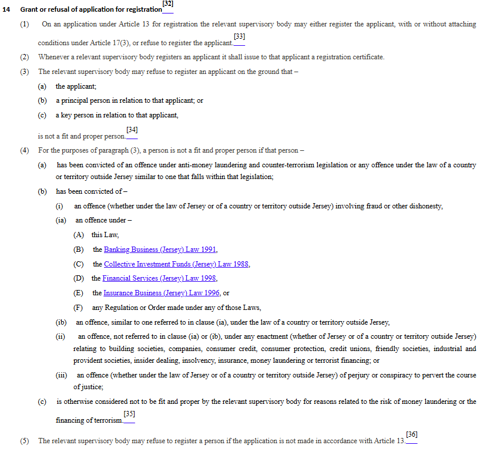
The law itself sets out the registration process, and Article 14(4) specifies when the JFSC (or other supervisory body) must refuse registration, including on criminality grounds.
What the Criminality Test Is
- Under Article 14, anyone applying to be registered to conduct Schedule 2 business (AML‑regulated business) must be assessed by the supervisory body (usually the JFSC).
- One mandatory element of the decision is the Criminality Test:
- The supervisory body must refuse an application if the applicant, any principal person, key person, or associate has been convicted of a relevant offence, or if their criminal history indicates they are not fit and proper to conduct supervised business.
- This flows from the law’s objective of preventing criminals from controlling, owning, or materially influencing AML‑regulated entities.
- Although the search results provide the whole law’s structure and definitions, the specific wording of Article 14(4) is not directly shown in the returned extracts. The law is accessible at the official source:
What “Criminality” Means in This Context
- The Criminality Test normally covers whether anyone involved in the business has been convicted—locally or overseas—of:
- Money laundering offences (per Proceeds of Crime (Jersey) Law 1999)
- Terrorist financing offences (per Terrorism (Jersey) Law 2002)
- Serious dishonesty, fraud, corruption, tax offences, or other crimes relevant to probity
- Offences under AML/CFT regulatory laws or sanctions laws
- The JFSC’s AML/CFT/CPF Handbook confirms that supervised persons must be fit and proper, including being free from relevant criminal convictions.
Who Does the Criminality Test Apply To
- Under the law’s definitions (Article 1), the test applies broadly to:
- The applicant
- Principal persons (shareholders with ≥10% control, directors, controllers)
- Key persons (compliance officer, MLRO, MLCO)
- Associates in some circumstances
- This is designed to stop unsuitable individuals from influencing AML-regulated activity.
Legal Effect of Failing the Criminality Test
- If the supervisory body determines that any of the above persons fails the Criminality Test, then:
- Registration must be refused under Article 14(4)
- The applicant receives a Notice of Refusal (Article 15)
- The person may appeal to the Royal Court
Appendix 2 Glossary
- AML/CFT/CPF Handbook or the Handbook
- Handbook for the prevention and detection of money laundering, the countering of terrorist financing, and the countering of proliferation financing
- CBC
- Criminal background checks
- DBS
- Disclosure and Barring Service
- DBS Check or foreign equivalent
- A certificate containing details of spent and unspent convictions provided by the DBS or an equivalent body in a foreign jurisdiction
- FATF
- The Financial Action Task Force
- GDPR
- General Data Protection Regulation
- JFSC
- Jersey Financial Services Commission
- KP
- Key Person
- MONEYVAL
- Committee of Experts on the Evaluation of Anti-Money Laundering Measures and the Financing of Terrorism
- PP
- Principal Person
- SBJL
- Proceeds of Crime (Supervisory Bodies) (Jersey) Law 2008
Here are the official, most relevant web sources from the Jersey Financial Services Commission (JFSC) on the final rules on Enhancements to Criminal Background Checks for Principal and Key Persons.
Primary Official JFSC Documents
- Feedback Paper (Final Policy Position) – Published 27 November 2025 https://www.jerseyfsc.org/media/0rpnaady/feedback-on-enhancements-to-criminal-background-checks.pdf
- Feedback Paper Web Page (with summary and download link) https://www.jerseyfsc.org/industry/consultations/feedback-on-enhancements-to-criminal-background-checks/
- Handbook Update on Complex Structures and Criminal Background Checks (recent announcement, includes confirmation of 31 May 2026 effective date) https://www.jerseyfsc.org/news-and-events/handbook-update-on-complex-structures-and-criminal-background-checks/
- Criminal Background Checks FAQs (directly linked from the handbook update page) https://www.jerseyfsc.org/industry/financial-crime/criminal-background-checks-faqs/
- Drop-in Session Page (for updated guidance on criminal background checks) https://www.jerseyfsc.org/news-and-events/drop-in-session-criminal-background-check-enhancements/
Supporting / Related Official Pages
- Original Consultation Paper announcement (29 January 2025) https://www.jerseyfsc.org/news-and-events/consultation-on-enhancements-to-criminal-background-checks-for-principal-and-key-persons/
- Implementation Date Announcement for AML/CFT/CPF Handbook (including criminal background checks) https://www.jerseyfsc.org/news-and-events/implementation-date-for-amlcftcpf-handbook-enhancements/
Additional Useful Links (for context)
- Original Consultation Paper PDF (for comparison) https://www.jerseyfsc.org/media/8066/consultation-on-enhancements-to-criminal-background-checks-no1-2025.pdf
The Team
Meet the team of industry experts behind Comsure
Find out moreLatest News
Keep up to date with the very latest news from Comsure
Find out moreGallery
View our latest imagery from our news and work
Find out moreContact
Think we can help you and your business? Chat to us today
Get In TouchNews Disclaimer
As well as owning and publishing Comsure's copyrighted works, Comsure wishes to use the copyright-protected works of others. To do so, Comsure is applying for exemptions in the UK copyright law. There are certain very specific situations where Comsure is permitted to do so without seeking permission from the owner. These exemptions are in the copyright sections of the Copyright, Designs and Patents Act 1988 (as amended)[www.gov.UK/government/publications/copyright-acts-and-related-laws]. Many situations allow for Comsure to apply for exemptions. These include 1] Non-commercial research and private study, 2] Criticism, review and reporting of current events, 3] the copying of works in any medium as long as the use is to illustrate a point. 4] no posting is for commercial purposes [payment]. (for a full list of exemptions, please read here www.gov.uk/guidance/exceptions-to-copyright]. Concerning the exceptions, Comsure will acknowledge the work of the source author by providing a link to the source material. Comsure claims no ownership of non-Comsure content. The non-Comsure articles posted on the Comsure website are deemed important, relevant, and newsworthy to a Comsure audience (e.g. regulated financial services and professional firms [DNFSBs]). Comsure does not wish to take any credit for the publication, and the publication can be read in full in its original form if you click the articles link that always accompanies the news item. Also, Comsure does not seek any payment for highlighting these important articles. If you want any article removed, Comsure will automatically do so on a reasonable request if you email info@comsuregroup.com.


As well as owning and publishing Comsure's copyrighted works, Comsure wishes to use the copyright-protected works of others. To do so, Comsure is applying for exemptions in the UK copyright law. There are certain very specific situations where Comsure is permitted to do so without seeking permission from the owner. These exemptions are in the copyright sections of the Copyright, Designs and Patents Act 1988 (as amended)[www.gov.UK/government/publications/copyright-acts-and-related-laws]. Many situations allow for Comsure to apply for exemptions. These include 1] Non-commercial research and private study, 2] Criticism, review and reporting of current events, 3] the copying of works in any medium as long as the use is to illustrate a point. 4] no posting is for commercial purposes [payment]. (for a full list of exemptions, please read here www.gov.uk/guidance/exceptions-to-copyright]. Concerning the exceptions, Comsure will acknowledge the work of the source author by providing a link to the source material. Comsure claims no ownership of non-Comsure content. The non-Comsure articles posted on the Comsure website are deemed important, relevant, and newsworthy to a Comsure audience (e.g. regulated financial services and professional firms [DNFSBs]). Comsure does not wish to take any credit for the publication, and the publication can be read in full in its original form if you click the articles link that always accompanies the news item. Also, Comsure does not seek any payment for highlighting these important articles. If you want any article removed, Comsure will automatically do so on a reasonable request if you email info@comsuregroup.com.