
Jersey's decision to reject pre-election transparency betrays "cleaner than clean"
13/03/2026
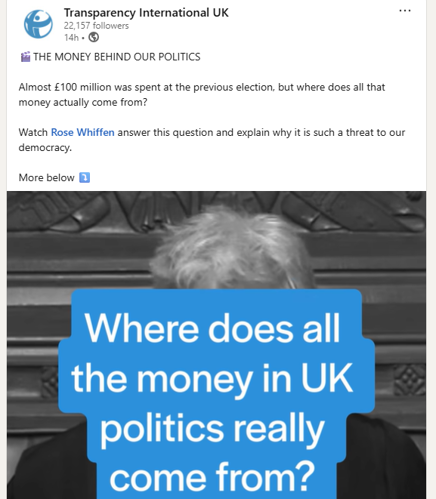
In an era where trust in democratic institutions is fraying, the role of undisclosed funding in politics has come under intense scrutiny. Rose Whiffen, Senior Research Officer at Transparency International UK, recently spotlighted this issue in a compelling video titled "The Money Behind Our Politics."
[SEE BRIEFING 1 BELOW FOR FURTHER DETAILS]
Drawing on data from the UK's 2024 general election, where nearly £100 million was spent, Whiffen warns that unchecked "big money" erodes public confidence, enables undue influence, and heightens corruption risks.
Her analysis reveals a surge in mega-donations, with over 35% of private funds now coming from donors giving £1 million or more, up from just 1% in 2015. This "arms race" of political spending, she argues, turns democracy into a playground for the wealthy, where access and policy sway are bought rather than earned.
Whiffen's call for reforms, including donation caps, lower reporting thresholds, and reduced spending limits, echoes global concerns about "dark money."
Opaque sources, including shell companies and foreign-linked funds, not only distort fair elections but also invite foreign interference. In the UK, nearly £1 in every £10 of donations since 2001 has questionable origins, fuelling a "democratic doom loop" of declining trust.
Her message is clear:
- Without transparency, big money isn't just a threat, it's a corrosion at democracy's core.
JERSEY VOTES AGAINST MANDATORY TRANSPARENCY FOR LARGE SPONSORS BEFORE BALLOTS ARE CAST
Here in Jersey, a self-governing British Crown Dependency renowned for its financial services hub and adherence to international standards, particularly those associated with the prevention of financial crime, a recent parliamentary decision underscores similar tensions to Whiffen's.
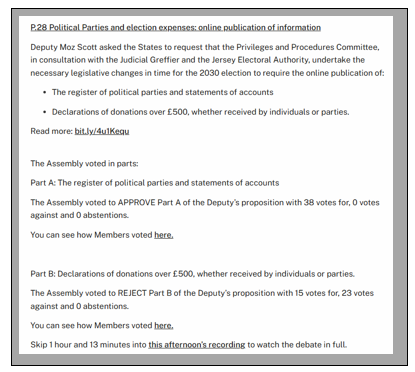
On March 12, 2026, the Jersey States (parliamentary) Assembly rejected part of a proposition by Deputy Moz Scott requiring pre-election disclosure of donations over £500. Members voted 23-15 against mandatory transparency for large sponsors before ballots are cast. While approving online publication of party registers and accounts,
[SEE BRIEFING 2 BELOW FOR FURTHER DETAILS]
This vote maintains the status quo: under the Public Elections (Expenditure and Donations) (Jersey) Law 2014, details are only reported post-election, leaving voters in the dark about potential influences during campaigns.
And it can be argued that these two votes are not the end of the world. Part A's approval does introduce some valuable transparency through online party registers and accounts. However, the rejection of Part B can be seen as the thin end of the wedge: if even modest pre-election disclosure of major donors is deemed unnecessary, what exactly is there to hide? In a jurisdiction that prides itself on impeccable financial integrity, this selective approach to openness risks fuelling suspicion rather than quelling it.
Democracy demands sunlight, not selective shadows.
JERSEY'S FINANCIAL SERVICES, THE JFSC AND AML
Jersey's finance industry, contributing over 50% of its economy, prides itself on "cleaner than clean" standards. As a leading international finance centre (IFC), it emphasises robust regulation to combat financial crime and uphold global standards. The Jersey Financial Services Commission (JFSC) enforces stringent anti-money laundering (AML), counter-terrorist financing (CTF), and countering proliferation financing (CPF) measures, including customer due diligence and risk-based supervision, with a focus on higher risk customers, including politically exposed persons (PEPs)
The jurisdiction's Policy Framework for the Financial Services Industry outlines commitments to transparency, positioning Jersey as a "leading jurisdictional expert in delivering transparency, client due diligence, and combating financial crime." This includes adherence to tax transparency initiatives such as the OECD's Common Reporting Standard, which has earned Jersey top ratings for compliance. Also, most recently, MONEYVAL's Fifth Round Mutual Evaluation Report, published on 24 July 2024, confirmed Jersey's exceptional performance, concluding that its effectiveness in preventing financial crime is among the highest levels observed in jurisdictions evaluated worldwide. The report found Jersey "Compliant" or "Largely Compliant" on 39 of 40 FATF Recommendations, highlighting strengths in risk understanding, national coordination, and overall AML/CFT/CPF measures, while noting targeted areas for ongoing improvement in private-sector implementation.
FATF
Yet this rigour contrasts sharply with the Assembly's reluctance regarding political donations. Jersey's determination to meet international standards is evident in its alignment with the Financial Action Task Force (FATF) Recommendations. FATF Recommendation 12 mandates enhanced due diligence (EDD) for politically exposed persons (PEPs) in prominent public roles, including their families and associates, to verify the sources of their wealth and funds, thereby mitigating corruption and money-laundering risks. Recommendations 24 and 25 further require transparency into the beneficial ownership of legal persons and arrangements to prevent misuse through opaque structures.
While FATF doesn't explicitly address political donations, its focus on PEP risks and beneficial ownership indirectly highlights vulnerabilities: undisclosed large donations could mask influence from high-risk sources, echoing Whiffen's concerns about "buying" access.
A PARADOX
This duality reveals a paradox. Jersey requires its finance sector, which manages trillions in assets, to be fully transparent, with mandatory reporting of suspicious activity and rigorous PEP screening. Private entities must assess risks in complex structures and apply EDD to PEPs, yet politicians themselves face no pre-election obligation to reveal major backers. Critics might argue this creates a double standard: why enforce "cleaner than clean" in banking but tolerate opacity in ballots? In a small island of 108,000, where networks are tight, hidden funding could amplify undue sway, undermining the public interest and transparency principles in the States Members' Code of Conduct.
MONEYVAL, THE COUNCIL OF EUROPE'S FATF-STYLE BODY
Looking ahead, Moneyval, the Council of Europe's FATF-style body, will scrutinise Jersey's progress. Following its 2024 Mutual Evaluation Report (on-site visit in late 2023), which praised Jersey's high effectiveness in AML/CTF/CPF, the jurisdiction must report back in December 2026 as part of the regular follow-up. The report noted strengths but flagged improvements needed in private-sector EDD for PEPs and suspicious-transaction reporting.
If political donation opacity persists, evaluators might question consistency: does rejecting pre-election transparency align with FATF's PEP risk management?
A poor showing could tarnish Jersey's IFC reputation, especially amid global efforts to promote cleaner politics.
CONCLUSIONS
Whiffen's video and Jersey's vote serve as cautionary tales. “MONEY IN POLITICS AS A THREAT ISN'T ABSTRACT; IT'S A REAL EROSION OF DEMOCRATIC EQUITY”, and the Jersey state chamber’s rejection of even modest pre-election disclosure of major donors is deemed unnecessary. What exactly is there to hide? Can it be seen as the thin end of the wedge?
In a jurisdiction that prides itself on impeccable financial integrity, this selective approach to openness risks fuelling suspicion rather than quelling it.
For Jersey, bridging the gap between financial and political transparency isn't just prudent; it's essential to safeguard its standing in the international community.
Democracy demands sunlight, not secrecy.
KEY SOURCES
- Original LinkedIn post/video share: https://www.linkedin.com/posts/transparencyuk_the-money-behind-our-politics-almost-activity-7437914990516539392-jsun
- TI UK report "Taking Big Money Out of Politics" (March 2026): https://www.transparency.org.uk/publications/taking-big-money-out-politics
FURTHER BRIEFINGS AND SOURCE MATERIAL ON THE ABOVE BLOG ARE BELOW
- BRIEFING 1 - "The Money Behind Our Politics" as a Threat to UK Democracy
- BRIEFING 2 - Briefing on the Rejection of Electoral Funding Disclosure Proposition in Jersey's States Assembly
BRIEFING 1 - "The Money Behind Our Politics" as a Threat to UK Democracy
Rose Whiffen, Senior Research Officer at Transparency International UK (TI UK), an anti-corruption watchdog, appears in a short promotional video shared by the organisation on LinkedIn (posted in early 2026). The video, titled "THE MONEY BEHIND OUR POLITICS", highlights that almost £100 million was spent during the previous UK general election (referring to the 2024 election, where parties and candidates spent over £90 million, the highest in modern UK history, up nearly 80% from 2015). It poses the question: Where does all this money come from? Whiffen explains the sources and why unchecked "big money" in politics poses a serious threat to democracy.
Key Points from the Video and TI UK's Broader Work
The video serves as an accessible explainer that ties into TI UK's ongoing campaign and research on political finance reform. Whiffen addresses:
- Sources of the Money Much of UK political funding comes from a small number of ultra-wealthy individuals, companies, and sometimes opaque or questionable channels. TI UK's analysis shows a dramatic shift: The share of private donations from donors giving £1 million or more surged from just 1% in 2015 to over 35% in 2024, a 35-fold increase. Other concerns include "dark money" through shell companies, unincorporated associations, foreign-linked funds (e.g., £4.6 million from foreign governments or state-linked groups since 2001), and sources that are unknown or linked to allegations of buying access or criminal activity. Overall, nearly £1 in every £10 of reported political donations since 2001 has come from unknown or questionable origins.
- Why It Is a Threat to Democracy Whiffen and TI UK argue that this "corrosive impact of big money" undermines core democratic principles in several ways:
- Undue Influence and Access Large donors gain privileged access to politicians, policy influence, honours, or favourable decisions (e.g., in planning, procurement, or national security). Money effectively "buys" outcomes, turning democracy into a "plaything of the rich" rather than equal representation for all citizens.
- Erosion of Public Trust High spending creates an "arms race" where parties depend heavily on mega-donors, fuelling perceptions of corruption. Public surveys show widespread concern, e.g., only 18% believe money in politics is open to scrutiny, and many feel the ultra-wealthy have excessive sway.
- Risk of Corruption and Foreign Interference Opaque funding allows vested interests (domestic or foreign) to exert hidden influence, distorting fair competition, policy-making, and electoral integrity. Without caps, transparency gaps (e.g., high reporting thresholds), or spending limits, these risks grow, creating a "democratic doom loop" of declining trust and integrity.
- Worsening Trends The problem has intensified over the past decade, exacerbated by raised spending limits and weak rules that fail to prevent shell companies or other loopholes.
Context and Recommendations
This video promotes TI UK's March 2026 report/publication "Taking Big Money Out of Politics" (co-authored with input from Whiffen), which calls for reforms such as:
- Caps on individual donations (e.g., starting higher and reducing over time, unlike the UK's current uncapped system).
- Lower reporting thresholds (e.g., £500).
- Reduced campaign spending limits.
- Greater transparency over sources, think tanks, and non-party influencers.
Whiffen has consistently emphasised in other TI UK outputs (e.g., evidence to parliamentary committees and articles) that addressing "big money" is essential to restoring trust and preventing corruption risks.
Source Links for Reference
- Original LinkedIn post/video share: https://www.linkedin.com/posts/transparencyuk_the-money-behind-our-politics-almost-activity-7437914990516539392-jsun
- TI UK report "Taking Big Money Out of Politics" (March 2026): https://www.transparency.org.uk/publications/taking-big-money-out-politics
- Related TI UK news on mega-donors and risks: https://www.transparency.org.uk/news/mega-donor-grip-uk-politics-has-increased-35-fold-decade-anti-corruption-experts-warn
- Broader analysis on suspect funds: https://www.transparency.org.uk/news/new-research-reveals-almost-ps1-every-ps10-political-donations-comes-unknown-or-questionable
This aligns with global concerns about political finance, but TI UK emphasises the UK's specific vulnerabilities arising from its permissive rules compared to countries with donation caps (e.g., France, Australia). For the full video content, please use the LinkedIn link above.
BRIEFING 2 - Briefing on the Rejection of Electoral Funding Disclosure Proposition in Jersey's States Assembly
Overview
On March 12, 2026, the States Assembly of Jersey, a self-governing British Crown Dependency, debated and voted on a proposition (P.2026/12) lodged by Deputy Moz Scott of St. Brelade, an independent member and Assistant Minister for Sustainable Economic Development and External Relations.
The proposition sought legislative changes to enhance transparency in political financing ahead of future elections, specifically requiring the online publication of political party registers, accounts, and declarations of significant donations.
This was intended to inform voters about funding sources for candidates and parties, aligning with principles of open governance.
The vote occurred amid preparations for Jersey's upcoming general election on June 22, 2026 (though the proposition referenced implementation in time for the 2030 election, likely to allow for phased reforms). Jersey's electoral system involves 49 elected members (Deputies and Constables) serving four-year terms, with no strict party dominance but growing influence from groups like Reform Jersey.
Key Details of the Proposition
Deputy Scott's proposal requested the Privileges and Procedures Committee (PPC), in consultation with the Judicial Greffier and Jersey Electoral Authority, to amend laws for:
- Part A: Online publication of the register of political parties and their statements of accounts.
- Part B: Online declarations of donations exceeding £500, whether to individuals or parties.
These changes were intended to ensure voters could access information about "major election sponsors" before casting ballots, helping address potential undue influence in campaigns. Under current Jersey law (Public Elections (Expenditure and Donations) (Jersey) Law 2014), candidates must report donations over £100 post-election, but there is no pre-election public disclosure requirement for large sponsors.
The proposition was debated during a sitting that covered multiple items, including planning policies, government reviews, and social security matters.
Voting Outcome
The Assembly voted on the proposition in parts:
- Part A (party registers and accounts): Approved with 38 votes in favour, 0 against, and 0 abstentions.
- Part B (donation declarations over £500): Rejected with 15 votes in favour, 23 against, and 0 abstentions.
A total of 38 members participated in the vote on Part B, falling short of the full 49-member Assembly due to possible absences or abstentions. This outcome means no mandatory pre-election disclosure of large donations will be implemented, maintaining the status quo in which such details are reported only after elections.
Debate and Participation
Official records from the Assembly's live updates indicate no detailed speeches or interventions were highlighted on the issue during the sitting. The focus appeared procedural, with the vote proceeding without noted opposition arguments in public summaries. This lack of vocal engagement contrasts with other items debated that day, such as assisted dying extensions (rejected 8-34) and planning impact assessments (partially approved).
Context: Code of Conduct for States Members
A Code of Conduct binds Jersey's States Members under Standing Orders, which explicitly requires them to:
- Act in the public interest at all times.
- Promote transparency and openness in decision-making.
The rejection of Part B has raised questions about adherence to these principles, as pre-election disclosure could mitigate perceptions of hidden influence from wealthy donors. Critics argue this undermines voter awareness, especially in a small jurisdiction like Jersey (population ~108,000), where personal networks and funding can sway outcomes. Supporters of the rejection might cite privacy concerns for donors, administrative costs, or alignment with existing post-election reporting.
Implications and Reactions
- Electoral Impact: With the 2026 election approaching, candidates will not be required to disclose major sponsors pre-emptively. This could affect public trust, particularly amid global trends toward stricter campaign finance rules (e.g., the UK's Political Parties, Elections and Referendums Act 2000).
- Broader Transparency Efforts: Part A's approval advances some accountability for political parties, building on recent reforms like automatic voter registration (approved in the same sitting). However, the partial rejection highlights divisions on deeper reforms.
- Public Sentiment: Limited online reactions include scepticism toward "no" voters, with some users implying hidden motives (e.g., "Why did you vote NO? You wouldn't be hiding anything, would you?"). No widespread protests or media uproar noted as of March 13. Still, it may fuel calls from reform advocates like Deputy Scott, who lodged multiple propositions that day (two others were fully rejected).
This decision underscores ongoing tensions between privacy and transparency in Jersey's politics. Future propositions could revisit the issue, potentially via PPC reviews of the Code of Conduct (as flagged in prior decision trackers). For updates, you can monitor the State Assembly's official channels.
Only 15 supported the Proposition. Information on which states' members voted which way is available at the link below.
Sources
Here are the most relevant and reliable web sources on the recent Jersey States Assembly debate and vote on Deputy Moz Scott's proposition (P.28/2026 or similar reference) regarding the online publication of political party information and election donation disclosures. These focus on official State Assembly pages, news coverage of the proposition, and related transparency discussions from around February–March 2026.
SOURCE
- Official States Assembly Meeting Summary for 12 March 2026 (covers the day's proceedings, including votes): https://statesassembly.je/news/states-meeting-summary-12-march
- Comments on Proposition P.28/2026 (Political Parties and Election Expenses: Online Publication of Information – the key document for Deputy Moz Scott's proposition): https://statesassembly.je/publications/comments/2026/p-28-2026-com
- States Assembly Votes Page (general archive of recent votes, including items from March 2026; check for specifics like P.50/2026 or related commencement acts): https://statesassembly.je/votes
- States Assembly Decision Tracker (tracks implementation of approved decisions, including electoral reforms and transparency matters): https://statesassembly.je/states-assembly-decision-tracker
- Jersey Evening Post article: "Call to publish election donations online" (February 2026 coverage of Deputy Moz Scott lodging the proposition for pre-election disclosure changes): https://jerseyeveningpost.com/news/2026/02/11/call-to-publish-election-donations-online
- Jersey Evening Post related coverage (Election Authority's response to political group funding proposals, providing context on transparency debates): https://jerseyeveningpost.com/news/2026/01/18/election-authority-uncertain-about-political-group-funding-proposal
- States Assembly Webcast Archive (interactive recording/transcript access for the March 11–12, 2026 sitting, where Deputy Moz Scott appears multiple times): https://statesassembly.public-i.tv/core/portal/webcast_interactive/1076384
These sources include official records from the State Assembly website (the primary authority) and contemporary local news reporting. For the exact voting breakdown on the donation disclosure part (which was rejected), refer to the meeting summary or votes page above, as detailed Hansard/official reports may appear there shortly after the sitting.
IF YOU WISH TO KNOW MORE ABOUT COMSURE’S SERVICES AND SUPPORT, PLEASE CONTACT
Mathew Beale | Chartered FCSI
- Principal & Director | Comsure Compliance Limited | Comsure Mauritius (The Comsure Group of Companies) |mathew@comsuregroup.com | www.comsuregroup.com
- Co-Founder & CEO | iTrack Ventures Limited (iTrackAML) | mathew@iTrackAML.com | www.iTrackAML.com
No 1 Bond Street Chambers, St Helier, Jersey, Channel Islands, JE2 3NP | T (Jersey): +44 1534 626841 | Mobile: +44 7797 747490

Disclaimer | Risk Warning Disclaimer | Environmental Policy | Company Details | Terms & Conditions | Our Fees | Privacy Policy | Conflicts
The Team
Meet the team of industry experts behind Comsure
Find out moreLatest News
Keep up to date with the very latest news from Comsure
Find out moreGallery
View our latest imagery from our news and work
Find out moreContact
Think we can help you and your business? Chat to us today
Get In TouchNews Disclaimer
As well as owning and publishing Comsure's copyrighted works, Comsure wishes to use the copyright-protected works of others. To do so, Comsure is applying for exemptions in the UK copyright law. There are certain very specific situations where Comsure is permitted to do so without seeking permission from the owner. These exemptions are in the copyright sections of the Copyright, Designs and Patents Act 1988 (as amended)[www.gov.UK/government/publications/copyright-acts-and-related-laws]. Many situations allow for Comsure to apply for exemptions. These include 1] Non-commercial research and private study, 2] Criticism, review and reporting of current events, 3] the copying of works in any medium as long as the use is to illustrate a point. 4] no posting is for commercial purposes [payment]. (for a full list of exemptions, please read here www.gov.uk/guidance/exceptions-to-copyright]. Concerning the exceptions, Comsure will acknowledge the work of the source author by providing a link to the source material. Comsure claims no ownership of non-Comsure content. The non-Comsure articles posted on the Comsure website are deemed important, relevant, and newsworthy to a Comsure audience (e.g. regulated financial services and professional firms [DNFSBs]). Comsure does not wish to take any credit for the publication, and the publication can be read in full in its original form if you click the articles link that always accompanies the news item. Also, Comsure does not seek any payment for highlighting these important articles. If you want any article removed, Comsure will automatically do so on a reasonable request if you email info@comsuregroup.com.


As well as owning and publishing Comsure's copyrighted works, Comsure wishes to use the copyright-protected works of others. To do so, Comsure is applying for exemptions in the UK copyright law. There are certain very specific situations where Comsure is permitted to do so without seeking permission from the owner. These exemptions are in the copyright sections of the Copyright, Designs and Patents Act 1988 (as amended)[www.gov.UK/government/publications/copyright-acts-and-related-laws]. Many situations allow for Comsure to apply for exemptions. These include 1] Non-commercial research and private study, 2] Criticism, review and reporting of current events, 3] the copying of works in any medium as long as the use is to illustrate a point. 4] no posting is for commercial purposes [payment]. (for a full list of exemptions, please read here www.gov.uk/guidance/exceptions-to-copyright]. Concerning the exceptions, Comsure will acknowledge the work of the source author by providing a link to the source material. Comsure claims no ownership of non-Comsure content. The non-Comsure articles posted on the Comsure website are deemed important, relevant, and newsworthy to a Comsure audience (e.g. regulated financial services and professional firms [DNFSBs]). Comsure does not wish to take any credit for the publication, and the publication can be read in full in its original form if you click the articles link that always accompanies the news item. Also, Comsure does not seek any payment for highlighting these important articles. If you want any article removed, Comsure will automatically do so on a reasonable request if you email info@comsuregroup.com.