




 Published on : 22/05/2026
Jersey vs Guernsey: A Tale of Two Island Regulators on Financial Penalties
The Channel Islands' two main financial centres — Jersey and Guernsey — both maintain strong regulatory regimes through their respective commissions (JFSC and GFSC).
However, when it comes to CIVIL FINANCIAL PENALTIES (FINES) [NOT CRIMINAL], the approaches differ notably in style, volume, and emphasis on personal accountability.
Jersey JFSC: Corporate Focus, Zero Individual Fines
Since introducing its civil financial penalty regime in 2015, the JFSC has taken a measured approach, issuing public statements alongside penalties for significant and material contraventions (often AML/CFT, governance, and systems/controls failings).
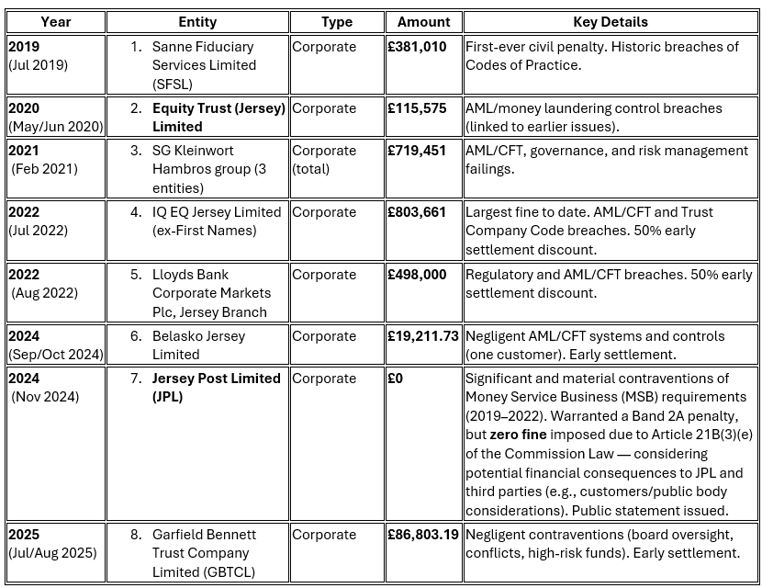
Total major corporate fines: Approximately £2.62 million (excluding the £0).
Notable observation:
- As of mid-2026, the JFSC has not imposed any civil financial penalties on individuals (principal persons, key persons, or senior managers), despite having the legal powers since 2018/2019 (with maximums up to £400k in some bands, later adjusted).
- Enforcement has remained firmly at the corporate level, often accompanied by remediation requirements and public naming.
Guernsey GFSC: Higher Volume and Personal Accountability
In contrast, the GFSC has been significantly more active in enforcement. Guernsey started issuing civil financial penalties earlier than Jersey, with notable activity from 2014 onwards and a clear increase in both volume and value following the strengthening of powers in the mid-2010s. According to the detailed list provided:
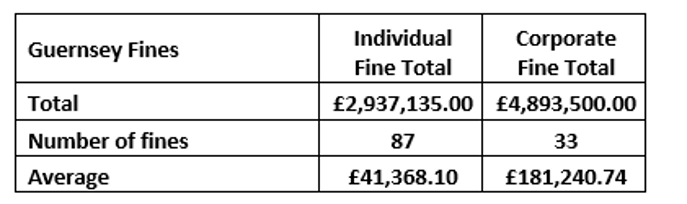
This includes high-profile cases such as Utmost Worldwide Limited (£1.96m corporate fine in 2026) and numerous personal fines imposed on directors and executives. Guernsey regularly holds individuals personally accountable, with fines often issued alongside corporate penalties for the same underlying issues.
Also, the fines started earlier…
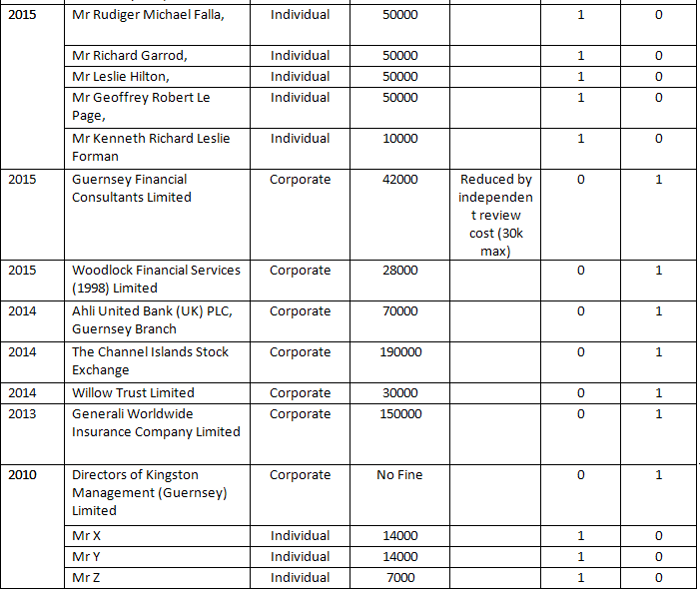
[Comsure has a full list of all fines to 2026]
Comparison and Contrast
- Volume & Aggression: Guernsey issues far more penalties overall and is quicker to fine individuals. Jersey prefers fewer, larger corporate cases with generous early settlement discounts.
- Individual Accountability: This is the starkest difference. Guernsey actively fines people (dozens of cases). Jersey has yet to issue a single public individual civil fine, raising questions about personal deterrence.
- Philosophy: Jersey often emphasises remediation and proportionality (e.g., £0 for Jersey Post). Guernsey leans into higher totals and the naming and shaming of both firms and individuals.
- Trends: Both islands focus heavily on AML/CFT and governance, but Guernsey's approach results in higher cumulative penalties and more visible personal consequences.
Important Reminder: Criminal Prosecutions Are Separate
- This analysis covers only civil financial penalties issued by the JFSC and GFSC.
- It does not include criminal prosecutions under the Money Laundering (Jersey) Order (or equivalent legislation in Guernsey).
- Jersey has secured several notable criminal convictions for breaches of the Money Laundering Order.
Jersey Criminal AML / MLO Prosecutions (Key Cases)
- Caversham Fiduciary Services Ltd / Caversham Trustees Ltd / Nicholas Bell (2005) Wrongdoing: Failed to conduct proper customer identification / KYC on a trust structure involving ~£850,000 in funds. Breaches of the Money Laundering (Jersey) Order 1999 (failure to maintain required AML procedures). Criminal penalties: Companies fined £65,000 (total); Nicholas Bell (individual): £35,000 fine. Costs: Prosecution sought ~£60,000 costs; Bell's liability capped at £10,000.
- Kevin Manning (Jersey lawyer) (2018 conviction) Wrongdoing: Manning received an imprisonment sentence, and that was alongside wider fraud, not solely for the AML systems' failure. Failure to comply with the Money Laundering (Jersey) Order 2008 (failed to maintain proper client records over ~6 years). In parallel: Fraudulent conversion of client funds (misuse of client/curatorship monies). Criminal penalties: 3.5 years' imprisonment (overall sentence, including 8 months concurrent for the MLO breach). Costs: Not prominently reported (the focus was on the custodial sentence and removal from the roll).
- Abu Dhabi Commercial Bank PJSC – Jersey Branch (2020) Wrongdoing: Failed to maintain adequate AML policies and procedures. Allowed over US$1.2 million in high-risk cash withdrawals without scrutiny. Failure to apply CDD and risk monitoring effectively. Criminal penalties: £475,000 fine. Costs: £25,000 costs order.
- LGL Trustees Limited (2021) Wrongdoing: Failed to identify and respond to obvious corruption/misappropriation risk involving Angolan public funds. Failed to identify and verify beneficial ownership/controllers (National Bank of Angola). Failed to remedy deficiencies for ~6 years (ongoing monitoring failures). Criminal penalties: £550,000 fine. Costs: £50,000 prosecution costs.
Consolidated Table (in Date Order)

Key observation:
- All corporate cases resulted in financial penalties only (no custodial sentences).
- Only one individual (Manning) received an imprisonment sentence, and that was alongside wider fraud, not solely for the AML systems' failure.
As international standards (e.g., FATF/MONEYVAL) push for stronger deterrence, Jersey may eventually follow Guernsey's lead on individual fines. For now, the contrast highlights two valid but different regulatory philosophies in very similar jurisdictions.
Here are all the main sources for the blog post content (especially the criminal prosecutions section), ready for copy-paste:
Jersey Criminal AML / MLO Prosecutions Sources
- Caversham Fiduciary Services Ltd / Nicholas Bell (2005)
- BBC News: https://news.bbc.co.uk/2/hi/europe/jersey/4271674.stm
- Comsure Group (detailed summary): https://www.comsuregroup.com/news/caversham-fiduciary-services-ltd-and-caversham-trustees-ltd-and-nicholas-bell-2005-judgement/
- Judgment: https://www.jerseylaw.je/judgments/unreported/PDFs/%5B2005%5DJRC165.pdf
- Kevin Manning (Jersey lawyer, 2018)
- JFSC Public Statement: https://www.jerseyfsc.org/news-and-events/mr-kevin-robert-manning-r/
- Bar Standards Board: https://www.barstandardsboard.org.uk/disciplinary_finding/183595.html
- Comsure Group: https://www.comsuregroup.com/news/jersey-lawyer-removed-from-the-roll-of-solicitors-of-the-royal-court-for-following-fraud-and-money-laundering-conviction/
- Abu Dhabi Commercial Bank PJSC – Jersey Branch (2020)
- Official Gov.je: https://www.gov.je/News/2020/pages/bankfined.aspx
- Judgment: https://www.jerseylaw.je/judgments/unreported/Pages/[2020]JRC059.aspx
- Comsure Group: https://www.comsuregroup.com/news/a-jersey-bank-is-prosecuted-following-making-a-sar-2020-case/
- LGL Trustees Limited (2021)
- Law Officers' Department (Gov.je): https://www.lawofficers.je/publications/news/breaches-of-money-laundering-order/
- Gov. je Financial Crime Judgments page: https://www.gov.je/Industry/Finance/FinancialCrime/pages/judgments.aspx
- Judgment: https://www.jerseylaw.je/judgments/unreported/Pages/[2021]JRC058.aspx
General Jersey Civil Penalties Sources
- JFSC Civil Financial Penalties Policy: https://www.jerseyfsc.org/industry/guidance-and-policy/civil-financial-penalties-on-registered-persons/
- JFSC Civil Penalties on Natural Persons: https://www.jerseyfsc.org/industry/guidance-and-policy/civil-financial-penalties-on-natural-persons/
The Team
Meet the team of industry experts behind Comsure
Find out moreLatest News
Keep up to date with the very latest news from Comsure
Find out moreGallery
View our latest imagery from our news and work
Find out moreNews Disclaimer
As well as owning and publishing Comsure's copyrighted works, Comsure wishes to use the copyright-protected works of others. To do so, Comsure is applying for exemptions in the UK copyright law. There are certain very specific situations where Comsure is permitted to do so without seeking permission from the owner. These exemptions are in the copyright sections of the Copyright, Designs and Patents Act 1988 (as amended)[www.gov.UK/government/publications/copyright-acts-and-related-laws]. Many situations allow for Comsure to apply for exemptions. These include 1] Non-commercial research and private study, 2] Criticism, review and reporting of current events, 3] the copying of works in any medium as long as the use is to illustrate a point. 4] no posting is for commercial purposes [payment]. (for a full list of exemptions, please read here www.gov.uk/guidance/exceptions-to-copyright]. Concerning the exceptions, Comsure will acknowledge the work of the source author by providing a link to the source material. Comsure claims no ownership of non-Comsure content. The non-Comsure articles posted on the Comsure website are deemed important, relevant, and newsworthy to a Comsure audience (e.g. regulated financial services and professional firms [DNFSBs]). Comsure does not wish to take any credit for the publication, and the publication can be read in full in its original form if you click the articles link that always accompanies the news item. Also, Comsure does not seek any payment for highlighting these important articles. If you want any article removed, Comsure will automatically do so on a reasonable request if you email info@comsuregroup.com.
Archived News
To find our older articles, please click here.
View archive

To find our older articles, please click here.