

Jersey sanction risk - indirect links - Article 2A and Schedule 2 of the Sanctions and Asset-Freezing (Jersey) Law 2019
04/12/2025
To follow up on the following, Feedback on enhancements to the AML/CFT/CPF Handbook Issued: 27 November 2025, the JFSC has reiterated the statutory requirements under Article 2A and Schedule 2 of the Sanctions and Asset-Freezing (Jersey) Law 2019 (Sanctions and Asset Freezing Law).
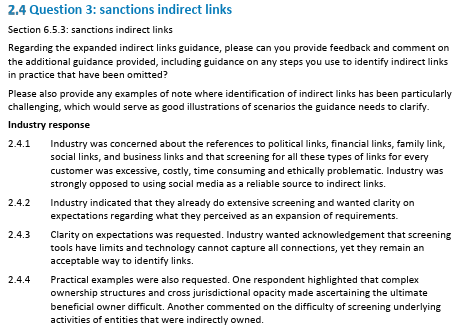
Guidance
- The following is COMSURE’s guidance note summarising Article 2A and Schedule 2 of the Sanctions and Asset-Freezing (Jersey) Law 2019,
Purpose:
- To clarify statutory requirements for determining ownership and control under Jersey’s sanctions regime, as set out in Article 2A and Schedule 2 of the Sanctions and Asset-Freezing (Jersey) Law 2019 (SAFL).
Article 2A – Definitions
Article 2A provides legal definitions for:
- Owned
- Held
- Controlled
- Directly or indirectly
These definitions apply when assessing whether a person or entity is subject to sanctions obligations. They ensure that asset-freeze measures capture not only direct ownership but also indirect control through complex structures.
Schedule 2 – Interpretation Rules
Schedule 2 sets out detailed interpretive rules for applying Article 2A, including:
- Ownership thresholds: 50% or more shareholding or voting rights.
- Control indicators: Ability to appoint/remove directors or exercise dominant influence.
- Indirect control: Through chains of ownership, trusts, or nominee arrangements.
Does Jersey adopt the UK 50:50 rule?
Jersey implements all UK sanctions regimes under the Sanctions and Anti-Money Laundering Act 2018 (SAMLA) through the Sanctions and Asset-Freezing (Jersey) Law 2019 and related Orders.
This means Jersey applies the same ownership and control principles as the UK, including the “50% rule” for determining whether an entity is subject to financial sanctions. [jerseyfsc.org], [jerseyfsc.org]
What is the UK 50% Rule?
The UK 50% rule (sometimes called the “ownership and control rule”) means:
- Any entity owned, directly or indirectly, 50% or more by one or more designated persons is itself treated as a sanctioned entity, even if it is not listed on the UK Sanctions List. [windward.ai], [symphonyai.com]
- Ownership can be aggregated:
- Example: Two sanctioned individuals each own 25% → combined 50% → entity is sanctioned.
- The UK also considers “control” beyond ownership:
- Significant influence, voting rights, or ability to appoint/remove directors can trigger sanctions exposure even below 50%. [linkedin.com]
Key Compliance Implications
- Screening must go beyond listed names: Entities not on the sanctions list may still be sanctioned under the 50% rule.
- Indirect ownership matters: Through chains of companies, trusts, or nominee arrangements.
- Control indicators: Even if ownership is <50%, control through governance rights can make an entity sanctioned under UK (and therefore Jersey) law.
These provisions align Jersey’s framework with UK sanctions regulations and FATF standards.
Compliance Obligations
- Screening: Firms must identify sanctioned persons/entities, considering direct and indirect control.
- Beneficial Ownership: Systems must capture layered structures and nominee arrangements.
- Documentation: Maintain evidence of ownership/control assessments for audit and regulatory review.
Practical Steps
- Update sanctions screening tools to include ownership/control logic.
- Train staff on Article 2A definitions and Schedule 2 rules.
- Review high-risk structures (trusts, layered companies) for indirect control risks.
Official Sources
- JFSC – Sanctions and Asset-Freezing Law [jerseyfsc.org]
- JFSC – Financial Sanctions Practical Guidance [jerseyfsc.org]
- JFSC – Sanctions Overview [jerseyfsc.org]
- https://windward.ai/blog/the-fifty-percent-rule-in-maritime-sanctions-compliance-explained/
The Team
Meet the team of industry experts behind Comsure
Find out moreLatest News
Keep up to date with the very latest news from Comsure
Find out moreGallery
View our latest imagery from our news and work
Find out moreContact
Think we can help you and your business? Chat to us today
Get In TouchNews Disclaimer
As well as owning and publishing Comsure's copyrighted works, Comsure wishes to use the copyright-protected works of others. To do so, Comsure is applying for exemptions in the UK copyright law. There are certain very specific situations where Comsure is permitted to do so without seeking permission from the owner. These exemptions are in the copyright sections of the Copyright, Designs and Patents Act 1988 (as amended)[www.gov.UK/government/publications/copyright-acts-and-related-laws]. Many situations allow for Comsure to apply for exemptions. These include 1] Non-commercial research and private study, 2] Criticism, review and reporting of current events, 3] the copying of works in any medium as long as the use is to illustrate a point. 4] no posting is for commercial purposes [payment]. (for a full list of exemptions, please read here www.gov.uk/guidance/exceptions-to-copyright]. Concerning the exceptions, Comsure will acknowledge the work of the source author by providing a link to the source material. Comsure claims no ownership of non-Comsure content. The non-Comsure articles posted on the Comsure website are deemed important, relevant, and newsworthy to a Comsure audience (e.g. regulated financial services and professional firms [DNFSBs]). Comsure does not wish to take any credit for the publication, and the publication can be read in full in its original form if you click the articles link that always accompanies the news item. Also, Comsure does not seek any payment for highlighting these important articles. If you want any article removed, Comsure will automatically do so on a reasonable request if you email info@comsuregroup.com.


As well as owning and publishing Comsure's copyrighted works, Comsure wishes to use the copyright-protected works of others. To do so, Comsure is applying for exemptions in the UK copyright law. There are certain very specific situations where Comsure is permitted to do so without seeking permission from the owner. These exemptions are in the copyright sections of the Copyright, Designs and Patents Act 1988 (as amended)[www.gov.UK/government/publications/copyright-acts-and-related-laws]. Many situations allow for Comsure to apply for exemptions. These include 1] Non-commercial research and private study, 2] Criticism, review and reporting of current events, 3] the copying of works in any medium as long as the use is to illustrate a point. 4] no posting is for commercial purposes [payment]. (for a full list of exemptions, please read here www.gov.uk/guidance/exceptions-to-copyright]. Concerning the exceptions, Comsure will acknowledge the work of the source author by providing a link to the source material. Comsure claims no ownership of non-Comsure content. The non-Comsure articles posted on the Comsure website are deemed important, relevant, and newsworthy to a Comsure audience (e.g. regulated financial services and professional firms [DNFSBs]). Comsure does not wish to take any credit for the publication, and the publication can be read in full in its original form if you click the articles link that always accompanies the news item. Also, Comsure does not seek any payment for highlighting these important articles. If you want any article removed, Comsure will automatically do so on a reasonable request if you email info@comsuregroup.com.