




 Published on : 12/10/2026
Jersey: No Place to Hide the Proceeds of Crime – €6bn frozen and €311m taken from criminals, 2018–2023
MONEYVAL called Jersey’s Proceeds of Crime recovery figure "considerable" and rated Jersey's confiscation regime Substantial, the second-highest effectiveness rating available.
Between 2018 and 2022, Jersey recovered about €311 million of criminal proceeds.
From 2018 to mid-2023, it froze assets worth €6.04 billion under 25 court orders.
Those headline figures need unpacking before anyone repeats them.
One externally driven corruption case makes up about 90% of the money recovered.
One 2022 restraint accounts for almost all of the frozen money.
Most of what Jersey recovered was then returned to the countries that were harmed.
The article below covers
What the numbers show and what they don't.
It explains the terms used in asset recovery and the two legal routes Jersey uses:
Criminal confiscation, which follows a conviction, and
Civil forfeiture, which does not.
It ends with what this means for regulated firms on the island.
Jersey: No Place to Hide the Proceeds of Crime – €6bn frozen and €311m taken from criminals, 2018–2023
Introductory paragraph
Between 2018 and mid-2023, Jersey’s courts froze more than €6 billion of suspected criminal assets, and between 2018 and 2022 the Island recovered about €311 million of criminal proceeds.
MONEYVAL, the Council of Europe’s anti-money laundering body, described the recovery figure as “considerable” in its 2024 evaluation. Both numbers need unpacking.
Almost all of the €6 billion comes from a single freezing order in 2022, and freezing assets is not the same as taking them.
Most of the €311 million came from one corruption case and went back to Nigeria.
This article explains what the figures really show, how assets are traced, frozen and confiscated in Jersey, and the difference between the criminal and civil routes to recovery. It draws on recent Jersey case law and the Proceeds of Crime (Jersey) Law 1999.
It ends with what this means for regulated firms, whose suspicious activity reports are where most recoveries begin.
The numbers and what sits behind them
All figures below come from MONEYVAL's 2024 Mutual Evaluation Report on Jersey, and each one measures something different. Adding them together gives a meaningless total.
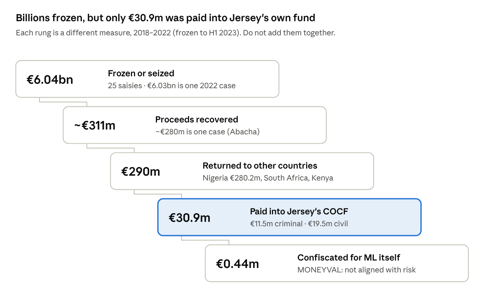
MONEYVAL(2024)7 Tables 8.1, 8.2, 8.4 and paras 287–293 · EUR
The ladder, largest figure first:
Frozen or seized: €6,040,928,912 (2018 – H1 2023)
25 saisies judiciaires
About €6.03bn of it is from a 2022 corruption restraint. Without that case, the total is about €8.6m.
The money is frozen, not yet recovered.
MER Table 8.2, paras 294–295
Total proceeds recovered: ~€311 million (2018 – 2022)
Covers Jersey criminal confiscation, Jersey civil forfeiture, and enforcement of foreign criminal and civil orders
About €280m of it is one case (Abacha)
MER paras 287–288
Shared with or returned to other countries: €290,449,220 (2018 – 2022)
Nigeria €280.2m, South Africa €6.3m, Kenya €3.3m, US and UK about €0.6m
MER Table 8.4
Recovered through Jersey court orders and paid into the COCF: €30,890,939 (2018 – 2022)
€11.5m from criminal confiscation, €19.5m from civil forfeiture
MER Table 8.1, para 289
Confiscated for the money laundering offence itself: €435,827 (2018 – 2022)
MONEYVAL says this "does not properly align" with Jersey's risk profile
MER para 293
What the €6.04 billion actually is
Almost all of it is one case. Between 2018 and mid-2023 Jersey's courts made 25 freezing orders (saisies judiciaires) over assets worth €6,040,928,912. Of that, €6,034,341,057 was frozen in a single year, 2022, and MONEYVAL links it to one high-profile corruption case (paras 294–295, Tables 8.2 and 8.8).
That one case is more than 99.8% of the total.
Without it, the figure is small.
The other orders froze roughly €6.6m to €8.2m over five and a half years, depending on how the MER's tables are read. That is a little over €1m a year.
Frozen is not recovered.
A saisie judiciaire stops assets being moved while a case is built. It is not a confiscation, and the money may yet be released. The MER records no confiscation from the 2022 case within its review period.
It dwarfs what was recovered.
The €6.04bn frozen is about 19 times the €311m Jersey recovered over 2018–2022.
MONEYVAL itself notes the "significant discrepancy" between seized and confiscated figures and attributes it to this one seizure (para 295).
The case is not named.
MONEYVAL says only that it is "one high profile case", discussed with the assessors on site, that shows a "high level of expertise" in tracing and freezing assets.
Neither the MER nor any public source I have found identifies it, and the article does not speculate.
Sanctions freezes are separate and not included.
About £1.38bn of assets were frozen under the UK Russia sanctions regime as at 31 July 2023 (MER para 386, footnote 22).
Those freezes arise from a person's designation, not suspected crime. They cannot be confiscated and must not be added to the €6.04bn.
Other freezes are also left out.
The €6.04bn counts court saisies only. It does not include FIU "no consent" freezes (MER footnote 18) or civil Property Restraint Orders, so Jersey's true frozen total is higher.
The saisie judiciaire over assets linked to Roman Abramovich
What we know
On 12 April 2022 the Royal Court granted a saisie judiciaire over assets in Jersey, or owned by Jersey-incorporated entities, suspected to be connected to Roman Abramovich.
The Law Officers’ Department said the assets were “understood to be valued in excess of US$7 billion” (Al Jazeera, 13 April 2022, https://www.aljazeera.com/news/2022/4/13/jersey-freezes-7bn-of-assets-connected-to-roman-abramovich; Jersey Evening Post, 13 April 2022, https://jerseyeveningpost.com/news/2022/04/13/assets-suspected-to-be-linked-to-abramovich-frozen/).
States of Jersey Police also searched premises in Jersey linked to his business activities.
The year and scale match the €6.03bn that MONEYVAL attributes to a single 2022 freezing order.
What is not confirmed.
MONEYVAL does not name the case and classifies it as corruption. Linking the €6.03bn to the Abramovich order is a strong inference, not a confirmed fact.
In November 2025 Mr Abramovich’s spokesperson said no charges had been brought in the three and a half years since the investigation began. He calls the investigation baseless, and he has been allowed to bring conspiracy claims against the Government of Jersey (SRN News / Reuters, 16 November 2025, https://srnnews.com/billionaire-abramovich-says-jersey-investigation-is-baseless-and-illegal/).
Mr Abramovich has not been charged with any offence in Jersey. A saisie judiciaire is a provisional measure while an investigation is ongoing; it is not a finding of wrongdoing.
No published source confirms whether the freeze is still in force today.
This is why the €6.04bn headline should be handled with care. If the order is lifted without a confiscation, almost the whole figure falls away.
In one line:
A single 2022 corruption restraint turns a modest freezing record into a headline of billions.
The figure shows what Jersey can freeze when a big case arrives, not what it freezes in a typical year.
The figures
Taken together, the figures show that Jersey is very good at freezing and recovering assets belonging to others. Most of what it recovers goes back to the victim state, which is how international asset recovery is meant to work.
The yearly payments into the Criminal Offences Confiscation Fund show how uneven the domestic figures are. The years 2018 and 2020 account for 84% of the five-year total.
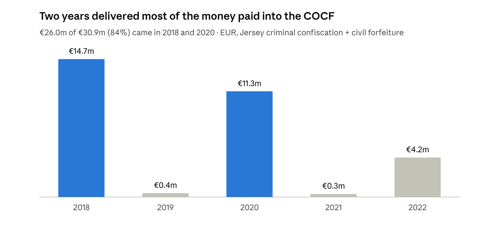
MONEYVAL(2024)7 Table 8.1 · funds recovered and paid into the COCF, 2018–2022
MER
The MER does not say what percentage of shared cases Jersey kept. It also gives no cumulative total for the Criminal Offences Confiscation Fund.
The last published figure is £62.87m received between 2004 and 2017, of which more than £43m was subject to asset-sharing agreements (Bailiwick Express, FOI figures).
About £14.8m of the Fund was spent on the new police headquarters in 2014 (States Assembly WQ.124/2018).
The language of asset recovery
The stages follow a set order. Assets are found, then frozen so they can't be moved, then taken permanently by a court order, and finally realised and paid out. In Jersey, each stage has its own term.
Rung 1: Find
Tracing. Investigators identify and follow the assets, using production orders, search powers, financial information orders and account monitoring orders. POCL Arts 40, 41, 41A and Sch. 3
Rung 2: Freeze
"No consent" (consent regime). When a firm reports a suspicion and requests the FIU's consent to act, the assets are frozen by law until consent is granted. Unlike a single-transaction freeze, it can cover everything a customer holds. In 2022, the FIU refused consent in 197 of 1,303 requests. POCL Art. 32(4); Proceeds of Crime (Financial Intelligence) (Jersey) Regulations 2015, Arts 3–4
Saisie judiciaire. The criminal-route freezing order. The Attorney General applies to the Royal Court, which can hear the application ex parte. Once it is granted, all of the defendant's realisable property vests in the Viscount. POCL Arts 15–16
Property Restraint Order. The civil-route freezing order. It prevents money from being withdrawn, transferred, or paid out of a specified bank account. Forfeiture of Assets (Civil Proceedings) (Jersey) Law 2018, Art. 12
Cash seizure and detention. An authorised officer may seize cash for up to 96 hours if they reasonably suspect it is tainted. The Bailiff can authorise detention for a longer period. Civil Forfeiture Law, Art. 5
Rung 3: Take permanently
Confiscation order. Made after a conviction. It orders the defendant to pay a sum equal to the benefit they derived from the crime. It is a payment order, not the seizure of a particular asset, and it can be backed by imprisonment in default. POCL Part 2
Assumed benefit. When setting a confiscation order, the court may assume that property the defendant held over the previous six years was obtained through crime. POCL; MER para 290
Forfeiture order (civil). A court order permanently taking "tainted" property, meaning property reasonably suspected of coming from or being used in unlawful conduct. No conviction is needed. Civil Forfeiture Law, Art. 2 (tainted property), Arts. 10–11 (summary procedure) and Art. 15 (general procedure)
Instrumentalities. The tools of the crime, not its profits. See the explanation below. POCL Art. 28B; Criminal Justice (Forfeiture Orders) (Jersey) Law 2001, Art. 2
External order. A confiscation or civil recovery order made by a foreign court and registered and enforced by the Royal Court against assets held in Jersey. POCL; Civil Asset Recovery (International Co-operation) (Jersey) Law 2007
Rung 4: Realise and pay out
Viscount. The Royal Court's executive officer. Manages frozen and restrained property, then realises it to satisfy orders. MER para 305
COCF (Criminal Offences Confiscation Fund). Receives money from criminal confiscation, instrumentality forfeiture and civil forfeiture, as well as shares received under asset-sharing agreements. POCL Art. 24; Civil Forfeiture Law Arts 11(5) and 15(7)
CARF (Civil Asset Recovery Fund). Receives money from external civil asset recovery orders, as in the Abacha case. Civil Asset Recovery (International Co-operation) (Jersey) Law 2007
Asset sharing / repatriation. An agreement to split recovered money with, or return it to, the country that was harmed or that helped. Jersey has a permanent sharing agreement with the US (2015) and signed its first case-specific agreement in 2022. POCL Art. 24; MER para 779
Instrumentalities explained
The proceeds of crime are what the criminal gains:
The bribe, the fraud money, the drug profits.
Instrumentalities are the means the criminal uses to commit the crime:
The cash being laundered, the bank account it passes through, the vehicle used to transport drugs, or the goods bought to convert dirty cash into clean value.
The difference matters because confiscation is based on benefit.
A defendant who says "I was only a courier, none of it was mine, and I made nothing" may have little or no benefit to confiscate.
Forfeiting instrumentalities gets around that.
The court takes the property because of how it was used, NOT BECAUSE OF what the defendant gained.
Jersey has two powers for this:
POCL Art. 28B gives the court power to forfeit instrumentalities as part of criminal proceedings.
Criminal Justice (Forfeiture Orders) (Jersey) Law 2001, Art. 2, allows forfeiture of property used or intended to be used to commit or facilitate any offence.
The Law Officers and the Royal Court have taken a firm view of what counts as an instrumentality.
Where money laundering is proven to have run through particular bank accounts, the entire account can be forfeited, including any legitimate funds in it.
The reasoning is that the clean funds helped disguise the dirty ones.
MONEYVAL called this "an interesting interpretation" and said it ensures
"Proper consequences are in place for an engagement in ML activity" (MER para 297).
The point for firms:
A customer whose account was used to launder money can lose the clean money in that account as well.
How the Proceeds of Crime (Jersey) Law 1999 frames instrumentalities
The Law does not treat instrumentalities as a side issue. It writes them in at every stage, from the definition through to the reporting duty. The ladder below follows the Law step by step (official consolidated version, 2 July 2025 – current).
Definition (Art. 1). "Instrumentalities" means "property used in or intended to be used in criminal conduct".
"Criminal conduct" means any Schedule 1 offence, which is any Jersey offence carrying one year's imprisonment or more.
Conduct abroad counts if it would have been an offence had it occurred in Jersey.
The phrase "intended to be used" means the property does not have to have been used yet.
Instrumentalities are criminal property (Art. 29(1)(b)). "Criminal property" includes "any property that is used in, or intended to be used in, criminal conduct", where the person knows or suspects that use.
It does not matter whose criminal conduct it is or who benefits (Art. 29(2)).
So clean money can be criminal property if it is intended to be used for a crime.
Dealing with them is money laundering (Arts 30 and 31).
Acquiring, using, possessing or controlling criminal property, or becoming concerned in an arrangement that helps someone else to do so, is an offence carrying up to 14 years (Art. 30).
Concealing, disguising, converting, transferring or removing it from Jersey is also an offence carrying up to 14 years (Art. 31).
Importing or exporting instrumentalities of drug trafficking is expressly prohibited (Art. 31(5)).
The court can take them (Art. 28B). When a defendant is sentenced for a Schedule 1 offence, the Attorney General may apply for an instrumentalities forfeiture order. The order can cover:
(a) property used or intended to be used in the offence;
(b) for money laundering offences, property used in the predicate conduct in Jersey;
(c) property those assets have been converted into; or
(d) an equivalent sum of money.
The order is limited to what is not disproportionate.
The court must consider the defendant's means, gifts, and any civil claims by victims (Art. 28B(3)–(4)).
Contested facts are decided to the civil standard (Art. 28B(11)).
The court must deal with instrumentalities' forfeiture before confiscation and must not count the same property twice (Art. 28B(5)).
The court can direct that the value be paid to compensate victims (Art. 28B(9)).
Article 28B was inserted by the Proceeds of Crime (Amendment No. 5) (Jersey) Law 2022, Art. 27, which came into force on 21 April 2022 (seven days after registration on 14 April 2022, under Art. 38 of that Law), and applies only to offences committed after it came into force (Art. 28B(2)). For earlier offences, prosecutors use the Criminal Justice (Forfeiture Orders) (Jersey) Law 2001, as in case study 3.
A protected disclosure covers instrumentalities too (Art. 32(1)(a)).
A disclosure to the FIU of a suspicion that property is the proceeds of crime "or property used in or intended to be used in criminal conduct" protects the person making the disclosure.
Acting with FIU consent is a defence to Articles 30 and 31 (Art. 32(3)–(4)).
This is the legal basis of the consent regime.
The duty to report covers instrumentalities expressly (Art. 34D(2)(c)).
In a financial services business, a person must report where they know, suspect, or have reasonable grounds to suspect that "any property has been, is being or is intended to be used in criminal conduct".
The report must go to the FIU or the nominated officer, in good faith, as soon as practicable (Art. 34D(4A)).
Failure to report is an offence carrying up to 5 years (Art. 34D(10)).
What does this mean for reporting
The SAR trigger looks forward as well as back.
Article 34D(2) has three separate limbs: (a) money laundering, (b) proceeds, and (c) property used or intended to be used in crime.
Funds that are entirely legitimate in origin must still be reported if there are grounds to suspect they are about to fund a bribe, a fraud, sanctions evasion or drug importation.
You do not have to identify a past crime first.
The test in a financial services business is partly objective.
"Reasonable grounds for suspecting" means a firm can commit an offence by failing to spot what it should have, not only by ignoring what it actually suspected.
Article 34A, which applies outside the financial services business, has no instrumentalities limb and no reasonable-grounds test.
It is triggered only by knowledge or suspicion that another person "is engaged in money laundering".
Processing the payment can be the offence.
Because instrumentalities are criminal property under Article 29(1)(b),
A firm that executes a transaction it suspects is intended to fund a crime may itself commit an offence under Article 30 or 31.
The protection is to report and get consent first (Art. 32(4)(a)).
Expect the whole relationship to be frozen.
A consent request regarding intended use can result in a no-consent decision that covers everything the customer holds.
After a conviction, an Article 28B order can take the property used in the crime, including the account the money passed through.
Write the SAR in the Law's terms.
If your concern is what the money is to be used for rather than where it came from, say so plainly and cite Article 34D(2)(c).
That tells the FIU your suspicion is about instrumentalities, not proceeds.
Case law: the account as the tool of the crime
The leading Jersey authority is the Ellis litigation. It concerned a bank account at the Jersey branch of Standard Chartered that had been opened to evade tax. It shows exactly why going after instrumentalities gets around the argument "I only benefited by the tax I didn't pay".
AG v Ellis [2019] JRC 141 (Royal Court, 22 July 2019).
The Attorney General used the summary procedure in the Forfeiture of Assets (Civil Proceedings) (Jersey) Law 2018. Under that procedure, the burden was on the respondent to satisfy the Court, on the balance of probabilities, that the account was not tainted. He could not.
The Court accepted that the money came from his legitimate taxi and car-dealing businesses, not from drugs. It found that he had paid it into the account as part of a dishonest scheme to under-declare his income to HMRC.
The account, holding £33,804.52, was therefore "used in, or intended to be used in, that unlawful conduct" (para 42).
AG v Ellis [2019] JRC 219 (Royal Court, 31 October 2019, Commissioner Clyde-Smith sitting alone). This hearing decided how much should be forfeited.
The Attorney General argued that the definition of instrumentalities was wide enough to reach legitimately owned assets, "such as aircraft or boats used to transport drugs or, as in this case, an account in Jersey used to evade tax" (para 17).
He accepted that the concept "could be taken very far": to the clothes a courier wore, the car he drove to the airport, or the flat he owned nearby (para 19).
The respondent gave the example of a friend who lets £1,000 of drug money pass through an account holding £100,000 of life savings. Should all the savings be forfeited (para 20)?
Article 11(4) allows forfeiture of the property "or any part of it" (para 21).
Holding: relying on R v Waya [2012] UKSC 51 and Ahmed v HMRC [2013] EWHC 2241 (Admin), "it would be disproportionate for the entire Account, comprising, as it does, the respondent's legitimately earned moneys, to be forfeited".
The order "should be limited to that part which represents the evaded tax and, arguably, penalties and interest" (para 23). The burden of showing that the order sought was proportionate was put on the Attorney General (para 28).
AG v Ellis [2020] JCA 098 (Court of Appeal, 1 June 2020). The Court of Appeal allowed the Attorney General's appeal against [2019] JRC 219 and held:
"The Account was opened for the purpose of committing unlawful tax evasion" (para 48).
It was therefore an instrumentality, and the whole balance was tainted, not just the tax evaded.
Ahmed "was dealing only with the proceeds of crime" (para 43). The English regime covers only proceeds, whereas the Jersey Law also covers property used in unlawful conduct, so Ahmed "is not in any sense a precedent which should be followed" (para 40(ii)).
For instrumentalities, how much is forfeited depends on the facts, "taking into account, for example, the degree of proximity between the property and the unlawful conduct" (para 54).
"The evidential burden in relation to proportionality is plainly on the Respondent" (para 55). This reverses the Royal Court's view that the burden lay on the Attorney General. It is an evidential burden, not a legal burden of proof.
AG v Ellis [2020] JRC 245 (Royal Court, 24 November 2020, on remittal).
The Court found the account "was opened and used in its entirety as a tool or instrumentality to commit tax evasion" and
Held that "the forfeiture of the entire account" was proportionate (paras 10–11).
Proportionality still applies.
Ellis does not mean every asset touched by a crime is forfeited.
The examples argued in [2019] JRC 219 (the courier's clothes, the friend's life savings) and the Court of Appeal's "proximity" test show the limit.
The closer the property is to the unlawful conduct, the more of it can be taken.
An account opened for the purpose of the crime is about as close as it gets.
Why it matters.
If only the proceeds could be taken, Ellis would have lost only the tax he evaded. Because the account itself was the tool of the crime, he lost the whole balance.
The same reasoning lies behind the approach MONEYVAL describes in criminal money laundering cases (MER para 297).
On the criminal route,
The clearest example is the Umurzokov case (case study 3 below). The sentencing judgment is published (AG v Umurzokov and Ors [2022] JRC 101).
The forfeiture of the cash and goods that followed in October 2022 is recorded only in MONEYVAL Case Study 8.1.
In writing this blog, the author found no reported judgment under Article 28B, which applies only to offences committed on or after 21 April 2022.
The law restricts what the COCF can be spent on.
The money must go on preventing or dealing with criminal conduct or its consequences, on meeting asset-sharing obligations, or on running the Fund (POCL Art. 24). It is not a general fund for community projects.
Criminal route versus civil route
The basic difference is what the court is targeting. The criminal route goes after the person: it requires a conviction and then makes them pay back what they gained. The civil route comes after the property: it asks whether the money is tainted and whether anyone is ever convicted.
Main law
Criminal: Proceeds of Crime (Jersey) Law 1999
Civil: Forfeiture of Assets (Civil Proceedings) (Jersey) Law 2018, in force 20 August 2018
Aimed at
Criminal: the offender, who is ordered to pay a sum
Civil: the property itself ("tainted property")
Precondition
Criminal: a conviction in Jersey, or abroad if a foreign order is being enforced
Civil: none. Used when a prosecution isn't possible, for example, because the evidence is abroad, the case is old, or the suspect is out of reach.
Standard of proof
Criminal: conviction to the criminal standard (beyond reasonable doubt)
Civil: the civil standard. MONEYVAL counts this as the route's main advantage (para 299). Under the summary procedure, the burden is reversed: once notice is served, the respondent must satisfy the Court that the property is not tainted (Civil Forfeiture Law Art. 11(2)–(4); AG v Ellis [2019] JRC 141). On proportionality, the Court of Appeal places an evidential burden on the respondent (AG v Ellis [2020] JCA 098, para 55).
Freezing tool
Criminal: saisie judiciaire, which vests the realisable property in the Viscount
Civil: cash seizure (96 hours, then extended by the Bailiff) or a Property Restraint Order over a bank account
What can be taken
Criminal: any realisable property up to the value of the benefit, including legitimate assets of equal value and some gifts. Instrumentalities can be forfeited as well.
Civil: only the tainted cash or bank funds. Where funds are mixed, only the tainted part.
Penalty if unpaid
Criminal: imprisonment in default
Civil: not applicable, because the property itself is forfeited
Who brings it
Criminal: Attorney General (in practice, the ECCU, which sits within the Law Officers' Department)
Civil: Attorney General
Where the money goes
Criminal: COCF
Civil: COCF (Civil Forfeiture Law Arts 11(5) and 15(7)). External civil orders go to the CARF.
Results, 2018 – 2022
Criminal: €11.5m from 127 confiscation cases
Civil: €19.5m. MER Table 8.10 lists 9 civil forfeiture orders totaling about €18.5m (2018 – 2023).
In practice, the two routes run on from each other, and both usually begin with a suspicious activity report:
A firm files a SAR and asks for consent. The FIU refuses, and the assets are frozen by law.
The FIU passes intelligence to the ECCU, JFCU or Customs, which investigate and trace the assets.
If the evidence supports a prosecution, the Attorney General obtains a saisie judiciaire, prosecutes, and after conviction seeks a confiscation order.
If it won't, the Attorney General obtains a Property Restraint Order and applies for civil forfeiture.
If a foreign court has already made an order, the Royal Court registers and enforces it.
The Viscount realises the assets. The proceeds are paid into the COCF or CARF and then shared or returned under an asset-sharing agreement, where applicable.
MONEYVAL VERDICT
MONEYVAL's verdict is that civil forfeiture "brought more tangible results than conviction-based confiscation" (para 299).
For an international finance centre, where the predicate crime and the evidence are usually overseas, that is to be expected. It also reflects a weakness:
Jersey is better at taking the money than at convicting the people who launder it.
Four cases that show each route at work
1. Abacha: enforcing a foreign civil order (about €280m).
Proceeds of corruption from Nigeria's 1993–1998 military regime passed through the US banking system and ended up in Jersey bank accounts. In 2014, the Attorney General obtained a Property Restraint Order under the Civil Asset Recovery (International Co-operation) Law.
The account holder challenged it in the Royal Court and the Court of Appeal and lost both times, and was refused permission to appeal to the Privy Council.
A US forfeiture judgment became final in 2018, and the Royal Court registered and enforced it in 2019.
Under a February 2020 three-way agreement between Jersey, Nigeria and the US, more than US$300m was returned to Nigeria for specified infrastructure projects, with independent auditing and monitoring by civil society (MER Case Study 8.3).
A no-consent freeze turned into civil forfeiture.
A SAR in 2007 led the FIU to refuse consent over funds linked to a senior Nigerian military and political figure.
After the 2018 Civil Forfeiture Law took effect, the authorities reviewed prior no-consent cases. This case went to the ECCU, which decided that the case's age made a prosecution unworkable. It took the civil route instead. In 2022, about £448k, €295k and US$1.75m were forfeited, and the Court rejected a human-rights appeal over access to the funds to pay legal fees (Case Study 8.2).
3. Instrumentalities: when the launderer says "it isn't my money" (the Umurzokov case, MONEYVAL Case Study 8.1).
Muhiddin Umurzokov and Anvarjon Eshonkulov, both from Uzbekistan, and Batsukh Bataa, from Mongolia, were arrested in Jersey in October 2021.
The Law Officers' Department described them as "a professional team who had been contracted to launder cash" for a separate organised crime group.
They tried to convert Jersey banknotes through the Post Office, banks, car dealerships and retailers. Island banks and businesses "generally identified the risk that the funds were criminal in nature" and refused many of the transactions. The defendants still bought mobile phones, other devices and clothing, and made 13 currency conversions totaling about £36,000.
All three pleaded guilty to 22 money laundering counts. On 25 April 2022, the Royal Court sentenced them to four, three and three years' imprisonment (AG v Umurzokov and Ors [2022] JRC 101).
The Crown asked to postpone confiscation until 2023, and the Deputy Bailiff refused. The Court allowed "a short extension of the six-month period following conviction permitted by statute" and listed the confiscation hearing for "the first open date after the 1st September 2022 (para 2).
The defendants denied benefiting from the offences and denied that the money was theirs, saying they had laundered it for the organised crime group.
A confiscation order depends on proving benefit, so the prosecution dropped the planned confiscation hearing. Instead, it applied for a forfeiture order under Article 2 of the Criminal Justice (Forfeiture Orders) (Jersey) Law 2001, which covers property used or intended to be used to commit or facilitate an offence. The defendants did not oppose it.
In October 2022, the Court forfeited £15,432 in cash, €2,550 in cash and goods worth £20,155 bought with the cash (MER Case Study 8.1).
Why the 2001 Law and not Article 28B?
Article 28B applies "only to offences committed after it comes into force" (Art. 28B(2)). It came into force on 21 April 2022, six months after the arrests.
The older 2001 Law was the only route available. No judgment on the forfeiture order has been published, which is consistent with an uncontested application. Instrumentalities are explained in the section on the language of asset recovery above.
Later context.
In December 2024, the UK National Crime Agency's Operation Destabilise exposed a multi-billion-dollar Russian-linked laundering network linking Russian sanctions evaders, Colombian cartels and British drug gangs.
The operation produced 84 arrests across the network. The Jersey Evening Post then reported that the trio had been working for a "UK organised crime group" and were "bit players" in that wider conspiracy (JEP, 5 December 2024).
That description comes from reporting two and a half years after sentencing. The 2022 judgment, the Law Officers' statement and the MONEYVAL case study do not say where the instructing group was based. Treat the "UK" label as a later characterisation, not a finding of the court.
The same December 2024 reporting describes what Jersey police found on the defendants' phones and in their papers. None of this was tested in court, and the defendants were not charged with any of it in Jersey.
BBC: evidence from "seized mobile phones, documentation, receipts and lists revealed their possible involvement in sub-letting UK properties paid for in cash, human and drug trafficking or prostitution" (BBC, 5 December 2024).
Jersey Evening Post: police found "pictures of them counting wads of cash" and "messages between them and other criminals". The trio held "the identities of Uzbekistanis, Hungarians, Latvians and Romanians" who had entered the UK illegally, to be housed in the sublet properties. There were "huge sums of money moving in and out of their bank accounts", with substantial transfers to and from UK business accounts. One such business account had £4.31m pass through it in ten months in 2021–22. "All the information was subsequently passed on to the UK authorities" (JEP, 5 December 2024).
LESSONS
Neither report says the defendants owned or controlled that business account, or that the £4.31m was theirs.
For firms, this is the real lesson of the case. The £60,000 the trio tried to launder in Jersey was the small, visible part of a much larger operation.
Local banks and businesses spotted the warning signs, refused the transactions and raised the alarm.
That led to the arrests and to the seizure of the devices that revealed the rest.
4. Kenya: returning money directly to the victim state.
In 2016, a Jersey company pleaded guilty to money laundering connected to Kenyan public corruption, and a confiscation order of about £3.6m followed (Basel Institute).
In 2022, Jersey signed an asset recovery agreement and returned about €3.3m to Kenya (MER Table 8.4).
Where MONEYVAL wants more
The Substantial rating comes with clear criticisms.
One of the report's priority actions tells Jersey to "enhance its efforts to increase the seizure and confiscation for ML offences only, and from tax offences committed abroad."
Money laundering offences.
Confiscation tied to the money laundering offence itself came to €435,827 over the whole review period (para 293), and most convictions involve self-laundering. This matches the Moderate rating for investigation and prosecution under IO.7.
Foreign tax crime.
The NRA names tax evasion as one of the three main threats from abroad. Yet from 2018 to H1 2023, only one tax case resulted in the confiscation of €44,087 (Table 8.8).
Recovering assets held abroad.
Jersey sent 9 outgoing freezing or confiscation requests over five years, totaling €324,309 (Table 8.3).
MONEYVAL suggests a "more active role" in going after offenders' assets held outside the island (para 302).
Cash.
Tainted cash is regularly found and forfeited.
But no sanction beyond forfeiture has been imposed, so MONEYVAL could not assess whether sanctions are dissuasive.
Put simply,
Jersey is very good at stopping and returning other countries' dirty money that passes through it.
It is less effective at prosecuting the professionals and structures that move that money.
What does this mean for regulated firms?
Every recovery in this article began with a firm's records, and most began with a firm's SAR. The MLRO's desk is where asset recovery starts.
A consent request freezes everything.
About 14% of SARs include one, and a refusal can cover a customer's entire holdings, including complex structures, for months or years.
Plan for that before you file: how you will manage the relationship, how you will avoid tipping off, and how you will respond if the customer goes to court.
Report early.
MONEYVAL found that some firms' policies "do not always ensure prompt reporting".
A late SAR gives the money time to leave before a no-consent freeze can catch it.
Your records are the evidence.
Source of funds and source of wealth files, beneficial ownership records and transaction histories are what investigators obtain under production orders.
MONEYVAL's priority actions specifically mention gaps in SOF and SOW for legacy customers.
Old freezes can still lead to forfeiture.
Jersey reopened no-consent cases from before 2018 and forfeited the funds. The 2018 Law's summary procedure is designed for this. Where the FIU refused consent on an account at least 12 months earlier, the Attorney General can serve notice on the account holder, who must then satisfy the Royal Court that the money is not tainted (Civil Forfeiture Law Arts 10–11). Accounts frozen years ago can still end up forfeited, so keep the file complete.
Third parties are protected, but only if they can show it.
POCL and the Civil Forfeiture Law protect bona fide third parties.
Firms holding assets for others should be able to show good faith from their own records.
Sources
All web sources below were opened and checked on 12 October 2026.
Legislation
Proceeds of Crime (Jersey) Law 1999, official consolidated version (2 July 2025 to current): Arts 1, 24, 28B, 29–32, 34A–34D and Schedule 1
https://www.jerseylaw.je/laws/current/l_8_1999Proceeds of Crime (Amendment No. 5) (Jersey) Law 2022 (L.8/2022), enacted text: registered 14 April 2022, in force 21 April 2022; Art. 27 inserts Art. 28B
https://www.jerseylaw.je/laws/enacted/Pages/L-08-2022.aspxForfeiture of Assets (Civil Proceedings) (Jersey) Law 2018, current version: Arts 2, 5, 10–12 and 15
https://www.jerseylaw.je/laws/current/l_26_2018Criminal Justice (Forfeiture Orders) (Jersey) Law 2001, current version: Art. 2
https://www.jerseylaw.je/laws/current/l_6_2001Jersey and Guernsey Law Review, legislation notes JGLR 2022(2)
https://www.jerseylaw.je/publications/jglr/Pages/JGLR2202_Legislation.aspx
Case law
AG v Ellis [2019] JRC 141, Royal Court, 22 July 2019
https://www.jerseylaw.je/judgments/unreported/Pages/[2019]JRC141.aspxAG v Ellis [2019] JRC 219, Royal Court, 31 October 2019 (text checked against the copy supplied by Comsure)
https://www.jerseylaw.je/judgments/unreported/Pages/[2019]JRC219.aspxAG v Ellis [2020] JCA 098, Court of Appeal, 1 June 2020
https://www.jerseylaw.je/judgments/unreported/Pages/[2020]JCA098.aspxAG v Ellis [2020] JRC 245, Royal Court, 24 November 2020
https://www.jerseylaw.je/judgments/unreported/Pages/[2020]JRC245.aspxAG v Umurzokov and Ors [2022] JRC 101, Royal Court, sentencing, 25 April 2022 (the web page and PDF block automated access; the para 2 text was supplied by Comsure)
https://www.jerseylaw.je/judgments/unreported/Pages/[2022]JRC101.aspx
MONEYVAL and FATF
MONEYVAL(2024)7, Jersey Fifth Round Mutual Evaluation Report (May 2024): IO.6 paras 179–181 and Table 6.6; IO.8 paras 280–307, 317–322, Tables 8.1–8.10 and Case Studies 8.1–8.3; IO.2 paras 777–779; R.4 and R.38
https://rm.coe.int/moneyval-2024-7-5thround-mer-jers/1680b10dd7FATF, Jersey Mutual Evaluation Report 2024 (publication page)
https://www.fatf-gafi.org/en/publications/Mutualevaluations/MER-Jersey-2024.html
Government of Jersey and States Assembly
Law Officers' Department, International Assistance and asset recovery agreements (Nigeria 2020, Kenya 2022, Nigeria 2024)
https://www.gov.je/Government/NonexecLegal/LawOfficers/Pages/InternationalAssistance.aspxGovernment of Jersey news, Money laundering case in the Royal Court (27 April 2022)
https://www.gov.je/News/2022/pages/moneylaunderingcase.aspxStates Assembly WQ.124/2018, Criminal Offences Confiscation Fund allocations 2014–2018 (police station £14,775,677)
https://statesassembly.je/getmedia/a4bfeeb3-d6cf-4677-9f91-af1303861f39/(124)%20APPROVED%20AND%20ANSWERED%20Dep%20Higgins%20to%20TR%20re%20Criminal%20Offences%20Compensation%20Fund.pdf?ext=.pdf
Other sources
US Department of Justice, repatriation of Abacha assets (US$311.7m located in Jersey, 2020)
https://www.justice.gov/opa/pr/united-states-repatriates-over-20-million-assets-stolen-former-nigerian-dictatorBasel Institute on Governance, Government of Kenya to recover GBP 3.6 million from Jersey (25 February 2016)
https://baselgovernance.org/resources/news/government-of-kenya-to-recover-gbp-36-million-from-jersey-124Bailiwick Express, Criminal confiscations fund received over £62 million since 2004 (24 November 2017)
https://www.bailiwickexpress.com/news/jersey-no-place-hide-proceeds-crime/Jersey Evening Post, Trio jailed for trying to launder crime-gang cash (26 April 2022)
https://jerseyeveningpost.com/news/2022/04/26/trio-jailed-for-trying-to-launder-crime-gang-cash/ITV News Channel, Three people sentenced for attempted money laundering in Jersey (25 April 2022)
https://www.itv.com/news/channel/2022-04-25/three-people-sentenced-for-attempted-money-laundering-in-jerseyComsure, Professional money launderers jailed in Jersey
https://www.comsuregroup.com/news/professional-money-launderers-jailed-in-jersey/Jersey Evening Post, Combating a global criminal conspiracy (5 December 2024)
https://jerseyeveningpost.com/news/2024/12/05/combating-a-global-criminal-conspiracy/BBC News, report of 5 December 2024 on the Jersey arrests and Operation Destabilise (link and quotes supplied by Comsure; the BBC site blocks automated access, so not independently opened)
https://www.bbc.co.uk/news/articles/c0lgp05zy4zo
Currency: The MER reports in euros at its own conversion rates. Treasury and States Assembly figures are in sterling. Euro and sterling figures have not been converted and should not be added together.
The Team
Meet the team of industry experts behind Comsure
Find out moreLatest News
Keep up to date with the very latest news from Comsure
Find out moreGallery
View our latest imagery from our news and work
Find out moreNews Disclaimer
As well as owning and publishing Comsure's copyrighted works, Comsure wishes to use the copyright-protected works of others. To do so, Comsure is applying for exemptions in the UK copyright law. There are certain very specific situations where Comsure is permitted to do so without seeking permission from the owner. These exemptions are in the copyright sections of the Copyright, Designs and Patents Act 1988 (as amended)[www.gov.UK/government/publications/copyright-acts-and-related-laws]. Many situations allow for Comsure to apply for exemptions. These include 1] Non-commercial research and private study, 2] Criticism, review and reporting of current events, 3] the copying of works in any medium as long as the use is to illustrate a point. 4] no posting is for commercial purposes [payment]. (for a full list of exemptions, please read here www.gov.uk/guidance/exceptions-to-copyright]. Concerning the exceptions, Comsure will acknowledge the work of the source author by providing a link to the source material. Comsure claims no ownership of non-Comsure content. The non-Comsure articles posted on the Comsure website are deemed important, relevant, and newsworthy to a Comsure audience (e.g. regulated financial services and professional firms [DNFSBs]). Comsure does not wish to take any credit for the publication, and the publication can be read in full in its original form if you click the articles link that always accompanies the news item. Also, Comsure does not seek any payment for highlighting these important articles. If you want any article removed, Comsure will automatically do so on a reasonable request if you email info@comsuregroup.com.
Archived News
To find our older articles, please click here.
View archive

To find our older articles, please click here.