




 Published on : 05/05/2026
Implementing AI: Intelligent Prevention with Embedded Human Oversight
Organisations are rushing to implement Artificial Intelligence [AI] at scale; it is no longer a futuristic experiment; it’s the engine powering digital-first businesses today.
- From automating customer service to optimising supply chains.
However, with great capability comes great risk.
- Biased models, data leaks, hallucinations that mislead decisions, and unexpected failures in production environments are no longer theoretical threats.
- They are real, costly, and often invisible until it’s too late.
The traditional approach to managing these risks, layering on human supervision and post-deployment checks, simply doesn’t scale in an AI-driven world.
- Manual reviews can’t keep pace with models that generate millions of decisions per hour.
- Reactive audits catch problems after they’ve already impacted customers, revenue, or reputation.
Good control design in the future will look less like supervision and more like intelligent prevention.
This is the fundamental shift organizations must make.
- Instead of asking, “Did someone check it?”
- The new mindset must be: “Could it go wrong at all?”
Intelligent prevention means
- Embedding controls directly into the AI lifecycle,
- From design through training, deployment, and ongoing operation.
Intelligent prevention means:
- Automated guardrails that detect bias or drift in real time.
- Proactive simulation of failure scenarios before models ever touch live data.
- Self-healing systems that flag and quarantine risky outputs instantly.
- Governance frameworks that treat risk as a feature, not an afterthought.
Humans - This is exactly where HUMAN oversight and governance must be embedded.
- Humans don’t disappear from the equation; they move upstream.
- Leaders and risk teams define the ethical boundaries, risk appetite, and “non-negotiable” principles that the intelligent controls then enforce at machine speed.
- Governance becomes the operating system for prevention: setting the rules the AI cannot break, reviewing exceptions in real time, and continuously updating the guardrails as the business and technology evolve.
- Without this human layer, even the smartest prevention systems drift into dangerous territory. With it, oversight becomes strategic, proactive, and truly scalable.
In a digital-first world, controls don’t just support the business; they define how safely it can scale.
- When prevention is built in, and human governance is intelligently embedded, AI becomes a trusted multiplier rather than a hidden liability.
- Companies that master this shift won’t just move faster; they’ll move farther, with confidence that their systems are resilient by design.
- The era of bolting on controls after the fact is over. The winners in AI will be those who treat intelligent prevention powered by embedded human oversight and governance as the new standard of excellence.
Questions
- The question isn’t whether your AI will face risks it will.
- The real question is whether your controls are smart enough, and your governance strong enough, to stop them before they start.
Image sourced from LinkedIn
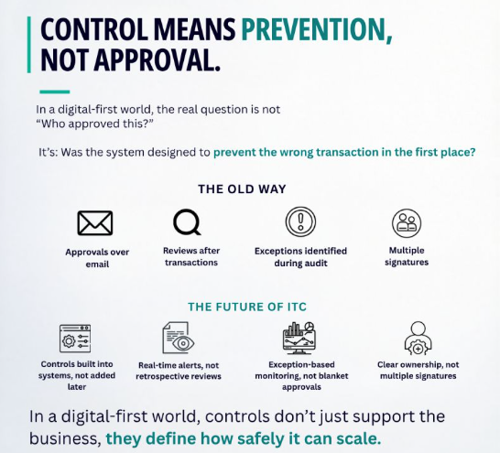
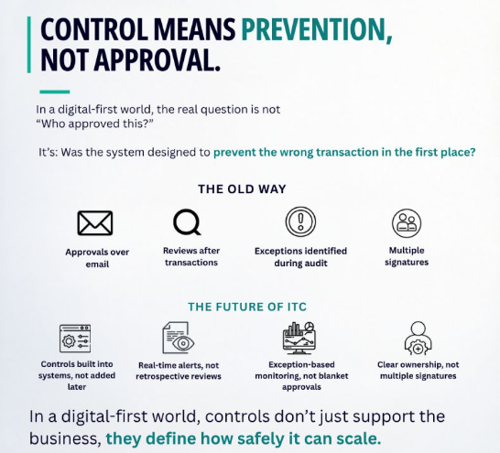
For years, internal controls were designed around people maker–checker, approvals, and physical reviews. But in a digital-first organisation, that model begins to break down. Because today, transactions don’t wait for approvals. They move through systems - APIs, automated workflows, real-time integrations. And that changes everything.
The question is no longer: “Who approved this?” It’s: “Was the system designed to prevent the wrong transaction in the first place?” In many companies, I still see controls outside the system: Approvals via email; Reviews after transactions; Exceptions identified during audits. That’s not control. That’s post-mortem. The future of IFC is different:
-Controls built into systems, not added later
-Real-time alerts, not retrospective reviews
-Exception-based monitoring, not blanket approvals
-Clear ownership, not multiple signatures
In a digital environment, too many manual controls don’t reduce risk; they create blind spots. Because while people are busy approving, the system has already moved ahead. Good control design in the future will look less like supervision and more like intelligent prevention.
The shift we need is from “Did someone check it?” to “Could it go wrong at all?” Because in a digital-first world, controls don’t just support the business, they define how safely it can scale.
SOURCES
- https://www.linkedin.com/feed/update/urn:li:groupPost:1174257-7457290400073105409?utm_source=share&utm_medium=member_desktop&rcm=ACoAAAA_6EIB0wPAWyjQcuq_XiD3asUV8xpMeZ0
- AI Governance: 5 Ways to Embed AI Oversight into GRC https://riskonnect.com/ai/ai-governance-embed-ai-oversight-grc/
- What is AI Governance? (IBM) – Excellent on automated guardrails and lifecycle controls https://www.ibm.com/think/topics/ai-governance
- Article 14: Human Oversight – EU Artificial Intelligence Act (official legal foundation) https://artificialintelligenceact.eu/article/14/
- AI Governance: A Guide to Responsible AI for Boards (Diligent) https://www.diligent.com/resources/blog/ai-governance
- Can Your Governance Keep Pace with Your AI Ambitions? (AWS – proactive/dynamic governance) https://aws.amazon.com/blogs/machine-learning/can-your-governance-keep-pace-with-your-ai-ambitions-ai-risk-intelligence-in-the-agentic-era/
- AI Risk Mitigation: Turning Compliance Into Continuous Protection (proactive prevention focus) https://www.obsidiansecurity.com/blog/ai-risk-mitigation
- Embedding Ethical Oversight in AI Governance through Independent Review https://www.responsible.ai/news/embedding-ethical-oversight-in-ai-governance-through-independent-review/
- Keeping AI in Check: The Critical Role of Human Agency and Oversight https://www.nemko.com/blog/keeping-ai-in-check-the-critical-role-of-human-agency-and-oversight
- AI Governance vs. AI Compliance: Why Governance Is the Key (proactive vs reactive) https://www.cyera.com/blog/ai-governance-vs-ai-compliance-why-governance-is-the-key-to-ai-security-readiness
- Top 6 Trends in Artificial Intelligence (AI) Risk Management (Riskonnect) https://riskonnect.com/ai/top-6-trends-in-artificial-intelligence-ai-risk-management/
The Team
Meet the team of industry experts behind Comsure
Find out moreLatest News
Keep up to date with the very latest news from Comsure
Find out moreGallery
View our latest imagery from our news and work
Find out moreNews Disclaimer
As well as owning and publishing Comsure's copyrighted works, Comsure wishes to use the copyright-protected works of others. To do so, Comsure is applying for exemptions in the UK copyright law. There are certain very specific situations where Comsure is permitted to do so without seeking permission from the owner. These exemptions are in the copyright sections of the Copyright, Designs and Patents Act 1988 (as amended)[www.gov.UK/government/publications/copyright-acts-and-related-laws]. Many situations allow for Comsure to apply for exemptions. These include 1] Non-commercial research and private study, 2] Criticism, review and reporting of current events, 3] the copying of works in any medium as long as the use is to illustrate a point. 4] no posting is for commercial purposes [payment]. (for a full list of exemptions, please read here www.gov.uk/guidance/exceptions-to-copyright]. Concerning the exceptions, Comsure will acknowledge the work of the source author by providing a link to the source material. Comsure claims no ownership of non-Comsure content. The non-Comsure articles posted on the Comsure website are deemed important, relevant, and newsworthy to a Comsure audience (e.g. regulated financial services and professional firms [DNFSBs]). Comsure does not wish to take any credit for the publication, and the publication can be read in full in its original form if you click the articles link that always accompanies the news item. Also, Comsure does not seek any payment for highlighting these important articles. If you want any article removed, Comsure will automatically do so on a reasonable request if you email info@comsuregroup.com.
Archived News
To find our older articles, please click here.
View archive

To find our older articles, please click here.