

GUERNSEY REGULATORY RISK FOLLOWING Mitchell v Sheikh Mohamed Bin Issa Al Jaber decision
08/12/2025
London, 24 November 2025, The UK Supreme Court
- Has reinstated a €67 million award to the Krys Global liquidators in Mitchell & another v Sheikh Mohamed Bin Issa Al Jaber & another,
- Confirmed that a director who acts after a company’s liquidation can assume fiduciary duties and be held accountable for misappropriation.
- Clarified that there is no set time from which equitable compensation must be measured, and the burden is on the fiduciary to prove any events reducing that loss
GUERNSEY REGULATORY RISK FOLLOWING Mitchell v Sheikh Mohamed Bin Issa Al Jaber decision
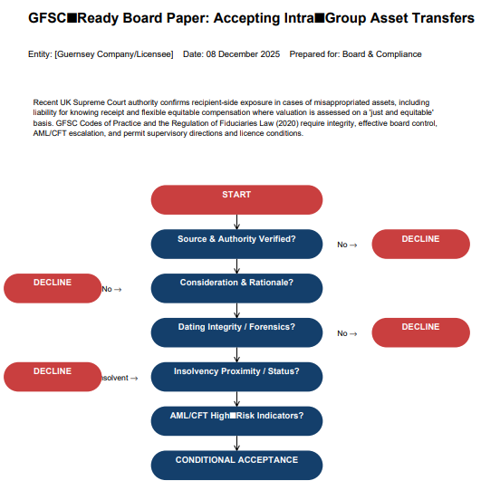
- Recent UK Supreme Court authority confirms that recipients of misappropriated assets can face knowing receipt liability and equitable compensation, even when the transferor's formal authority is disputed (e.g., post‑liquidation) and valuation is not fixed at the trial date but assessed on a “just and equitable” basis.
- This heightens recipient‑side risk where shares are transferred for no consideration on backdated forms within a group.
- For GFSC‑regulated firms, the Codes of Practice for Directors/CSPs/TCSPs and the Regulation of Fiduciaries Law, 2020 require integrity, effective board control, AML/CFT escalation, and permit supervisory directions, licence conditions, and skilled person reviews where governance is deficient.
CONCISE RISK BRIEFING FOR THE GUERNSEY COMPANY (THE ASSOCIATED RECIPIENT ENTITY)
- Below is a concise risk briefing for the Guernsey company (the associated recipient entity) in which shares were transferred for no consideration on backdated forms, with an emphasis on the exposure if the entity is regulated by the Guernsey Financial Services Commission (GFSC).
1) Civil & Insolvency Exposure
a) Knowing receipt / unjust enrichment
- In Mitchell v Sheikh Mohamed Bin Issa Al Jaber (No 2) [2025] UKSC 43, the courts found the Guernsey recipient company liable in knowing receipt where it took misappropriated assets for no consideration from a company in liquidation.
- This establishes exposure to equitable compensation and restitution, even where formal title/powers are disputed. [supremecourt.uk]
- The Supreme Court emphasised that liability could attach where a recipient participates in or benefits from an unauthorised transfer and cannot provide an innocent explanation for subsequent events that destroy value; valuation of loss is assessed on a “just and equitable” basis, not fixed at the trial date. [natlawreview.com]
b) Transactions at undervalue & insolvency remedies
- Under Guernsey law, directors face exposure where the company engages in transactions at an undervalue, preferences, or fraudulent/wrongful trading in proximity to insolvency (Companies (Guernsey) Law, 2008), increasing the risk of personal liability, compensation orders, or disqualification. [mourant.com]
2) Directors’ & Officers’ Liability (Guernsey law)
- Guernsey directors owe duties to act bona fide, for proper purposes, avoid conflicts, and exercise care, skill and diligence.
- Acceptance of assets for no consideration in circumstances of misappropriation may breach these duties—triggering personal liability. [bedellcristin.com]
- Guernsey recognises that de facto/shadow directors and anyone “occupying the position of director” can be treated as directors for duty purposes, widening the net of potential liability where individuals orchestrate or approve problematic transfers. [mourant.com]
3) Regulatory Risks if the Recipient is GFSC‑Regulated
a) Breach of GFSC Codes of Practice
-
- The Company Directors' Code of Practice requires directors to understand and act in accordance with legal duties (including AML/CFT) and ensure the board has effective control. Accepting misappropriated assets or relying on backdated instruments can be seen as failures of integrity, governance, and control. [gfsc.gg]
- Corporate Service Providers (CSP) Code and Trust Service Providers (TSP) Code emphasise integrity, competence, and not contracting out of responsibilities. Failures may influence GFSC decisions on fitness & propriety, supervisory direction, or licence conditions. [gfsc.gg], [gfsc.gg]
b) GFSC supervisory powers, directions & sanctions
-
- Under the Regulation of Fiduciaries, Administration Businesses and Company Directors, etc. (Bailiwick of Guernsey) Law, 2020, the GFSC may issue directions, impose or vary licence conditions, require skilled person reviews, and take enforcement action where principles of conduct are breached, or governance is inadequate. [guernseyle…sources.gg]
- The GFSC framework also enables requirements for information production, auditor engagement, and possible public statements affecting reputation where systemic governance weaknesses are identified. [guernseyle…sources.gg]
c) AML/CFT implications
-
- Directors are expected to understand relevant AML/CFT laws and ensure suspicious transactions are escalated. Accepting asset transfers for no consideration from a distressed/insolvent group on backdated documentation raises obvious red flags (source of funds/wealth, legitimacy of the transfer, potential proceeds of crime).
- Failure to apply enhanced due diligence or to consider SAR obligations can constitute code breaches. [gfsc.gg]
4) Litigation & Enforcement Pathways
- Restitutionary claims by liquidators: exposure to equitable compensation for the value of the shares at a just and equitable valuation date; burden on the company to show supervening events reducing loss are innocent. [natlawreview.com]
- Court directions and relief: Guernsey courts may consider directors’ conduct under common law fiduciary principles and Companies Law—reinforced by cross-border precedents such as Mitchell v Al Jaber, which treated substance over form and imposed robust remedies. [bedellcristin.com]
- Regulatory action by GFSC: potential licence variations, business restrictions, public censure, or revocation in extreme cases, especially where failures indicate systemic governance or AML weaknesses. [guernseyle…sources.gg]
5) Practical Risk Mitigations (for the Guernsey recipient)
a)Immediate legality review & remediation
-
- Commission independent legal review of the transfer chain, with board minutes recording independence, scope, and findings. If misappropriation is indicated, consider reversing the transfer or negotiating restitution with liquidators. [Supreme Court.uk]
b)Board governance controls
-
- Re‑confirm authority for all asset transfers; prohibit acceptance of assets lacking consideration or where documentation is backdated; implement dual‑control and legal sign‑off for share register changes. [gfsc.gg]
c) Directors’ fiduciary training & conflicts management
-
- Refresh training on Guernsey fiduciary duties; update conflicts registers; enforce recusal where group relationships create potential self-dealing. [bedellcristin.com], [mourant.com]
d) AML/CFT escalation
-
- Apply EDD to high-risk intra-group transfers, verify legitimacy with independent evidence, and assess whether circumstances warrant a Suspicious Activity Report. Document the rationale and outcomes. [gfsc.gg]
e) Regulatory engagement
-
- If regulated, brief the GFSC proactively on governance enhancements (e.g., appointing a skilled person, reinforcing board oversight) to mitigate supervisory concerns. [guernseyle…sources.gg]
6) Bottom Line
- The UKSC ruling confirms that recipients of misappropriated assets—especially those within the same group—face real civil exposure (knowing receipt, equitable compensation) even where formalities are contested. The directors of the Guernsey company and any de facto/shadow controllers also face personal fiduciary risk.
- For GFSC-regulated entities, the governance and AML/CFT implications are significant and can trigger supervisory intervention.
- Robust, documented controls and proactive remediation are essential. [Supreme Court.uk], [natlawreview.com], [bedellcristin.com], [guernseyle…sources.gg]
7) Flow Chart
The Team
Meet the team of industry experts behind Comsure
Find out moreLatest News
Keep up to date with the very latest news from Comsure
Find out moreGallery
View our latest imagery from our news and work
Find out moreContact
Think we can help you and your business? Chat to us today
Get In TouchNews Disclaimer
As well as owning and publishing Comsure's copyrighted works, Comsure wishes to use the copyright-protected works of others. To do so, Comsure is applying for exemptions in the UK copyright law. There are certain very specific situations where Comsure is permitted to do so without seeking permission from the owner. These exemptions are in the copyright sections of the Copyright, Designs and Patents Act 1988 (as amended)[www.gov.UK/government/publications/copyright-acts-and-related-laws]. Many situations allow for Comsure to apply for exemptions. These include 1] Non-commercial research and private study, 2] Criticism, review and reporting of current events, 3] the copying of works in any medium as long as the use is to illustrate a point. 4] no posting is for commercial purposes [payment]. (for a full list of exemptions, please read here www.gov.uk/guidance/exceptions-to-copyright]. Concerning the exceptions, Comsure will acknowledge the work of the source author by providing a link to the source material. Comsure claims no ownership of non-Comsure content. The non-Comsure articles posted on the Comsure website are deemed important, relevant, and newsworthy to a Comsure audience (e.g. regulated financial services and professional firms [DNFSBs]). Comsure does not wish to take any credit for the publication, and the publication can be read in full in its original form if you click the articles link that always accompanies the news item. Also, Comsure does not seek any payment for highlighting these important articles. If you want any article removed, Comsure will automatically do so on a reasonable request if you email info@comsuregroup.com.


As well as owning and publishing Comsure's copyrighted works, Comsure wishes to use the copyright-protected works of others. To do so, Comsure is applying for exemptions in the UK copyright law. There are certain very specific situations where Comsure is permitted to do so without seeking permission from the owner. These exemptions are in the copyright sections of the Copyright, Designs and Patents Act 1988 (as amended)[www.gov.UK/government/publications/copyright-acts-and-related-laws]. Many situations allow for Comsure to apply for exemptions. These include 1] Non-commercial research and private study, 2] Criticism, review and reporting of current events, 3] the copying of works in any medium as long as the use is to illustrate a point. 4] no posting is for commercial purposes [payment]. (for a full list of exemptions, please read here www.gov.uk/guidance/exceptions-to-copyright]. Concerning the exceptions, Comsure will acknowledge the work of the source author by providing a link to the source material. Comsure claims no ownership of non-Comsure content. The non-Comsure articles posted on the Comsure website are deemed important, relevant, and newsworthy to a Comsure audience (e.g. regulated financial services and professional firms [DNFSBs]). Comsure does not wish to take any credit for the publication, and the publication can be read in full in its original form if you click the articles link that always accompanies the news item. Also, Comsure does not seek any payment for highlighting these important articles. If you want any article removed, Comsure will automatically do so on a reasonable request if you email info@comsuregroup.com.