

“Guernsey Case Highlights Integrity Standards in Financial Regulation”
18/11/2025
ON NOVEMBER 18, 2025, THE GFSC NOTED
- A judgment from the Royal Court which upholds and puts into the public domain several serious concerns we have about Mr Pybus, which we have been wishing to place into the public domain for some time.
- Paul Randall Pybus (2) Adjure Global Limited v. Guernsey Financial Services Commission
- The Royal Court upholds many of the Senior Decision Maker's findings whilst asking us to appoint a new Senior Decision Maker to consider the matters of probity and integrity again, explicitly considering the Ivey Test, which the Royal Court adjudges the Senior Decision Maker should have done more explicitly in his decision.
WHAT THIS ALL MEANS- BOTTOM LINE:
- The Pybus/Adjure Global case is a landmark in Guernsey’s regulatory jurisprudence.
- The Royal Court validated the GFSC’s concerns about probity but required a new decision-maker to reassess integrity issues using the Ivey Test.
- The “Ivey Test” is the current legal standard in the UK for deciding whether someone has acted dishonestly. It comes from the Supreme Court case Ivey v Genting Casinos [2017] UKSC 67. The Ivey Test asks what the person believed about the facts, then judges their conduct against the standards of ordinary decent people. If ordinary people would call it dishonest, then it is unfair — regardless of whether the person realised that at the time.
- The case underscores Guernsey’s dual commitment to robust regulation and judicial fairness.
- The Pybus case shows that Guernsey’s financial regulator is tough on integrity issues, but the courts demand procedural fairness.
- Firms should treat probity as a core compliance risk and anticipate that both regulators and courts will hold them accountable.
EXECUTIVE SUMMARY: PYBUS & ADJURE GLOBAL V. GFSC
Context
- The Guernsey Financial Services Commission (GFSC) sanctioned Paul Randall Pybus and Adjure Global Limited with fines, prohibitions, and a public statement over concerns about integrity and probity.
- The sanctions were challenged in the Royal Court of Guernsey.
Court Outcome (Oct 2025)
- The Royal Court upheld many of the GFSC’s findings, confirming serious concerns about Mr Pybus’s conduct.
- However, the Court required the GFSC to re-run the integrity assessment with a new decision‑maker, applying the Ivey Test (the modern standard for dishonesty).
- Sanctions were temporarily suspended pending this fresh review.
Practical Takeaways
- Regulators must be precise: Enforcement decisions must explicitly apply recognised legal standards (like the Ivey Test).
- Judicial oversight is active: Courts will scrutinise regulatory processes to ensure fairness, not just outcomes.
- Public accountability: Even with procedural corrections, serious concerns about conduct can be placed into the public domain.
- Risk for firms and individuals: Sanctions may be delayed, but reputational damage occurs once findings are upheld and published.
- Compliance lesson: Integrity and probity are non-negotiable; lapses invite both regulatory and judicial consequences.
Implications for Boards & Compliance Teams
- Document decision-making rigorously: Ensure internal investigations and regulatory responses apply the correct legal tests.
- Prepare for reputational exposure: Courts may publish findings even before final sanctions are confirmed.
- Expect dual scrutiny: Regulators enforce, but courts ensure fairness — both matter equally.
- Embed integrity standards: Train staff and management on probity expectations to avoid regulatory breaches.
Here’s a structured case brief for Paul Randall Pybus (2) Adjure Global Limited v. Guernsey Financial Services Commission that consolidates the timeline, findings, and implications into a clear reference document:
Case Brief: Pybus & Adjure Global Ltd v. GFSC
1. Case Citation
- Court: Royal Court of Guernsey
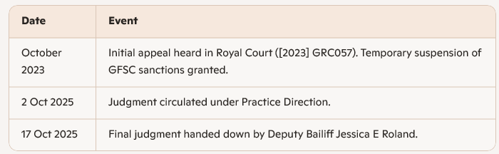
- Judgment Circulated: 2 October 2025 (under Practice Direction)
- Final Judgment Handed Down: 17 October 2025
- Judge: Jessica E Roland, Deputy Bailiff
2. Parties
- Appellants:
- Paul Randall Pybus
- Adjure Global Limited
- Respondent:
- Guernsey Financial Services Commission (GFSC)
3. Background
- The GFSC imposed enforcement measures on Mr Pybus and Adjure Global Limited, including:
- £150,000 financial penalty
- Prohibition order preventing involvement in regulated financial services
- Public statement detailing concerns about probity and integrity
- The appellants challenged these sanctions under the Financial Services Business (Enforcement Powers) (Bailiwick of Guernsey) Law, 2020.
4. Timeline of Proceedings
5. Key Judicial Findings
- The Royal Court upheld many of the GFSC’s findings, confirming serious concerns about Mr Pybus’s conduct.
- The Court required the GFSC to:
- Appoint a new Senior Decision Maker to reconsider matters of probity and integrity.
- Apply the Ivey Test explicitly when assessing dishonesty.
- The Court noted that the previous Senior Decision Maker had not sufficiently applied the Ivey Test, weakening the integrity assessment.
6. GFSC’s Position
- Welcomed the judgment as it placed into the public domain serious concerns about Mr. Pybus.
- Emphasised that the Court’s ruling validated many of its findings, while acknowledging the need for a fresh review of probity and integrity.
7. Legal Principle: The Ivey Test
Origin: Ivey v Genting Casinos [2017] UKSC 67. - Standard for dishonesty:
- Ascertain the individual’s actual belief or state of mind regarding the facts.
- Apply the objective standard of ordinary decent people to determine dishonesty.
The Court insisted that this test be explicitly applied in regulatory decision-making.
8. Implications
- For Regulators: Reinforces the need for procedural fairness and explicit application of dishonesty standards.
- For Individuals: Demonstrates that while sanctions can be suspended, courts will uphold findings if supported by evidence.
- For Guernsey’s Financial Sector: Shows strong judicial oversight of regulatory enforcement, balancing market integrity with fairness.
Summary
- The Pybus/Adjure Global case is a landmark in Guernsey’s regulatory jurisprudence.
- The Royal Court validated the GFSC’s concerns about probity but required a new decision-maker to reassess integrity issues using the Ivey Test.
- The case underscores Guernsey’s dual commitment to robust regulation and judicial fairness.
Reference
https://guernseylegalresources.gg/CHttpHandler.ashx?documentid=88009
The Team
Meet the team of industry experts behind Comsure
Find out moreLatest News
Keep up to date with the very latest news from Comsure
Find out moreGallery
View our latest imagery from our news and work
Find out moreContact
Think we can help you and your business? Chat to us today
Get In TouchNews Disclaimer
As well as owning and publishing Comsure's copyrighted works, Comsure wishes to use the copyright-protected works of others. To do so, Comsure is applying for exemptions in the UK copyright law. There are certain very specific situations where Comsure is permitted to do so without seeking permission from the owner. These exemptions are in the copyright sections of the Copyright, Designs and Patents Act 1988 (as amended)[www.gov.UK/government/publications/copyright-acts-and-related-laws]. Many situations allow for Comsure to apply for exemptions. These include 1] Non-commercial research and private study, 2] Criticism, review and reporting of current events, 3] the copying of works in any medium as long as the use is to illustrate a point. 4] no posting is for commercial purposes [payment]. (for a full list of exemptions, please read here www.gov.uk/guidance/exceptions-to-copyright]. Concerning the exceptions, Comsure will acknowledge the work of the source author by providing a link to the source material. Comsure claims no ownership of non-Comsure content. The non-Comsure articles posted on the Comsure website are deemed important, relevant, and newsworthy to a Comsure audience (e.g. regulated financial services and professional firms [DNFSBs]). Comsure does not wish to take any credit for the publication, and the publication can be read in full in its original form if you click the articles link that always accompanies the news item. Also, Comsure does not seek any payment for highlighting these important articles. If you want any article removed, Comsure will automatically do so on a reasonable request if you email info@comsuregroup.com.


As well as owning and publishing Comsure's copyrighted works, Comsure wishes to use the copyright-protected works of others. To do so, Comsure is applying for exemptions in the UK copyright law. There are certain very specific situations where Comsure is permitted to do so without seeking permission from the owner. These exemptions are in the copyright sections of the Copyright, Designs and Patents Act 1988 (as amended)[www.gov.UK/government/publications/copyright-acts-and-related-laws]. Many situations allow for Comsure to apply for exemptions. These include 1] Non-commercial research and private study, 2] Criticism, review and reporting of current events, 3] the copying of works in any medium as long as the use is to illustrate a point. 4] no posting is for commercial purposes [payment]. (for a full list of exemptions, please read here www.gov.uk/guidance/exceptions-to-copyright]. Concerning the exceptions, Comsure will acknowledge the work of the source author by providing a link to the source material. Comsure claims no ownership of non-Comsure content. The non-Comsure articles posted on the Comsure website are deemed important, relevant, and newsworthy to a Comsure audience (e.g. regulated financial services and professional firms [DNFSBs]). Comsure does not wish to take any credit for the publication, and the publication can be read in full in its original form if you click the articles link that always accompanies the news item. Also, Comsure does not seek any payment for highlighting these important articles. If you want any article removed, Comsure will automatically do so on a reasonable request if you email info@comsuregroup.com.