




 Published on : 11/05/2026
China's New Counter-Sanctions = A Wake-Up Call for Every Regulated Business in Jersey and Beyond
On Monday, May 11, the Chinese State Council quietly but dramatically expanded Beijing's COUNTER-SANCTIONS arsenal by issuing two regulations with immediate effect:
- Decree No. 834 – Regulations on Industrial and Supply Chain Security
- Decree No. 835 – Regulations on Countering Foreign Improper Extraterritorial Jurisdiction
These decrees
- Supercharge earlier decrees by
- adding an inter-agency supply-chain watchdog and
- giving the Ministry of Justice (MOJ) formal power to investigate, designate, and punish foreign "improper extraterritorial measures."
- Earlier decrees include:-
- Unreliable Entity List, Blocking Rules, Anti-Foreign Sanctions Law, or the 2025 AFSL Implementing Regulations.
Bottom Line risk
- Decrees 834 and 835 mark the maturation of China's countersanctions toolkit.
- The rules are deliberately broad, enforcement discretion is high, and the "actual control" piercing standard makes traditional Jersey structuring far less protective than it used to be.
- For regulated businesses in Jersey and beyond, the era of treating Chinese counter-sanctions as a theoretical risk is over. It is now an operational, licensing, and balance-sheet reality.
- The message to regulated businesses in Jersey – and every regulated firm worldwide – is crystal clear:
- China now has a fully operational, flexible, and extraterritorial countersanctions system that can bite back when you comply with Western sanctions.
The Real-World Risks for Regulated Businesses (Jersey, UK, EU, US, Asia – Same Exposure)
- Risk 1 – Malicious Entity List designation.
- You freeze or block a Chinese SOE or high-net-worth individual because of US, UK, or EU sanctions
- → China designates your Jersey-regulated firm (or its parent/group)
- → Immediate asset freeze inside China, data-transfer ban, and potential fines.
- Risk 2 – Supply-chain retaliation (Decree 834)
- Your bank, trust company, or CSP insists on enhanced due diligence that Chinese counterparties view as "discriminatory".
- Result: investigation, supply bans, or visa revocations for your staff in Jersey.
- Risk 3 – Data & technology squeeze
- Chinese subsidiaries or joint ventures can be ordered to stop transferring data to your Jersey office if you are on the Malicious Entity List – a major issue for local trust & corporate service providers and fund administrators.
- Risk 4 – Conflict-of-laws nightmare
- You are now caught between
- Mandatory Western sanctions/export-control rules and
- Chinese blocking/non-enforcement orders.
Jersey, UK, EU, US, or elsewhere nexus risk
- A regulated firm in Jersey faces the same menu of risks as a regulated firm in the UK, EU, US, or elsewhere once it has a China nexus.
- The location of incorporation or licensing is irrelevant; the trigger is conduct that China views as implementing "improper" foreign sanctions or disrupting Chinese supply chains.
Who Is Most Exposed Right Now in Jersey?
- Trust & corporate service providers (TCSPs), banks, and fund administrators handling Chinese HNWIs, SOEs, or red-chip structures.
- Exporters, technology firms, and professional services firms with any China nexus.
- Even firms with no direct China business are at risk if their parent, affiliate, or key client is designated.
Immediate Practical Steps Every Jersey-Regulated Compliance Programme Should Take
- Map your China exposure – clients, suppliers, counterparties, data flows.
- Review sanctions & supply-chain clauses in contracts.
- Update group sanctions policy with a dual-compliance matrix for China countersanctions.
- Scenario-test what happens if your Jersey entity or a key affiliate is listed.
- Prepare petition/response playbook – Chinese rules allow entities to petition the MOJ.
- Brief the Board – this is now enterprise-wide regulatory risk for every Jersey-regulated firm.
Full briefing
On Monday, the Chinese State Council quietly but dramatically expanded Beijing's countersanctions armoury by issuing two regulations with immediate effect:
- Decree No. 834 – Regulations on Industrial and Supply Chain Security
- Decree No. 835 – Regulations on Countering Foreign Improper Extraterritorial Jurisdiction
These decrees do not replace earlier tools (Unreliable Entity List, Blocking Rules, Anti-Foreign Sanctions Law, or the 2025 AFSL Implementing Regulations).
They supercharge them by adding an inter-agency supply-chain watchdog and giving the Ministry of Justice (MOJ) formal power to investigate, designate, and punish foreign "improper extraterritorial measures."
The message to regulated businesses in Jersey – and every regulated firm worldwide – is crystal clear:
- China now has a fully operational, flexible, and extraterritorial countersanctions system that can bite back when you comply with Western sanctions.
- What the Decrees Actually Do (in Plain English)
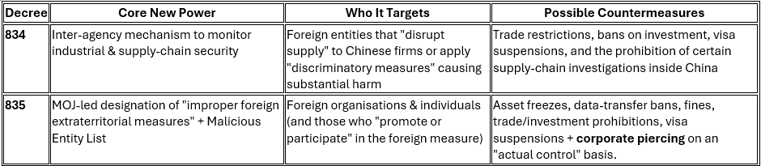
Key innovations that matter to compliance teams in Jersey and beyond:
- Explicit extraterritorial jurisdiction (Art 4, Decree 835):
- China now openly claims jurisdiction over conduct with an "appropriate connection" to China.
- This is the clearest "long-arm" countersanctions statement Beijing has ever made.
- "Actual control" piercing (Art 8, Decree 835):
- Unlike the rigid 50 % OFAC ownership rule, China will look through corporate structures on a case-by-case basis.
- A Jersey or Guernsey SPV, a trust structure, or a fund vehicle could be caught if Chinese authorities determine that the ultimate controller is on the Malicious Entity List.
- Broad, undefined triggers:
- "Substantial harm", "discriminatory measures", "harm to China's development interests" – all left to Chinese officials' discretion.
- Criminal liability
- Introduced for certain violations.
- The Real-World Risks for Regulated Businesses (Jersey, UK, EU, US, Asia – Same Exposure)
- Risk 1 – Malicious Entity List designation.
- You freeze or block a Chinese SOE or high-net-worth individual because of US, UK, or EU sanctions
- → China designates your Jersey-regulated firm (or its parent/group)
- → Immediate asset freeze inside China, data-transfer ban, and potential fines.
- Risk 2 – Supply-chain retaliation (Decree 834)
- Your bank, trust company, or CSP insists on enhanced due diligence that Chinese counterparties view as "discriminatory".
- Result: investigation, supply bans, or visa revocations for your staff in Jersey.
- Risk 3 – Data & technology squeeze
- Chinese subsidiaries or joint ventures can be ordered to stop transferring data to your Jersey office if you are on the Malicious Entity List – a major issue for local trust & corporate service providers and fund administrators.
- Risk 4 – Conflict-of-laws nightmare
- You are now caught between
- Mandatory Western sanctions/export-control rules and
- Chinese blocking/non-enforcement orders.
- Who Is Most Exposed Right Now in Jersey?
- Trust & corporate service providers (TCSPs), banks, and fund administrators handling Chinese HNWIs, SOEs, or red-chip structures.
- Exporters, technology firms, and professional services firms with any China nexus.
- Even firms with no direct China business are at risk if their parent, affiliate, or key client is designated.
- Immediate Practical Steps Every Jersey-Regulated Compliance Programme Should Take
- Map your China exposure – clients, suppliers, counterparties, data flows.
- Review sanctions & supply-chain clauses in contracts.
- Update group sanctions policy with a dual-compliance matrix for China countersanctions.
- Scenario-test what happens if your Jersey entity or a key affiliate is listed.
- Prepare petition/response playbook – Chinese rules allow entities to petition the MOJ.
- Brief the Board – this is now enterprise-wide regulatory risk for every Jersey-regulated firm.
Bottom Line
- Decrees 834 and 835 mark the maturation of China's countersanctions toolkit.
- The rules are deliberately broad, enforcement discretion is high, and the "actual control" piercing standard makes traditional Jersey structuring far less protective than it used to be.
- For regulated businesses in Jersey and beyond, the era of treating Chinese counter-sanctions as a theoretical risk is over. It is now an operational, licensing, and balance-sheet reality.
Questions or need a targeted risk assessment for your Jersey-regulated business? Contact our sanctions team – we are already helping clients across the Channel Islands run exposure reviews under the new decrees.
This is not legal advice. Firms should obtain specific counsel tailored to their operations.
Sources
https://www.lexology.com/library/detail.aspx?g=3e30ec10-6029-4d70-ad2e-b9d4f84b7e8b
Primary / Original Jones Day Alert (the exact source text you provided)
- Caught in the Crossfire: Two New Chinese Decrees Raise the Stakes on Sanctions Compliance https://www.jonesday.com/en/insights/2026/05/caught-in-the-crossfire-two-new-china-decrees-raise-the-stakes-on-sanctions-compliance (May 2026 – matches your update word-for-word)
Official Chinese Government Sources (English)
- Decree No. 834 – Regulations on Industrial and Supply Chain Security (State Council announcement) https://english.www.gov.cn/policies/latestreleases/202604/07/content_WS69d5038cc6d00ca5f9a0a460.html
- Decree No. 835 – Regulations on Countering Foreign Improper Extraterritorial Jurisdiction (State Council announcement) https://english.www.gov.cn/policies/latestreleases/202604/13/content_WS69dcc947c6d00ca5f9a0a5b9.html
Full English Translations of the Actual Decrees
- Decree No. 834 – State Council Provisions on Industrial and Supply Chain Security (China Law Translate) https://www.chinalawtranslate.com/en/-State-Council-Provisions-on-Industrial-and-Supply-Chain-Security/
- Decree No. 835 – PRC Regulations on Countering Improper Extraterritorial Jurisdiction (China Law Translate) https://www.chinalawtranslate.com/en/counter-long-arm/
Jones Day Background Articles (as cited in the original text)
- China Releases Rules to Address Extra-Territorial Applications of Foreign Laws (2021 Blocking Rules) https://www.jonesday.com/en/insights/2021/01/china-releases-rules-to-address-extraterritorial-applications-of-foreign-laws
- China Enacts Law to Counter Foreign Sanctions (2021 Anti-Foreign Sanctions Law) https://www.jonesday.com/en/insights/2021/06/china-enacts-law-to-counter-foreign-sanctions
Other Strong Supporting Law-Firm Summaries (for extra context)
- Baker McKenzie: China Introduces New State Council Decrees on Supply-Chain Security https://sanctionsnews.bakermckenzie.com/china-introduces-new-state-council-decrees-on-supply-chain-security-and-countering-unjustifiable-extraterritorial-measures/
- Morgan Lewis: China Issues New Regulations on Countering Foreign Extraterritorial Jurisdiction https://www.morganlewis.com/pubs/2026/04/china-issues-new-regulations-on-countering-foreign-extraterritorial-jurisdiction-what-mncs-need-to-know
The Team
Meet the team of industry experts behind Comsure
Find out moreLatest News
Keep up to date with the very latest news from Comsure
Find out moreGallery
View our latest imagery from our news and work
Find out moreNews Disclaimer
As well as owning and publishing Comsure's copyrighted works, Comsure wishes to use the copyright-protected works of others. To do so, Comsure is applying for exemptions in the UK copyright law. There are certain very specific situations where Comsure is permitted to do so without seeking permission from the owner. These exemptions are in the copyright sections of the Copyright, Designs and Patents Act 1988 (as amended)[www.gov.UK/government/publications/copyright-acts-and-related-laws]. Many situations allow for Comsure to apply for exemptions. These include 1] Non-commercial research and private study, 2] Criticism, review and reporting of current events, 3] the copying of works in any medium as long as the use is to illustrate a point. 4] no posting is for commercial purposes [payment]. (for a full list of exemptions, please read here www.gov.uk/guidance/exceptions-to-copyright]. Concerning the exceptions, Comsure will acknowledge the work of the source author by providing a link to the source material. Comsure claims no ownership of non-Comsure content. The non-Comsure articles posted on the Comsure website are deemed important, relevant, and newsworthy to a Comsure audience (e.g. regulated financial services and professional firms [DNFSBs]). Comsure does not wish to take any credit for the publication, and the publication can be read in full in its original form if you click the articles link that always accompanies the news item. Also, Comsure does not seek any payment for highlighting these important articles. If you want any article removed, Comsure will automatically do so on a reasonable request if you email info@comsuregroup.com.
Archived News
To find our older articles, please click here.
View archive

To find our older articles, please click here.