



 Published on : 17/06/2026
BRAZIL RISK - U.S. Terror Designations Trigger extraterritorial risks - WHAT HAVE YOU DONE?
On May 28, 2026,
- The U.S. Department of State designated two of Brazil's most powerful criminal organisations — Primeiro Comando da Capital (PCC) and Comando Vermelho (CV) — as Specially Designated Global Terrorists (SDGTs) under Executive Order 13224.
- The groups are set to receive full Foreign Terrorist Organisation (FTO) status effective June 5, 2026.
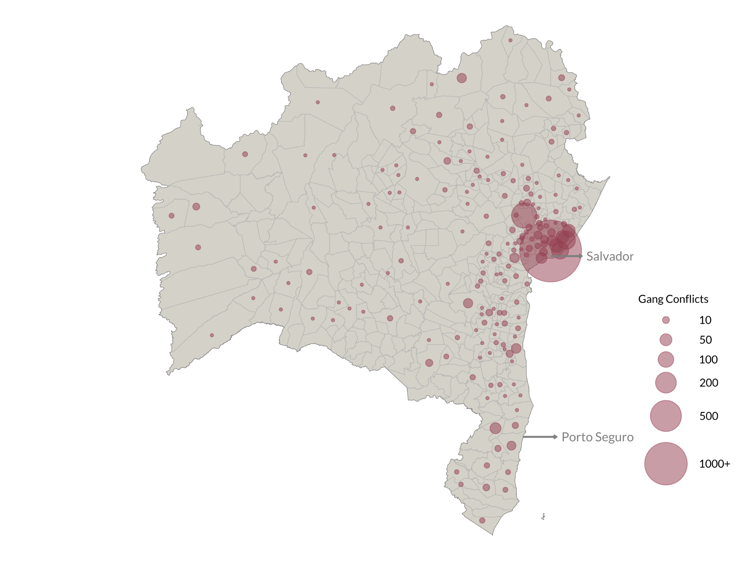
- This move dramatically escalates Washington's campaign against transnational criminal organisations, extending it into Latin America's largest economy.
- It sends a clear warning to multinationals, banks, and any company with operations, supply chains, or U.S. dollar flows connected to Brazil: the compliance stakes have fundamentally changed.
You may not be a "U.S. person,"
- But you can still face blocked payments, loss of banking relationships, civil lawsuits in U.S. courts, or criminal exposure if authorities establish jurisdiction.
- These designations effectively globalise compliance obligations.
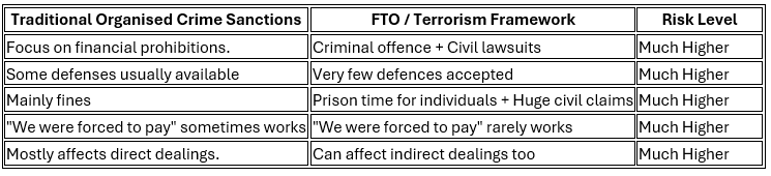
- Unlike traditional organised crime sanctions, the terrorism framework removes many practical defences and greatly expands both criminal and civil exposure.
- Precedents from Mexican cartel designations and earlier cases (such as Chiquita's payments to the AUC or Lafarge's dealings in Syria) demonstrate that even relatively small or coerced payments can trigger massive penalties.
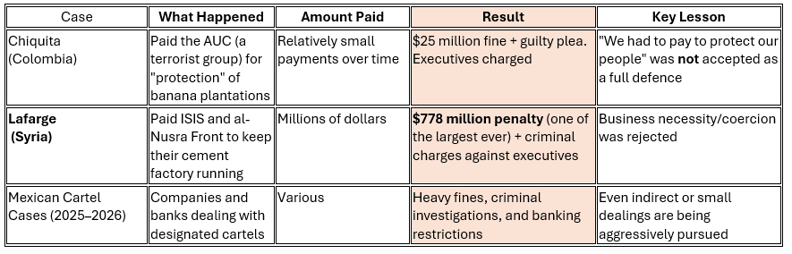
[SEE APPENDIX 1 FOR MORE INFO]
Bottom line:
- The terrorism designation removes the usual "business reality" excuses that companies normally use.
- Even relatively small or coerced payments to (or through) PCC or CV can now trigger criminal prosecution and hundreds of millions of dollars in penalties, as shown by real cases like Chiquita and Lafarge.
- This is why compliance experts are calling this a paradigm shift in risk for companies operating in Brazil.
Immediate and Long-Term Significance of the Designations
Immediate Impact (SDGT designation – effective May 28, 2026)
- All property and interests in property of PCC and CV within U.S. jurisdiction are now blocked. U.S. persons and entities with a U.S. nexus are prohibited from any direct or indirect dealings, transactions, or provision of services involving the groups.
- PCC was already on the OFAC SDN List since December 2021 under Executive Order 14059.
- The new SDGT designation reinforces these restrictions and significantly expands secondary sanctions risks for foreign financial institutions.
Longer-Term and More Severe Impact (FTO designation – effective June 5, 2026) The FTO designation introduces far-reaching consequences:
- Criminal prohibition on providing "material support" to FTOs under 18 U.S.C. § 2339B. This broadly covers money, goods, services, training, expert advice, or personnel — including indirect support through intermediaries. Limited duress defences apply.
- Civil liability under the Anti-Terrorism Act (ATA), enabling U.S. nationals (or their estates) injured by international terrorism to sue for treble damages, attorneys' fees, and costs.
- Heightened DOJ enforcement priority on corporate material support to designated cartels and FTOs.
- Potential FinCEN special measures (including correspondent account restrictions) and OFAC secondary sanctions against facilitators.
The Extraterritorial Reach: Why Non-U.S. Firms Face Significant Risk
- One of the most critical — and frequently underestimated — aspects of these designations is their extraterritorial reach. While the core rules target U.S. persons, non-U.S. companies (including Brazilian, European, Asian, and other foreign firms) are far from immune.
U.S. authorities have multiple tools to extend jurisdiction and pressure foreign entities:
- U.S. Dollar Clearing & Correspondent Banking — The majority of international transactions are cleared in USD through U.S. correspondent banks. Any USD payment — even between two non-U.S. parties — creates a U.S. nexus. Banks must block or reject transactions involving SDGTs/FTOs and can face severe penalties for facilitation.
- Secondary Sanctions on Foreign Financial Institutions — Foreign banks that "knowingly" facilitate significant transactions for PCC, CV, or their agents risk being cut off from the U.S. financial system via CAPTA sanctions. This tool has already been used aggressively against Mexican institutions and can be existential for banks reliant on USD clearing.
- Material Support & Anti-Terrorism Act (ATA) Liability — Both criminal and civil claims can reach foreign companies with any U.S. connection, such as using U.S. email or cloud services, travelling to the United States, maintaining U.S. subsidiaries or directors, or benefiting from U.S. markets. DOJ has pursued cases with relatively limited U.S. touchpoints, and ATA lawsuits can be filed in U.S. courts.
- Practical De-Risking — Even without formal enforcement, global banks and counterparties are proactively tightening controls or severing relationships with entities perceived as higher risk due to PCC or CV exposure.
- Enforcement Precedents — Recent actions against Mexican banks processing transactions linked to designated cartels show that U.S. authorities are willing to impose severe restrictions on foreign financial institutions.
Bottom line for non-U.S. firms:
- You may not be a "U.S. person," but you can still face blocked payments, loss of banking relationships, civil lawsuits in U.S. courts, or criminal exposure if authorities establish jurisdiction. These designations effectively globalise compliance obligations.
Anticipated U.S. Government Follow-Up Actions
Expect aggressive, multi-agency enforcement in the coming months:
- OFAC will likely designate additional individuals, leaders, front companies, and money launderers linked to PCC and CV.
- DOJ investigations and prosecutions focused on material support, supported by corporate whistleblower incentives of up to $50 million.
- FinCEN advisories or Section 311 actions targeting financial institutions.
- Coordination with Brazilian enforcement operations (such as Operação Carbono Oculto targeting PCC-linked fuel-sector laundering) and continued focus on virtual assets.
- Possible expansion to other Latin American groups and facilitators.
- The U.S. has framed this as part of a broader strategy to dismantle revenue streams funding "violent narco-terrorists" and keep illicit drugs off American streets.
Likely Reaction from Brazilian Authorities
- Brazilian officials, including President Lula, have strongly opposed the designations.
- They argue that PCC and CV are primarily profit-driven criminal enterprises rather than ideologically motivated terrorist groups, raising concerns about sovereignty and the extraterritorial application of U.S. law.
- Brazil was informed but not fully consulted. However, practical bilateral cooperation on counternarcotics, weapons trafficking, and financial crime continues (for example, through the DESARMA program). The designations add diplomatic friction but are unlikely to halt day-to-day law enforcement collaboration.
How Multinationals Should Reassess Their Regional Risk Profile
- Brazil — and areas of PCC and CV influence across borders with Paraguay, Bolivia, and into the Southern Cone — must now receive the same elevated scrutiny previously applied to high-risk cartel zones in Mexico and Colombia.
Key shifts in risk posture:
- Move from viewing these risks as "organised crime/extortion / AML" to "terrorism financing / material support / FTO / sanctions exposure."
- Re-evaluate country and sub-national risk ratings, insurance coverage, and investor disclosures.
- Heighten focus on sectors with historical infiltration: fuel distribution, financial services, agribusiness, construction, logistics/transport, and infrastructure.
- Map supply chains and third-party relationships for indirect exposure, including beneficial ownership and coerced suppliers.
- Companies with any U.S. nexus face the highest exposure, but even non-U.S. firms can be drawn in through correspondent banking or downstream enforcement.
Essential Due Diligence and Investigation Protocols to Adopt Right Now
Compliance leaders recommend immediate action in the following areas:
- Update Screening & Lists — Immediately incorporate PCC, CV, and any newly designated individuals or entities into sanctions, PEP, and adverse media screening tools. Supplement automated lists with open-source intelligence on known associates and front companies.
- Enhanced Third-Party & Counterparty Due Diligence — Apply risk-based enhanced due diligence to all Brazilian counterparties, especially in high-risk sectors. Focus on beneficial ownership, red flags for infiltration, and historical links. Map entire supply chains and logistics providers.
- Transaction Monitoring & Red-Flag Rules — Strengthen monitoring for unusual cash movements, payments to high-risk counterparties, and patterns suggestive of extortion or protection rackets. Train teams that "duress" or "we had no choice" is not a reliable defence under the material support statute.
- Historical Forensic Review — Conduct targeted reviews of transactions and relationships over at least the past 5–7 years. Identify potential exposure and evaluate voluntary self-disclosure options with experienced U.S. counsel.
- Policy & Training Updates — Revise sanctions, AML/CFT, anti-bribery (FCPA overlap is significant), and crisis management policies. Train employees — particularly in security, procurement, finance, and operations — on new red flags and escalation protocols.
- Crisis & Incident Response Playbooks — Develop clear procedures for real-time assessment of any security incident or demand that could be construed as material support. Involve U.S. sanctions counsel early.
- Engage Specialised Counsel — Retain U.S. counsel experienced in FTO material support, ATA litigation, and OFAC enforcement, alongside strong local Brazilian counsel. Consider tabletop exercises simulating extortion demands or adverse findings.
- Financial institutions should prepare for heightened scrutiny of Brazilian correspondent flows and potential CAPTA risks.
Bottom Line
- These designations are not symbolic. They materially expand criminal, civil, and regulatory exposure for companies doing business in or with Brazil. The compliance bar has been raised significantly — and the appetite for enforcement is high.
- Companies that act decisively now — by reassessing risk profiles, strengthening controls, and embedding these issues into enterprise risk management — will be far better positioned than those that treat this as "just another sanctions update."
- The window to get ahead of enforcement and litigation risk is open, but it is closing fast.
APPENDIX
- "Unlike traditional organised crime sanctions, the terrorism framework removes many practical defences and greatly expands both criminal and civil exposure."
What this actually means:
When a group is only designated under normal organised crime/drug trafficking sanctions (like the old SDN listing for PCC), companies usually face these risks:
- Asset blocking
- Prohibition on doing business with them
- Civil penalties (fines)
However, companies often still have some room to argue or negotiate. There may be licensing options, and enforcement is primarily focused on financial transactions.
But when a group is designated as an FTO (Foreign Terrorist Organisation) + SDGT, a completely different, much harsher legal framework applies—specifically, the "material support" laws.
This framework is much more dangerous because:
- Very few defences exist.
- The biggest one companies usually rely on is duress ("We were forced to pay because they threatened our staff/trucks/operations"). Under normal sanctions, this sometimes helps. Under the material support to an FTO defence, this defence is extremely weak or often rejected.
- Knowledge is enough.
- You don't necessarily need to prove the company wanted to support terrorism. If the company knew (or should have known) it was dealing with or supporting a designated FTO, that can be enough to establish liability.
- Both criminal + civil exposure at the same time.
- Criminal: Individuals can go to prison (up to 20 years). Companies can face huge fines.
- Civil: Under the Anti-Terrorism Act, victims (or their families) can sue the company in U.S. courts for treble damages (3 times the amount of damages). This is very expensive and damaging.
In simple terms:
- Normal sanctions = mostly financial risk.
- Terrorism designation = criminal risk + massive civil lawsuits + very few excuses accepted.
- "Precedents from Mexican cartel designations and earlier cases (such as Chiquita's payments to the AUC or Lafarge's dealings in Syria) demonstrate that even relatively small or coerced payments can trigger massive penalties."
This is the part that should worry companies the most.
Real-world examples prove that even small payments or payments made under pressure can destroy companies:
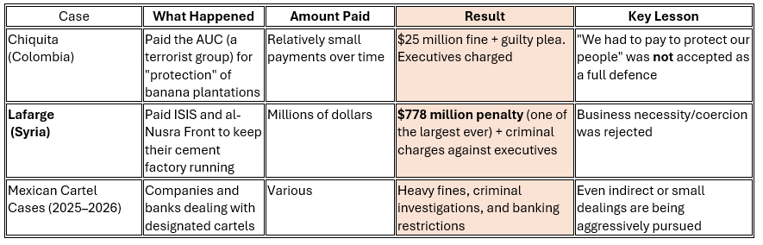
Why these cases matter for Brazil right now:
- PCC and CV are now treated the same way as ISIS or the AUC legally.
- If your company (or a subsidiary, agent, or supplier) makes any payment that can be seen as supporting PCC or CV — even if it's extortion money to keep operations running — U.S. authorities can treat it as material support to a terrorist organisation.
- The fact that the payment was "small" or that you were "forced" to pay is not a strong defence (as proven by Chiquita and Lafarge).
Summary: Why This Is High Risk
Bottom line:
- The terrorism designation removes the usual "business reality" excuses that companies normally use.
- Even relatively small or coerced payments to (or through) PCC or CV can now trigger criminal prosecution and hundreds of millions of dollars in penalties, as shown by real cases like Chiquita and Lafarge.
- This is why compliance experts are calling this a paradigm shift in risk for companies operating in Brazil.
SOURCES
Wikipedia – Primeiro Comando da Capital (good overview of the group and designation timeline) https://en.wikipedia.org/wiki/Primeiro_Comando_da_Capital
Official Sources:
Law Firm Analysis (Recommended):
- https://www.whitecase.com/insight-alert/united-states-designates-brazilian-criminal-organizations-foreign-terrorist
- https://www.mayerbrown.com/en/insights/publications/2026/05/united-states-designates-brazils-pcc-and-cv-as-terrorist-organizations-key-legal-and-compliance-implications
- https://www.jonesday.com/en/insights/2026/05/brazilian-criminal-factions-designated-as-terrorist-groups-by-us-state-department
- https://www.dlapiper.com/en/insights/publications/2026/06/us-designates-two-brazil-based-transnational-criminal-organizations-as-terrorist-entities
- https://www.aoshearman.com/en/insights/us-set-to-impose-foreign-terrorist-organization-designations
News Coverage:
- https://foreignpolicy.com/2026/06/03/us-brazil-gangs-first-command-capital-red-fto/
- https://www.theguardian.com/world/2026/may/29/brazil-gangs-terrorist-rubio
- https://www.france24.com/en/americas/20260529-us-designates-brazilian-crime-groups-as-terrorist-organisations
Background:
This analysis draws on official U.S. government statements and expert alerts from leading international law firms specialising in sanctions, export controls, and white-collar defence. Companies should consult qualified legal counsel for tailored advice.
The Team
Meet the team of industry experts behind Comsure
Find out moreLatest News
Keep up to date with the very latest news from Comsure
Find out moreGallery
View our latest imagery from our news and work
Find out moreNews Disclaimer
As well as owning and publishing Comsure's copyrighted works, Comsure wishes to use the copyright-protected works of others. To do so, Comsure is applying for exemptions in the UK copyright law. There are certain very specific situations where Comsure is permitted to do so without seeking permission from the owner. These exemptions are in the copyright sections of the Copyright, Designs and Patents Act 1988 (as amended)[www.gov.UK/government/publications/copyright-acts-and-related-laws]. Many situations allow for Comsure to apply for exemptions. These include 1] Non-commercial research and private study, 2] Criticism, review and reporting of current events, 3] the copying of works in any medium as long as the use is to illustrate a point. 4] no posting is for commercial purposes [payment]. (for a full list of exemptions, please read here www.gov.uk/guidance/exceptions-to-copyright]. Concerning the exceptions, Comsure will acknowledge the work of the source author by providing a link to the source material. Comsure claims no ownership of non-Comsure content. The non-Comsure articles posted on the Comsure website are deemed important, relevant, and newsworthy to a Comsure audience (e.g. regulated financial services and professional firms [DNFSBs]). Comsure does not wish to take any credit for the publication, and the publication can be read in full in its original form if you click the articles link that always accompanies the news item. Also, Comsure does not seek any payment for highlighting these important articles. If you want any article removed, Comsure will automatically do so on a reasonable request if you email info@comsuregroup.com.
Archived News
To find our older articles, please click here.
View archive

To find our older articles, please click here.