

ASK MAT - What is the difference between a DELISTING & REVOCATION in sanction notices
22/03/2026
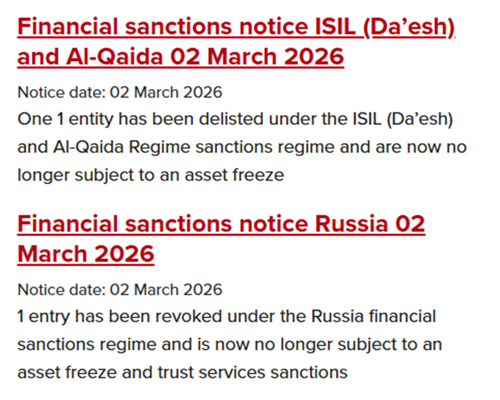
ASK MAT: While reviewing the sanction lists, I have a question: What is the difference between delisting and revocation? Below, the ISIL is delisted, but the Russian is revoked.
MAY SAYS:-
In the UK, financial sanctions administered by the Office of Financial Sanctions Implementation - OFSI, under the Sanctions and Anti-Money Laundering Act 2018 and related regulations, DELISTING AND REVOCATION both result in the same practical outcome:
- The person or entity is removed from the sanctions list,
- Is no longer designated, and
- Is no longer subject to the associated restrictions (such as an asset freeze, trust services bans, etc.).
The key difference lies in the origin of the sanctions listing and the terminology used in official notices, reflecting the underlying legal basis:
- Delisting is the term typically used for entries originally based on United Nations sanctions regimes (implemented in UK law via specific regulations, such as the ISIL (Da’esh) and Al-Qaida (United Nations Sanctions) (EU Exit) Regulations 2019).
These listings often follow decisions by the UN Security Council or the UN sanctions committee.
- When the UN decides to remove an entry (or the UK implements such a change), the UK notice describes it as a "delisting."
In ISIL (Da’esh) and Al-Qaida above: this is an UN-linked action
- The March 2, 2026, notice for ISIL (Da’esh) and Al-Qaida states, "One entity has been delisted" this aligns with a UN-linked regime (specifically, the entity AL-NUSRAH FRONT FOR THE PEOPLE OF THE LEVANT was removed following a UN decision).
- Revocation is the term typically used for entries under UK autonomous sanctions regimes (such as the Russia (Sanctions) (EU Exit) Regulations 2019).
- These are designations made directly by the UK government (via the Foreign, Commonwealth & Development Office - FCDO), not originating from a UN list. When the UK decides to remove such an entry (e.g., after a review, challenge, or policy decision), the notice describes it as a "revocation."
In the RUSSIAN note above, this is an autonomous UK designation
- The March 2, 2026, notice for Russia states "1 entry has been revoked"
- This refers to an autonomous UK designation - specifically, the individual John Michael Ormerod was removed
In both cases, the effect is identical:
- The asset freeze (and any other linked sanctions) no longer applies, and
- The entry is removed from the UK Sanctions List.
CONCLUSION
- This distinction in wording is mainly procedural and reflects the source of the original designation, rather than any difference in legal consequences.
- UK guidance and notices consistently use "delisting" for UN-derived regimes and "revocation" (or sometimes "removal") for UK autonomous ones.
- If you're reviewing specific sanctions lists or compliance obligations, always check the latest UK Sanctions List on GOV.UK for confirmation of status.
The Team
Meet the team of industry experts behind Comsure
Find out moreLatest News
Keep up to date with the very latest news from Comsure
Find out moreGallery
View our latest imagery from our news and work
Find out moreContact
Think we can help you and your business? Chat to us today
Get In TouchNews Disclaimer
As well as owning and publishing Comsure's copyrighted works, Comsure wishes to use the copyright-protected works of others. To do so, Comsure is applying for exemptions in the UK copyright law. There are certain very specific situations where Comsure is permitted to do so without seeking permission from the owner. These exemptions are in the copyright sections of the Copyright, Designs and Patents Act 1988 (as amended)[www.gov.UK/government/publications/copyright-acts-and-related-laws]. Many situations allow for Comsure to apply for exemptions. These include 1] Non-commercial research and private study, 2] Criticism, review and reporting of current events, 3] the copying of works in any medium as long as the use is to illustrate a point. 4] no posting is for commercial purposes [payment]. (for a full list of exemptions, please read here www.gov.uk/guidance/exceptions-to-copyright]. Concerning the exceptions, Comsure will acknowledge the work of the source author by providing a link to the source material. Comsure claims no ownership of non-Comsure content. The non-Comsure articles posted on the Comsure website are deemed important, relevant, and newsworthy to a Comsure audience (e.g. regulated financial services and professional firms [DNFSBs]). Comsure does not wish to take any credit for the publication, and the publication can be read in full in its original form if you click the articles link that always accompanies the news item. Also, Comsure does not seek any payment for highlighting these important articles. If you want any article removed, Comsure will automatically do so on a reasonable request if you email info@comsuregroup.com.


As well as owning and publishing Comsure's copyrighted works, Comsure wishes to use the copyright-protected works of others. To do so, Comsure is applying for exemptions in the UK copyright law. There are certain very specific situations where Comsure is permitted to do so without seeking permission from the owner. These exemptions are in the copyright sections of the Copyright, Designs and Patents Act 1988 (as amended)[www.gov.UK/government/publications/copyright-acts-and-related-laws]. Many situations allow for Comsure to apply for exemptions. These include 1] Non-commercial research and private study, 2] Criticism, review and reporting of current events, 3] the copying of works in any medium as long as the use is to illustrate a point. 4] no posting is for commercial purposes [payment]. (for a full list of exemptions, please read here www.gov.uk/guidance/exceptions-to-copyright]. Concerning the exceptions, Comsure will acknowledge the work of the source author by providing a link to the source material. Comsure claims no ownership of non-Comsure content. The non-Comsure articles posted on the Comsure website are deemed important, relevant, and newsworthy to a Comsure audience (e.g. regulated financial services and professional firms [DNFSBs]). Comsure does not wish to take any credit for the publication, and the publication can be read in full in its original form if you click the articles link that always accompanies the news item. Also, Comsure does not seek any payment for highlighting these important articles. If you want any article removed, Comsure will automatically do so on a reasonable request if you email info@comsuregroup.com.