

ASK MAT – WHAT COUNTRIES ARE EQUIVALENT TO JERSEY FOR AML/CFT/CPF PURPOSES
10/02/2026
ASK MAT – WHAT COUNTRIES ARE EQUIVALENT TO JERSEY FOR AML/CFT/CPF PURPOSES
MAT SAYS –
- You ask a great question: if you literally use the JFSC guidance, "Truly equivalent" countries are those that meet or exceed Jersey's standards, as assessed by the test (SEE BELOW).
- Given the strict criteria (particularly for IO4, where 98% of evaluated jurisdictions achieve only low or moderate effectiveness), only a small number qualify based on their FATF mutual evaluation results.
- So, the answer is THREE based on my methodology – I have added below a table of examples with their IO3 and IO4 ratings.
- And sorry, Guernsey did not make the cut.
JERSEY TEST
- According to the Jersey Financial Services Commission (JFSC) and relevant Jersey laws, such as the Money Laundering (Jersey) Order 2008, the term "equivalent jurisdiction" refers to:
- A country or territory outside Jersey that maintains anti-money laundering, countering the financing of terrorism, and countering proliferation financing (AML/CFT/CPF) requirements and supervisory standards that are consistent with those established in Jersey.
- This equivalence is not based on a fixed list maintained by the JFSC (as the list in Appendix B of the AML/CFT/CPF Handbook was discontinued effective 31 May 2021).
- Instead, it is determined on a case-by-case basis by assessing whether the jurisdiction's measures align with the Financial Action Task Force (FATF) Recommendations.
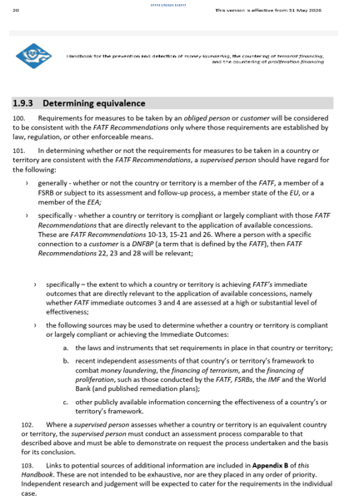
- Key factors for determining equivalence, as outlined in guidance from the JFSC's AML/CFT/CPF Handbook (Section 1.9.2 [Updated HB May 31, 2026), include:
- Whether the jurisdiction has undergone a FATF or FATF-style regional body (FSRB) mutual evaluation, and the results of that evaluation, particularly achieving a high or substantial level of effectiveness for Immediate Outcomes 3 (Supervision) and 4 (Preventive Measures).
- Membership in FATF or an FSRB.
- Implementation of requirements for customer due diligence, record-keeping, suspicious activity reporting, and other preventive measures that match FATF standards.
- Effective oversight by a regulatory authority to ensure compliance with these requirements.
- This concept is closely tied to "equivalent business," defined in Article 5 of the Money Laundering (Jersey) Order 2008 as business conducted in such a jurisdiction where:
- It would qualify as a regulated financial services business if carried out in Jersey.
- It can only be conducted by registered or authorised persons under local law.
- It is subject to AML/CFT/CPF requirements consistent with FATF Recommendations.
- An overseas regulatory authority supervises compliance.
RELEVANT / SUPERVISED PERSONS ASSESSMENT
- Relevant/supervised persons (e.g., financial institutions) must evaluate equivalence themselves when applying concessions or simplified measures, without relying on a pre-approved JFSC list.
RELEVANT/SUPERVISED PERSONS TEST
- Jersey was evaluated by MONEYVAL in 2024 and achieved:
- Substantial effectiveness in 7 of 11 Immediate Outcomes,
- With moderate effectiveness in the remaining 4.
- This places Jersey among the top 10 jurisdictions worldwide for overall AML/CFT/CPF effectiveness, with only a few countries matching or exceeding its ratings in key areas like IO3 and IO4.
- "Truly equivalent" countries are those that meet or exceed Jersey's standards as assessed by the test.
- Given the strict criteria (particularly for IO4, where 98% of evaluated jurisdictions achieve only low or moderate effectiveness), only a small number qualify based on their FATF mutual evaluation results. Below is a table of examples with their IO3 and IO4 ratings:
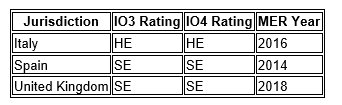
- These jurisdictions have demonstrated strong supervision and preventive measures consistent with Jersey's own high standards.
- Other countries may be assessed as equivalent on a case-by-case basis (using a different metric), but based on the strict test of se or he for both IO3 and IO4, the answer today is 3
- IO3: Substantial (SE)
- IO4: Moderate (ME)
WHAT ABOUT GUERNSEY
- According to the Jersey test for equivalent jurisdictions, as outlined in the JFSC's AML/CFT/CPF Handbook and based on alignment with FATF standards, a jurisdiction must achieve a high (HE) or substantial (SE) level of effectiveness for both Immediate Outcome 3 (IO3 - Supervision) and Immediate Outcome 4 (IO4 - Preventive measures) in its most recent FATF or FSRB mutual evaluation, among other factors.
- Guernsey's latest MONEYVAL mutual evaluation (onsite visit in April 2024, report adopted in December 2024, and published in February 2025) rated it as follows for the relevant IOs:
- Since Guernsey did not achieve HE or SE for both IO3 and IO4 (specifically falling short on IO4), it does not meet the criteria. It is therefore not considered an equivalent jurisdiction to Jersey under the applicable laws and regulations.
WHAT ABOY THE UPDATED JFSC HANDBOOK
- The JFSC's updated AML/CFT/CPF Handbook, effective from 31 May 2026, does not change the earlier answer.
- The guidance on determining equivalence remains consistent: there is no maintained list of equivalent jurisdictions, and equivalence is assessed on a case-by-case basis using the same criteria, including
- Membership in relevant bodies (e.g., FATF, FSRBs, EU, EEA),
- Compliance or large compliance with key FATF Recommendations (10-13, 15-21, 26, and 22-23, 28 for DNFBPs), and
- Achieving a high (HE) or substantial (SE) level of effectiveness for Immediate Outcomes 3 (Supervision) and 4 (Preventive Measures) in mutual evaluations.
- The handbook now references Appendix B as containing links to sources for assessments (e.g., FATF, FSRBs, IMF, World Bank reports), rather than a discontinued list of countries, but this does not alter the underlying test or the conclusion that only a small number of jurisdictions qualify. The examples provided (Italy, Spain, the United Kingdom) were based on their respective MERs at the time. While more recent follow-up reports or evaluations may exist by 2026, the strict criteria—particularly for IO4—still limit the number of qualifying jurisdictions.
- Supervised persons must conduct and document their own assessments using current sources.
Source
The Team
Meet the team of industry experts behind Comsure
Find out moreLatest News
Keep up to date with the very latest news from Comsure
Find out moreGallery
View our latest imagery from our news and work
Find out moreContact
Think we can help you and your business? Chat to us today
Get In TouchNews Disclaimer
As well as owning and publishing Comsure's copyrighted works, Comsure wishes to use the copyright-protected works of others. To do so, Comsure is applying for exemptions in the UK copyright law. There are certain very specific situations where Comsure is permitted to do so without seeking permission from the owner. These exemptions are in the copyright sections of the Copyright, Designs and Patents Act 1988 (as amended)[www.gov.UK/government/publications/copyright-acts-and-related-laws]. Many situations allow for Comsure to apply for exemptions. These include 1] Non-commercial research and private study, 2] Criticism, review and reporting of current events, 3] the copying of works in any medium as long as the use is to illustrate a point. 4] no posting is for commercial purposes [payment]. (for a full list of exemptions, please read here www.gov.uk/guidance/exceptions-to-copyright]. Concerning the exceptions, Comsure will acknowledge the work of the source author by providing a link to the source material. Comsure claims no ownership of non-Comsure content. The non-Comsure articles posted on the Comsure website are deemed important, relevant, and newsworthy to a Comsure audience (e.g. regulated financial services and professional firms [DNFSBs]). Comsure does not wish to take any credit for the publication, and the publication can be read in full in its original form if you click the articles link that always accompanies the news item. Also, Comsure does not seek any payment for highlighting these important articles. If you want any article removed, Comsure will automatically do so on a reasonable request if you email info@comsuregroup.com.


As well as owning and publishing Comsure's copyrighted works, Comsure wishes to use the copyright-protected works of others. To do so, Comsure is applying for exemptions in the UK copyright law. There are certain very specific situations where Comsure is permitted to do so without seeking permission from the owner. These exemptions are in the copyright sections of the Copyright, Designs and Patents Act 1988 (as amended)[www.gov.UK/government/publications/copyright-acts-and-related-laws]. Many situations allow for Comsure to apply for exemptions. These include 1] Non-commercial research and private study, 2] Criticism, review and reporting of current events, 3] the copying of works in any medium as long as the use is to illustrate a point. 4] no posting is for commercial purposes [payment]. (for a full list of exemptions, please read here www.gov.uk/guidance/exceptions-to-copyright]. Concerning the exceptions, Comsure will acknowledge the work of the source author by providing a link to the source material. Comsure claims no ownership of non-Comsure content. The non-Comsure articles posted on the Comsure website are deemed important, relevant, and newsworthy to a Comsure audience (e.g. regulated financial services and professional firms [DNFSBs]). Comsure does not wish to take any credit for the publication, and the publication can be read in full in its original form if you click the articles link that always accompanies the news item. Also, Comsure does not seek any payment for highlighting these important articles. If you want any article removed, Comsure will automatically do so on a reasonable request if you email info@comsuregroup.com.