




 Published on : 05/05/2026
ASK MAT- I have just been appointed as a NED of my friends' REGTECH Jersey firm – am I JFSC supervised?
ASK MAT- I have just been appointed as a NED of my friends' REGTECH Jersey firm – am I JFSC supervised?
MAT SAYS:- Thank you for your question. Many people are surprised to discover that even serving as a Non-Executive Director (NED) of a single third-party company (a common rule of thumb: typically up to 5–6 fee-paying roles) can require JFSC registration to mitigate financial crime (AML/CFT/CPF) risks.
The Short Answer
- Yes – in most cases.
Your Likely Status
- If you meet the criteria, you fall under the Proceeds of Crime (Low-Risk Financial Services Business) (Jersey) Order 2024 (as amended).
- This gives you supervised-person status with a proportionate, light-touch regime designed for low-risk sole-trader NEDs.
- You must still comply with core obligations, but you benefit from several important carve-outs.
Criteria for the Low-Risk Regime under the Proceeds of Crime (Low-Risk Financial Services Business) (Jersey) Order 2024 (as amended)
You qualify as a low-risk supervised person if you are:
- A natural person (individual) acting as a director or Non-Executive Director (NED) of one or more companies (typically third-party appointments).
In addition, your activity must meet the standard three-gateway test for financial services business (per the Article 36 Guidelines):
- It is a Schedule 2 activity (acting as director).
- It is conducted “as a business” for third parties/customers.
- There is a Jersey nexus (performed in or from within Jersey).
Practical indicators that keep you clearly low-risk (best practice to stay within the regime):
- You limit yourself to a small number of fee-paying directorships (typically ≤5).
- You do not “hold out” or advertise professional director services to the public.
If these criteria are met,
- You are required to register with the JFSC as a supervised person but benefit from the Order’s light-touch exemptions (no formal MLCO/MLRO, no full policies/procedures, no detailed BRA, etc.).
- This keeps compliance proportionate while still requiring core CDD, monitoring, sanctions checks, and suspicious activity reporting.
Key Must-Dos (No Exemptions)
- Carry out full Customer Due Diligence (CDD) – and Enhanced Due Diligence (EDD) where required – on every company you direct.
- Perform ongoing monitoring of activities and keep CDD information up to date.
- Monitor sanctions and report any suspicious activity promptly to the FIU.
- Complete annual financial-crime training and maintain clear records.
What You Are Exempt From Under the Low-Risk Order: you do not need to:
- Appoint a formal MLCO or MLRO
- Maintain full written policies and procedures
- Produce a detailed Business Risk Assessment (BRA)
Best-Practice Recommendations
- Even though not strictly required, prudent low-risk NEDs still prepare a simple Business Risk Assessment (BRA), Customer Risk Assessment (CRA), and a short risk-appetite statement.
- They also document onboarding decisions, conduct regular reviews, and stay well within the five-fee-paying-client limit without “holding out” services.
- This April 2026 briefing (updated for the Low-Risk Order 2024 and the new Article 36 Guidelines) is designed to give Jersey NEDs clear, practical guidance so they can stay compliant with confidence and minimal burden.
LONGER READ
Jersey Low-Risk Non-Executive Director (NED) – AML/CFT/CPF Briefing For Sole-Trader Supervised Persons April 2026 (post Low-Risk Order 2024 & Article 36 Guidelines)
Your Status
As a JFSC-supervised low-risk director under the Proceeds of Crime (Low-Risk Financial Services Business) (Jersey) Order 2024 (as amended).
- You must keep ≤5 fee-paying customers, not “hold out” services, and avoid excluded trust company activities as described in the three-gateway test (Activity + “As a Business” + Jersey Nexus) in the April 2026 Article 36 Guidelines supports your low-risk position.
- What You MUST Do (Core Obligations – No Exemption)
- Perform Customer Due Diligence (CDD) on each company you direct (your “customer”): identify/verify the entity, beneficial owners/controllers (three-tier test), ownership structure, and purpose of the relationship. Obtain evidence.
- Apply Enhanced Due Diligence (EDD) where triggers apply (e.g. PEPs, higher-risk countries, non-face-to-face, personal asset-holding vehicles, nominee/bearer shares, sensitive activities).
- Conduct ongoing monitoring – scrutinise activities, keep CDD information current, and monitor for sanctions.
- Sign up for and act on JFSC & Government of Jersey sanctions alerts.
- Report Suspicious Activity promptly to the FIU (or Minister for sanctions matters) if you know, suspect, or have reasonable grounds to suspect financial crime.
- Complete annual training (as part of CPD) on financial crime recognition and reporting.
- Maintain secure records of CDD, decisions, and monitoring (in line with Data Protection Law).
- What You ARE Exempt From (Low-Risk Carve-Outs)
Under the Low-Risk Order, Articles 7, 8, 9, 9A, 10, 11 & 11A of the Money Laundering (Jersey) Order 2008 are disapplied. You do not need to:
- Appoint a formal Compliance Officer (MLCO) or Reporting Officer (RO/MLRO).
- Maintain full written policies and procedures (including internal reporting or staff screening).
- Conduct or document a formal Business Risk Assessment (BRA) or full strategy document (note: local lenders have even broader exemptions; directors still benefit from proportionality).
- What You SHOULD Ensure (Best Practice – Prudent Steps)
Risk
- The JFSC Handbook still expects you (as sole trader = “the board”) to understand risks proportionately.
- Best practice would suggest you need a simple
- Business risk assessment [ BRA] and
- Customer risk assessment [CRA]
- And risk appetite statement and strategy
Onboarding a New Customer (Company)
- Confirm the appointment fits your low-risk criteria and personal risk appetite (e.g. Jersey-centric, no sanctions/FATF blocked/abusive tax exposure).
- Complete full CDD/EDD before accepting the role.
- Document a simple Customer Risk Assessment (CRA) and record the purpose of the directorship.
- Only proceed if risks are acceptable and you can monitor effectively.
Ongoing Monitoring Through the Year
- Review each directorship regularly (e.g. at board meetings or annually) for consistency with the risk profile.
- Watch for trigger events (ownership changes, new activities, geographic shifts, sanctions hits) and apply enhanced measures if needed.
- Keep all CDD information up to date.
- Refresh training annually and record it.
- Conduct a quick quarterly self-review of your overall compliance.
- Maintain clear records to demonstrate proportionate risk management.
Quick Tip
- Stay under 5 fee-paying roles, do not advertise services, and document your “conducted as a business” analysis. This keeps you firmly in the low-risk regime. The updated JFSC AML/CFT/CPF Handbook (effective 31 May 2026) will emphasise proportionate application for low-risk persons.
Quick Summary Table
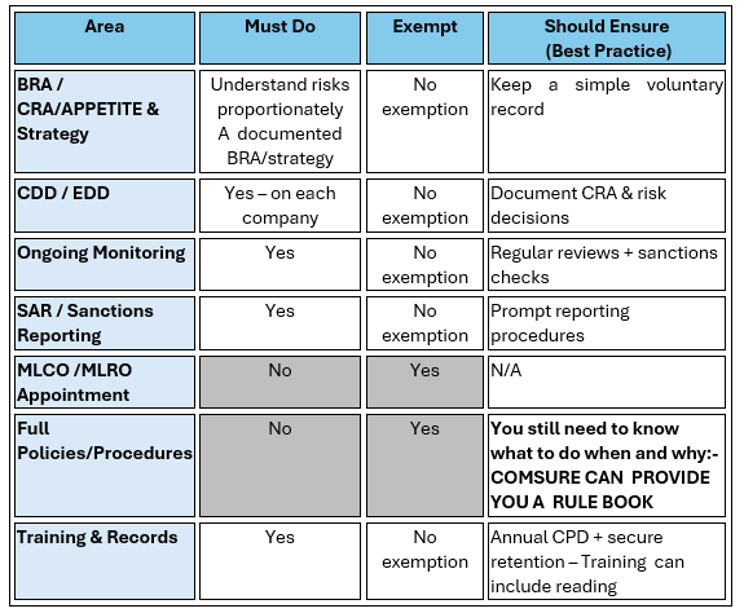
Important
- This is a high-level summary only. Always refer to the full Low-Risk Order, JFSC Handbook, and seek professional advice for your specific circumstances.
- Reviewed: April 2026 | Next review: Quarterly
Official Jersey Sources – Low-Risk NED / JFSC Supervised Persons (
- Proceeds of Crime (Low-Risk Financial Services Business) (Jersey) Order 2024 (as amended) https://www.jerseylaw.je/laws/current/ro_50_2024
- Money Laundering (Jersey) Order 2008 (the Order whose Articles 7–11A are disapplied for low-risk persons) https://www.jerseylaw.je/laws/current/ro_20_2008
- Proceeds of Crime (Jersey) Law 1999 – full law (includes Schedule 2 – the “three-gateway test”) https://www.jerseylaw.je/laws/current/l_8_1999
- JFSC Guidelines on Interpretation of Article 36 of the Proceeds of Crime (Jersey) Law 1999
- Current redline version (Oct 2024) https://www.jerseyfsc.org/media/7792/redline-guidelines-on-interpretation-of-article-36-october-2024.pdf
- Consultation Draft (December 2025 – intended for April 2026) https://www.jerseyfsc.org/media/itznibke/guidelines-on-interpretation-article-36-of-the-proceeds-of-crime-jersey-law-1999-consultation-draft-december-2025.pdf
- Consultation page https://www.jerseyfsc.org/industry/consultations/consultation-on-schedule-2-proposed-amendments-to-the-article-36-guidelines/
- JFSC AML/CFT/CPF Handbook (effective 31 May 2026) https://www.jerseyfsc.org/industry/financial-crime/amlcftcpf-handbooks/
- JFSC – Financial Crime / Schedule 2 Business page (main hub for directors & natural persons) https://www.jerseyfsc.org/industry/sectors/financial-crime-schedule-2-business/
The Team
Meet the team of industry experts behind Comsure
Find out moreLatest News
Keep up to date with the very latest news from Comsure
Find out moreGallery
View our latest imagery from our news and work
Find out moreNews Disclaimer
As well as owning and publishing Comsure's copyrighted works, Comsure wishes to use the copyright-protected works of others. To do so, Comsure is applying for exemptions in the UK copyright law. There are certain very specific situations where Comsure is permitted to do so without seeking permission from the owner. These exemptions are in the copyright sections of the Copyright, Designs and Patents Act 1988 (as amended)[www.gov.UK/government/publications/copyright-acts-and-related-laws]. Many situations allow for Comsure to apply for exemptions. These include 1] Non-commercial research and private study, 2] Criticism, review and reporting of current events, 3] the copying of works in any medium as long as the use is to illustrate a point. 4] no posting is for commercial purposes [payment]. (for a full list of exemptions, please read here www.gov.uk/guidance/exceptions-to-copyright]. Concerning the exceptions, Comsure will acknowledge the work of the source author by providing a link to the source material. Comsure claims no ownership of non-Comsure content. The non-Comsure articles posted on the Comsure website are deemed important, relevant, and newsworthy to a Comsure audience (e.g. regulated financial services and professional firms [DNFSBs]). Comsure does not wish to take any credit for the publication, and the publication can be read in full in its original form if you click the articles link that always accompanies the news item. Also, Comsure does not seek any payment for highlighting these important articles. If you want any article removed, Comsure will automatically do so on a reasonable request if you email info@comsuregroup.com.
Archived News
To find our older articles, please click here.
View archive

To find our older articles, please click here.