




 Published on : 20/04/2026
All change for MLCOs in Jersey after the Money Laundering (Jersey) Amendment Order 2026.
The Money Laundering (Jersey) Amendment Order 2026 (made 17 April 2026) introduces a more proportionate, risk-based framework for the Money Laundering Compliance Officer (MLCO / “compliance officer”) role.
- The Money Laundering (Jersey) Amendment Order 2026 (made 17 April 2026) amends the Money Laundering (Jersey) Order 2008 (MLJO).
- The changes to the MLCO role (referred to as “compliance officer” in the legislation) aim to make requirements more proportionate and risk-based, while keeping Jersey aligned with FATF standards.
- The MLCO amendments are in Article 3 of the Order (amending Article 7 of the MLJO) and come into force on 30 June 2026. (Other parts of the Order start on 31 October 2026.)
Key Changes (effective 30 June 2026):
- Appointment is now risk-based, not automatic
- Firms are no longer required to appoint an MLCO if it is not appropriate having regard to the size of the business and its money laundering risk.
- This decision must be made by reference to the relevant JFSC Code of Practice.
- Senior management requirement (if appointed)
- The MLCO must be appointed at senior management level and have timely access to all necessary records.
- Monitoring responsibilities clarified and made more flexible
- The MLCO remains responsible for monitoring compliance with Jersey AML laws and JFSC Codes of Practice.
- However, they may now delegate day-to-day monitoring to others while retaining overall accountability.
Overall Impact
- Smaller or lower-risk firms gain meaningful flexibility and potential cost savings.
- Larger or higher-risk firms benefit from clearer expectations around seniority and oversight.
- The changes enhance proportionality while maintaining robust AML controls and FATF alignment.
What should you do
- Firms should review their current arrangements (and the forthcoming updated JFSC Codes) and document any risk-based decisions before 30 June 2026.
Key changes to the MLCO role (new Article 7 of the MLJO)
Here is what the law now says:
- Appointment is no longer automatically mandatory for every business
- New Article 7(1A): “The requirement to make an appointment under paragraph (1) applies unless the appointment of a compliance officer is not appropriate having regard to –
- The size of the relevant person’s financial services business; and
- TThe risk of money laundering associated with that business.”
- New Article 7(1B): The business must decide what is “appropriate” by referring to a relevant Code of Practice issued by the JFSC under the Proceeds of Crime (Supervisory Bodies) Law.
- → In practice, smaller or lower-risk businesses may now decide they do not need a dedicated MLCO (this is the big proportionality win the government consulted on).
- If you do appoint an MLCO, the person must be at senior management level
- New Article 7(2A): The individual appointed must be:
- At senior management level in the business; and
- Have timely access to all records (including those kept under Article 19) needed to do the job.
- Core responsibility (monitoring)
- New Article 7(3): “The compliance officer must monitor whether the enactments in Jersey relating to money laundering and any relevant Code of Practice are being complied with in the conduct of the relevant person’s financial services business.”
- You can delegate day-to-day monitoring
- New Article 7(3A): “A compliance officer may fulfil their responsibilities under paragraph (3) by using another person to support them in, or to carry out, the monitoring required under that paragraph.”
- (This separates overall responsibility — which stays with the senior MLCO — from the function of day-to-day monitoring, giving firms more flexibility.)
Other related changes that affect the MLCO’s work
- The MLCO must now explicitly monitor compliance with the JFSC Codes of Practice (not just the law).
Summary – What does this mean in practice for Jersey firms?
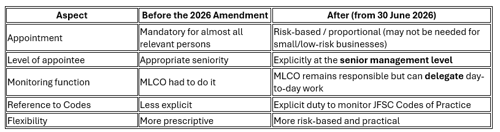
What did not change (or was not included in the final Order)
- The earlier public consultation (Jan–Mar 2026) also discussed allowing corporate (legal person) MLCOs and removing the “natural person only” rule.
- Those proposals were not included in the final enacted Order — the law still refers to “the individual appointed as compliance officer”, so the MLCO must still be a natural person.
- If your firm is small or low-risk, you will need to document (by reference to the JFSC Code) why you do not need an MLCO. Larger or higher-risk firms will still appoint one, but the role is now clearer, more senior, and more delegable.
Sources
The full text of the Amendment Order is here: https://www.jerseylaw.je/laws/enacted/Pages/RO-077-2026.aspx (the extract above is taken directly from it).
The Team
Meet the team of industry experts behind Comsure
Find out moreLatest News
Keep up to date with the very latest news from Comsure
Find out moreGallery
View our latest imagery from our news and work
Find out moreNews Disclaimer
As well as owning and publishing Comsure's copyrighted works, Comsure wishes to use the copyright-protected works of others. To do so, Comsure is applying for exemptions in the UK copyright law. There are certain very specific situations where Comsure is permitted to do so without seeking permission from the owner. These exemptions are in the copyright sections of the Copyright, Designs and Patents Act 1988 (as amended)[www.gov.UK/government/publications/copyright-acts-and-related-laws]. Many situations allow for Comsure to apply for exemptions. These include 1] Non-commercial research and private study, 2] Criticism, review and reporting of current events, 3] the copying of works in any medium as long as the use is to illustrate a point. 4] no posting is for commercial purposes [payment]. (for a full list of exemptions, please read here www.gov.uk/guidance/exceptions-to-copyright]. Concerning the exceptions, Comsure will acknowledge the work of the source author by providing a link to the source material. Comsure claims no ownership of non-Comsure content. The non-Comsure articles posted on the Comsure website are deemed important, relevant, and newsworthy to a Comsure audience (e.g. regulated financial services and professional firms [DNFSBs]). Comsure does not wish to take any credit for the publication, and the publication can be read in full in its original form if you click the articles link that always accompanies the news item. Also, Comsure does not seek any payment for highlighting these important articles. If you want any article removed, Comsure will automatically do so on a reasonable request if you email info@comsuregroup.com.
Archived News
To find our older articles, please click here.
View archive

To find our older articles, please click here.