

A Ghanaian National faces 20 years in a US prison for a $100 Million U.S. Fraud and BEC Attacks
06/03/2026
A Ghanaian national has pleaded guilty to his role in a vast transnational fraud network responsible for stealing more than $100 million from victims across the United States through a combination of business email compromise (BEC) attacks and romance scams that spanned several years.
40-year-old Derrick Van Yeboah entered a guilty plea on Thursday to conspiracy to commit wire fraud, admitting his involvement in a criminal enterprise that targeted vulnerable individuals and U.S. businesses between 2016 and May 2023. As part of the plea, Van Yeboah agreed to pay more than $10 million in restitution to victims.
High-ranking member of a Ghana-based fraud network
According to prosecutors, Van Yeboah held a senior operational role within a Ghana-based fraud organisation that coordinated its U.S. activities through a network of middlemen, money launderers, and digital facilitators. The ring was notorious for using social engineering, emotional manipulation, and sophisticated cyber‑fraud techniques to deceive victims and extract large sums of money.
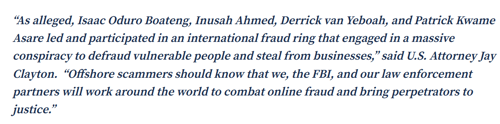
Van Yeboah was extradited to the United States in August 2025, following the arrests of accomplices Isaac Oduro Boateng (known as “Kofi Boat”), Inusah Ahmed (“Pascal”), and Patrick Kwame Asare (“Borgar”). All were implicated in the same criminal structure.
“Game Boys” and “Sakawa Boys”: Romance Scams Targeting Older Americans
Court documents reveal that members of the ring—who referred to themselves as “game boys” or “sakawa boys”—preyed on vulnerable older Americans, many of whom lived alone or were seeking companionship online.
The criminals created elaborate false personas on dating platforms and social networks, gradually gaining victims’ trust before persuading them to transfer money to U.S.-based intermediaries. These middlemen would then launder the funds, keeping a portion before sending the remainder to West Africa, where senior members—known internally as “chairmen”—coordinated the broader operation.
Prosecutors stated that Van Yeboah himself orchestrated multiple romance scams and was directly linked to more than $10 million in losses.
Business Email Compromise Attacks
In addition to romance schemes, the fraud network also carried out widespread business email compromise (BEC) attacks. Using spoofed email addresses designed to impersonate trusted customers, executives, or suppliers, the criminals tricked numerous U.S. companies into unknowingly wiring funds to accounts controlled by the conspiracy.
These attacks were a crucial revenue stream for the group, helping drive total losses above $100 million.
Prosecutors Warn of Online Vigilance
U.S. Attorney Jay Clayton condemned the exploitation of vulnerable individuals:
“Many New Yorkers search for companionship online, and no one deserves to have their vulnerability met with fraud and theft. Van Yeboah cruelly exploited those vulnerabilities for over $10 million in illicit profit.”
Clayton added a reminder for the public:
“Today’s plea is a reminder to be vigilant online—especially on dating websites. Never give money to someone you just met, and if it seems too good to be true, it probably is.”
Facing Up to 20 Years in Prison
Van Yeboah is scheduled for sentencing by U.S. District Judge Arun Subramanian on June 3, where he faces a potential maximum sentence of 20 years in federal prison.
Sources
- U.S. Attorney’s Office, Southern District of New York — Ghanaian Nationals Extradited for Roles in Criminal Organisation That Stole More Than $100 Million Through Romance Scams and Other Fraud (Press Release, Aug 8, 2025)
https://www.justice.gov/usao-sdny/pr/ghanaian-nationals-extradited-roles-criminal-organization-stole-more-100-million - U.S. Attorney’s Office, Southern District of New York — Ghanaian National Pleads Guilty To Stealing More Than $10 Million Via Romance Scams (Press Release, Mar 5, 2026; syndication copy)
https://ebs.publicnow.com/view/6577F10F79B69D3C2B31AB1DB4AF97FBE0BC95F1 - BleepingComputer — Ghanaian man pleads guilty to role in $100 million fraud ring (Mar 6, 2026)
Canonical: https://www.bleepingcomputer.com/news/security/ghanain-man-pleads-guilty-to-role-in-100-million-fraud-ring/
AMP mirror you shared: https://www-bleepingcomputer-com.cdn.ampproject.org/c/s/www.bleepingcomputer.com/news/security/ghanain-man-pleads-guilty-to-role-in-100-million-fraud-ring/amp/ - https://www-bleepingcomputer-com.cdn.ampproject.org/c/s/www.bleepingcomputer.com/news/security/ghanain-man-pleads-guilty-to-role-in-100-million-fraud-ring/amp/
- https://www.adomonline.com/ghanaians-extradited-for-alleged-roles-in-stealing-over-100m-through-romance-scams-other-fraud-in-us/
- https://ebs.publicnow.com/view/6577F10F79B69D3C2B31AB1DB4AF97FBE0BC95F1
The Team
Meet the team of industry experts behind Comsure
Find out moreLatest News
Keep up to date with the very latest news from Comsure
Find out moreGallery
View our latest imagery from our news and work
Find out moreContact
Think we can help you and your business? Chat to us today
Get In TouchNews Disclaimer
As well as owning and publishing Comsure's copyrighted works, Comsure wishes to use the copyright-protected works of others. To do so, Comsure is applying for exemptions in the UK copyright law. There are certain very specific situations where Comsure is permitted to do so without seeking permission from the owner. These exemptions are in the copyright sections of the Copyright, Designs and Patents Act 1988 (as amended)[www.gov.UK/government/publications/copyright-acts-and-related-laws]. Many situations allow for Comsure to apply for exemptions. These include 1] Non-commercial research and private study, 2] Criticism, review and reporting of current events, 3] the copying of works in any medium as long as the use is to illustrate a point. 4] no posting is for commercial purposes [payment]. (for a full list of exemptions, please read here www.gov.uk/guidance/exceptions-to-copyright]. Concerning the exceptions, Comsure will acknowledge the work of the source author by providing a link to the source material. Comsure claims no ownership of non-Comsure content. The non-Comsure articles posted on the Comsure website are deemed important, relevant, and newsworthy to a Comsure audience (e.g. regulated financial services and professional firms [DNFSBs]). Comsure does not wish to take any credit for the publication, and the publication can be read in full in its original form if you click the articles link that always accompanies the news item. Also, Comsure does not seek any payment for highlighting these important articles. If you want any article removed, Comsure will automatically do so on a reasonable request if you email info@comsuregroup.com.


As well as owning and publishing Comsure's copyrighted works, Comsure wishes to use the copyright-protected works of others. To do so, Comsure is applying for exemptions in the UK copyright law. There are certain very specific situations where Comsure is permitted to do so without seeking permission from the owner. These exemptions are in the copyright sections of the Copyright, Designs and Patents Act 1988 (as amended)[www.gov.UK/government/publications/copyright-acts-and-related-laws]. Many situations allow for Comsure to apply for exemptions. These include 1] Non-commercial research and private study, 2] Criticism, review and reporting of current events, 3] the copying of works in any medium as long as the use is to illustrate a point. 4] no posting is for commercial purposes [payment]. (for a full list of exemptions, please read here www.gov.uk/guidance/exceptions-to-copyright]. Concerning the exceptions, Comsure will acknowledge the work of the source author by providing a link to the source material. Comsure claims no ownership of non-Comsure content. The non-Comsure articles posted on the Comsure website are deemed important, relevant, and newsworthy to a Comsure audience (e.g. regulated financial services and professional firms [DNFSBs]). Comsure does not wish to take any credit for the publication, and the publication can be read in full in its original form if you click the articles link that always accompanies the news item. Also, Comsure does not seek any payment for highlighting these important articles. If you want any article removed, Comsure will automatically do so on a reasonable request if you email info@comsuregroup.com.