

€647 Billion in Dirty Illicit Flows Through Europe (based on 2024 data!!)
08/03/2026
- Europe’s financial system is facing an unprecedented challenge as illicit funds continue to move through its banking and payments infrastructure on a staggering scale.
- According to Derville Rowland, Executive Board Member of the EU’s new Anti‑Money Laundering Authority (AMLA),
- An estimated $750 billion (€647 billion) in dirty money flows through Europe every year.
- Rowland delivered this stark warning during a national payments conference in Dublin, Thursday, 5 March 2026
- However, these numbers [$750 billion (€647 billion)] align with Nasdaq Verafin Financial Crime Insights: Europe 2024 REPORT
2024 Nasdaq Verafin Financial Crime Insights: Europe,
- Nasdaq Verafin Financial Crime Insights analysis of the data from the 2024 Global Financial Crime Report, and industry insights from a survey of anti-financial crime professionals across Europe.
- It found that $750 billion in money laundering and illicit funds flowed through Europe, accounting for 2.3% of the region’s GDP.
- The report highlights the significant impact of financial crime, with $194.9 billion moved across borders in 2023, emphasising the global nature of illicit financial activity.
- Fraud also remains a major issue, causing $103.6 billion in losses. These crimes threaten Europe’s financial stability and have serious economic and societal consequences.
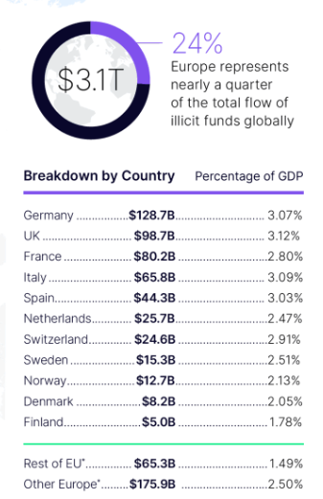
A Growing Threat to EU Financial Integrity
- Rowland’s statement highlights a systemic issue: Europe remains one of the most attractive regions for sophisticated criminal networks seeking to exploit financial loopholes.
- These illicit flows come from a mix of organised crime groups, international fraud rings, cybercrime actors, and professional money‑laundering syndicates.
- Criminals are increasingly exploiting cross-border payment channels, complex corporate structures, crypto‑asset markets, and high-value goods sectors.
- The sheer magnitude — €647 billion annually — signals not just criminal activity but a structural vulnerability in the EU’s financial architecture.
Why AMLA Says the Time for Change Is Now
As one of the five leaders of AMLA’s Executive Board, Rowland emphasises that Europe requires:
- Harmonised AML/CFT supervision across all Member States
- Direct oversight of high-risk financial institutions
- Unified enforcement powers across the EU
- Real-time intelligence collaboration between regulators, law enforcement, and private industry
Her message is clear:
- Fragmented national oversight frameworks cannot keep pace with transnational financial crime. AMLA — headquartered in Frankfurt and operational from 2025 — is designed to change this.
Related Findings Reinforce the Scale of Abuse
- The warning comes on the heels of multiple financial‑crime studies showing similar patterns. Industry analysis from companies specialising in anti-financial-crime technologies has identified hundreds of billions of euros in annual illicit transactions flowing across Europe, confirming Rowland’s concerns about escalating risks.
Financial crime is no longer a peripheral issue — it is a core threat to:
- Financial stability
- Fair markets
- National security
- Public trust in European institutions
Europe’s Response Enters a New Phase
- Rowland’s involvement in AMLA marks a pivotal moment for the EU’s campaign against money laundering. Previously Deputy Governor at the Central Bank of Ireland, she has long been recognised as a leading European voice on investor protection, enforcement, and anti-money laundering.
- Her elevation to AMLA’s top governance structure signifies the EU’s commitment to a far more assertive and unified approach to combating financial crime.
- With AMLA preparing to take on direct supervisory powers over certain high-risk entities — including crypto‑asset service providers, major banks, payment institutions, and fintech players — Europe may soon experience the most significant transformation of its AML/CFT regime in decades.
A Call for Collective Action
- Rowland’s message to industry, regulators, and policymakers is straightforward: the fight against illicit finance can no longer be merely reactive. Europe must adopt a coordinated, intelligence-driven, and technology-enabled framework that matches the scale and sophistication of the threat.
- Unless Europe steps up its efforts, the continent risks remaining a prime target for global criminal enterprises.
- With €647 billion in illicit funds already flooding its financial channels each year, the cost of inaction has never been higher.
Web Sources (Provided Once, As Requested)
- AML Intelligence: “NEWS: $750 billion in dirty money moves through Europe every year, warns AMLA’s Derville Rowland” (2026). [amlintelligence.com]
- AMLA – Executive profile of Derville Rowland. [amla.europa.eu]
- Central Bank of Ireland: Press release on Rowland’s appointment to AMLA (2025). [centralbank, i.e.]
- AML Analytics: Nasdaq Verafin report on illicit funds in Europe (2025). [aml-analytics.com]
Here are the direct links to Nasdaq Verafin’s “Financial Crime Insights: Europe”:
Primary landing page (with download form):
- Financial Crime Insights: Europe — Nasdaq Verafinhttps://verafin.com/financial-crime-insights-europe/ [verafin.com]
Direct PDF (final release, April 8, 2025):
- European-Financial-Crime-Report-Nasdaq-Verafin-20250408.pdfhttps://verafin.com/wp-content/uploads/2025/04/European-Financial-Crime-Report-Nasdaq-Verafin-20250408.pdf [verafin.com]
Direct PDF (earlier file, March 28, 2025 — same report series):
- European-Financial-Crime-Report-Nasdaq-Verafin-20250328.pdfhttps://verafin.com/wp-content/uploads/2025/03/European-Financial-Crime-Report-Nasdaq-Verafin-20250328.pdf [verafin.com]
Official press release (confirms figures and publication):
- Nasdaq press release (Mar 31, 2025)
https://www.nasdaq.com/press-release/nasdaq-verafin-report-finds-750-billion-money-laundering-and-illicit-funds-flowed [nasdaq.com]
The Team
Meet the team of industry experts behind Comsure
Find out moreLatest News
Keep up to date with the very latest news from Comsure
Find out moreGallery
View our latest imagery from our news and work
Find out moreContact
Think we can help you and your business? Chat to us today
Get In TouchNews Disclaimer
As well as owning and publishing Comsure's copyrighted works, Comsure wishes to use the copyright-protected works of others. To do so, Comsure is applying for exemptions in the UK copyright law. There are certain very specific situations where Comsure is permitted to do so without seeking permission from the owner. These exemptions are in the copyright sections of the Copyright, Designs and Patents Act 1988 (as amended)[www.gov.UK/government/publications/copyright-acts-and-related-laws]. Many situations allow for Comsure to apply for exemptions. These include 1] Non-commercial research and private study, 2] Criticism, review and reporting of current events, 3] the copying of works in any medium as long as the use is to illustrate a point. 4] no posting is for commercial purposes [payment]. (for a full list of exemptions, please read here www.gov.uk/guidance/exceptions-to-copyright]. Concerning the exceptions, Comsure will acknowledge the work of the source author by providing a link to the source material. Comsure claims no ownership of non-Comsure content. The non-Comsure articles posted on the Comsure website are deemed important, relevant, and newsworthy to a Comsure audience (e.g. regulated financial services and professional firms [DNFSBs]). Comsure does not wish to take any credit for the publication, and the publication can be read in full in its original form if you click the articles link that always accompanies the news item. Also, Comsure does not seek any payment for highlighting these important articles. If you want any article removed, Comsure will automatically do so on a reasonable request if you email info@comsuregroup.com.


As well as owning and publishing Comsure's copyrighted works, Comsure wishes to use the copyright-protected works of others. To do so, Comsure is applying for exemptions in the UK copyright law. There are certain very specific situations where Comsure is permitted to do so without seeking permission from the owner. These exemptions are in the copyright sections of the Copyright, Designs and Patents Act 1988 (as amended)[www.gov.UK/government/publications/copyright-acts-and-related-laws]. Many situations allow for Comsure to apply for exemptions. These include 1] Non-commercial research and private study, 2] Criticism, review and reporting of current events, 3] the copying of works in any medium as long as the use is to illustrate a point. 4] no posting is for commercial purposes [payment]. (for a full list of exemptions, please read here www.gov.uk/guidance/exceptions-to-copyright]. Concerning the exceptions, Comsure will acknowledge the work of the source author by providing a link to the source material. Comsure claims no ownership of non-Comsure content. The non-Comsure articles posted on the Comsure website are deemed important, relevant, and newsworthy to a Comsure audience (e.g. regulated financial services and professional firms [DNFSBs]). Comsure does not wish to take any credit for the publication, and the publication can be read in full in its original form if you click the articles link that always accompanies the news item. Also, Comsure does not seek any payment for highlighting these important articles. If you want any article removed, Comsure will automatically do so on a reasonable request if you email info@comsuregroup.com.