

€277 million in transfer fees with Russian clubs - Are European football clubs immune from sanction laws?
06/03/2026
More than four years after Russia invaded Ukraine, European clubs continue to carry out multi-million-euro transfers with Russian teams.
The deals offer Russian sides a vital financial lifeline – and hand the Kremlin a rare propaganda victory, analysts say.
FIFA under fire
- Despite the controversy around these transfers, European clubs often justify the deals by noting that they are allowed by football’s world governing body FIFA.
- FIFA and UEFA have been questioned by analysts such as Chadwick for not getting tougher with Russian football since the full-scale invasion started.
- Although Russian clubs and national teams have been barred from international competitions, the country’s football association remains represented in the administrative bodies of UEFA and FIFA.
- Most Russian representatives at UEFA were re-appointed in 2023, months after the international community had condemned the killing of hundreds of Ukrainians in the town of Bucha. Meanwhile, Russian officials at FIFA were re-appointed last year.
Show me the money
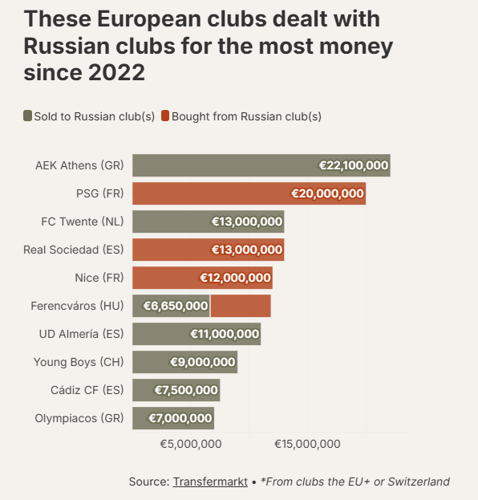
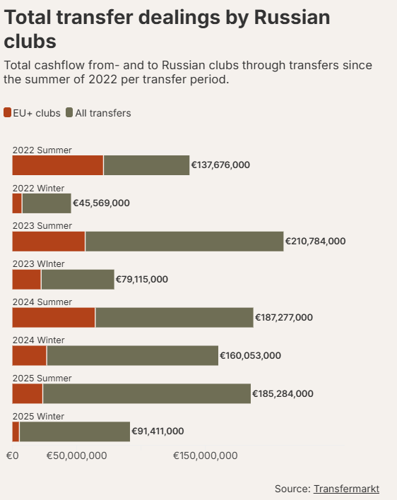
- European football clubs have done substantial transfer business with Russian sides since the full-scale invasion of Ukraine was launched in February 2022. More than €277 million in transfer fees has changed hands.
- French teams were responsible for the most lucrative deals, having conducted transfers worth more than €62 million with their Russian counterparts. In terms of numbers of transfers, clubs in Bulgaria and Portugal topped the charts.
- In terms of individual clubs, Greece’s AEK Athens earned the most from dealings with Russian sides, selling two players for more than €22 million.
Why does it matter?
- The Kremlin benefits from transfers between European and Russian sides, according to analysts.
- Firstly, the transfer fees provide a crucial financial lifeline.
- Secondly, such deals help the government to convey the message – at home and abroad – that it is business as usual despite the war in Ukraine.
- Many Russian club owners and directors have been sanctioned by the EU, the U.K. or the U.S. Several are also directly or indirectly connected to Russia’s war in Ukraine.
- Many of the transfers analysed by Follow the Money in previous reporting have potentially breached EU sanctions.
How was this investigated?
- Follow the Money analysed all international transfers to and from Russian clubs since the start of the full-scale invasion of Ukraine in February 2022.
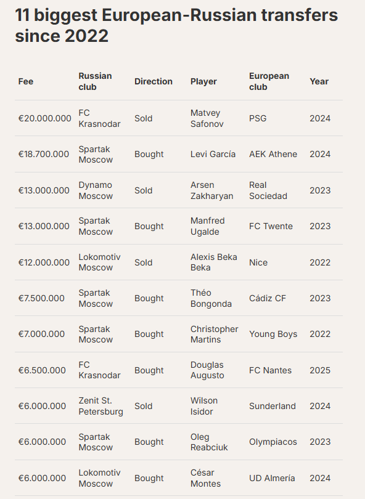
- Information on players, clubs, and transfer fees was sourced from the football database Transfermarkt.
Sources
- https://tinyurl.com/25vekzv2
- https://www.ftm.eu/articles/these-are-the-top-european-football-clubs-doing-deals-with-russia-in-wartime?utm_medium=social&utm_campaign=sharebuttonnietleden&utm_source=linkbutton&share=TxP8Y4v%2BRegPIoGvCButZzVQANecjaafA5MVpnxy9E5rP%2Bpowa0yka85Ev%2BHmH0%3D
The Team
Meet the team of industry experts behind Comsure
Find out moreLatest News
Keep up to date with the very latest news from Comsure
Find out moreGallery
View our latest imagery from our news and work
Find out moreContact
Think we can help you and your business? Chat to us today
Get In TouchNews Disclaimer
As well as owning and publishing Comsure's copyrighted works, Comsure wishes to use the copyright-protected works of others. To do so, Comsure is applying for exemptions in the UK copyright law. There are certain very specific situations where Comsure is permitted to do so without seeking permission from the owner. These exemptions are in the copyright sections of the Copyright, Designs and Patents Act 1988 (as amended)[www.gov.UK/government/publications/copyright-acts-and-related-laws]. Many situations allow for Comsure to apply for exemptions. These include 1] Non-commercial research and private study, 2] Criticism, review and reporting of current events, 3] the copying of works in any medium as long as the use is to illustrate a point. 4] no posting is for commercial purposes [payment]. (for a full list of exemptions, please read here www.gov.uk/guidance/exceptions-to-copyright]. Concerning the exceptions, Comsure will acknowledge the work of the source author by providing a link to the source material. Comsure claims no ownership of non-Comsure content. The non-Comsure articles posted on the Comsure website are deemed important, relevant, and newsworthy to a Comsure audience (e.g. regulated financial services and professional firms [DNFSBs]). Comsure does not wish to take any credit for the publication, and the publication can be read in full in its original form if you click the articles link that always accompanies the news item. Also, Comsure does not seek any payment for highlighting these important articles. If you want any article removed, Comsure will automatically do so on a reasonable request if you email info@comsuregroup.com.


As well as owning and publishing Comsure's copyrighted works, Comsure wishes to use the copyright-protected works of others. To do so, Comsure is applying for exemptions in the UK copyright law. There are certain very specific situations where Comsure is permitted to do so without seeking permission from the owner. These exemptions are in the copyright sections of the Copyright, Designs and Patents Act 1988 (as amended)[www.gov.UK/government/publications/copyright-acts-and-related-laws]. Many situations allow for Comsure to apply for exemptions. These include 1] Non-commercial research and private study, 2] Criticism, review and reporting of current events, 3] the copying of works in any medium as long as the use is to illustrate a point. 4] no posting is for commercial purposes [payment]. (for a full list of exemptions, please read here www.gov.uk/guidance/exceptions-to-copyright]. Concerning the exceptions, Comsure will acknowledge the work of the source author by providing a link to the source material. Comsure claims no ownership of non-Comsure content. The non-Comsure articles posted on the Comsure website are deemed important, relevant, and newsworthy to a Comsure audience (e.g. regulated financial services and professional firms [DNFSBs]). Comsure does not wish to take any credit for the publication, and the publication can be read in full in its original form if you click the articles link that always accompanies the news item. Also, Comsure does not seek any payment for highlighting these important articles. If you want any article removed, Comsure will automatically do so on a reasonable request if you email info@comsuregroup.com.