
€26> Billion in proceeds of crime were transferred through at least 75 companies & IFCs, with no prosecutions.
05/03/2026
From 2006 to 2013, €26,290,143,484 in proceeds of crime were transferred through at least 75 companies & IFCs, with no prosecutions.
Overview
- The Troika Laundromat
- Was a large, sophisticated money‑laundering and asset‑movement network uncovered in 2019 by the Organised Crime and Corruption Reporting Project (OCCRP) and Lithuanian outlet
- It remains a widely cited case study in AML/CFT risk management, demonstrating the convergence of offshore secrecy, weak banking controls, and high-risk client networks.
- Investigators
- Analysed 1.3 million banking transactions from 238,000 companies, making it one of the largest banking‑data leaks ever.
- Exposed how Troika Dialog, once Russia’s largest private investment bank, created and operated a system that moved billions of dollars out of Russia through complex offshore structures.
Prosecution
- Despite €26+ billion flowing through the Troika Laundromat, there have effectively been no major criminal prosecutions resulting from the revelations, aside from the ongoing Spanish case.
- In Spain Dmitry Artyakov (money laundering case tied to Troika network). [fincrimecentral.com], [vlst.pro] is under investigation; no prosecution filed.
- Current Status (as of 2026) - Arrest and criminal proceedings
- Dmitry Artyakov was arrested in Girona, Spain.
- He is currently under prosecution for money laundering tied to offshore networks exposed in the Troika Laundromat investigation.
- Spanish Anti‑Corruption Prosecutors are continuing to examine:
- Troika‑linked offshore loans
- Suspect real‑estate purchases in Girona/S’Agaró
- Possible use of family members as fronts
Investigation into Dmitry Artyakov – Troika Laundromat–Linked Case
- Dmitry Artyakov is the son of Vladimir Artyakov, a senior executive at the Russian state conglomerate Rostec and former governor of Russia’s Samara region.
- Spanish authorities consider Dmitry a beneficiary of real‑estate transactions financed through offshore entities tied to the Troika Laundromat network.
- Starting in 2019, Spanish authorities opened a major anti‑money‑laundering investigation into property transactions on the Costa Brava, particularly in Girona and S’Agaró.
- The investigation found that:
- Millions of euros used to purchase luxury real estate had passed through offshore companies connected to the Troika Laundromat.
- These included Delco Networks (BVI) and Digimarket Holdings (Cyprus) — both previously identified as Troika-linked entities.
Key Allegations
- Use of offshore companies to conceal the origin of funds
- Authorities claim that Artyakov used offshore vehicles tied to the Troika Laundromat to acquire high-value real estate, disguising the origin of the funds.
- Use of family members as fronts
- Spanish filings allege that Anna Kurepina, Dmitry’s grandmother, was used as a front (nominee owner) in transactions designed to launder funds through property purchases.
- Acquisition of properties at suspicious prices
- In 2008, Kurepina purchased a villa in S’Agaró for €14 million using a loan from the BVI-based Delco Networks, tied to Troika.
- In 2014, she sold it to her grandson Dmitry for €10 million, despite being 86 years old and lacking credible independent wealth.
- 4. Loans from Troika-linked companies
- Dmitry told investigators he financed the deal using a loan from Digimarket Holdings, another known Troika offshore. [
- 5. Connection to wider Russian illicit financial flows
- Spanish authorities view the Artyakov case as an extension of the Troika Laundromat’s method of integrating illicit Russian funds into the European luxury real‑estate market.
Was the €26.29 billion in the Troika Laundromat proceeds of crime?
- Yes — a significant portion of the funds flowing through the Troika Laundromat is widely reported to have originated from criminal activity, corruption schemes, tax evasion, and other illicit sources.
- The leaked data shows the Laundromat mixed legitimate and criminal money, but multiple investigations confirm that a substantial share was the proceeds of crime.
Evidence from Multiple Investigations
- OCCRP: Laundromat used to move corrupt and criminal funds
- OCCRP states that Laundromats (including Troika) allow
- “Corrupt politicians, organised crime figures, and wealthy businesspeople to secretly invest their ill-got millions, launder money, evade taxes, and fulfil other goals.”
- This directly confirms that criminal proceeds were part of the flows.
- Transparency International: Funds included the proceeds of corruption, tax evasion, and criminal activities
- Transparency International reports that the Troika Laundromat demonstrated “how easy it is to launder and hide the proceeds of corruption, tax evasion or other criminal activities in Europe.”
- This reinforces that illegal origin was a major component.
- Links to known financial crimes (Magnitsky fraud, fuel fraud, tax fraud)
- The scheme is connected to entities involved in major criminal cases, including:
- Magnitsky Affair (tax‑reclaim fraud)
- Sheremetyevo Airport fuel fraud
- Russian Laundromat (criminal extraction of state funds)
- This demonstrates that part of the money processed through Troika was directly tied to well-documented criminal offences.
- ICIJ: The scheme mixed criminal and legitimate funds
- The ICIJ states the Laundromat “combined criminal and legitimate money, making its sources difficult to trace.”
- This confirms that illicit proceeds formed a substantial part of the transactional flow.
- The €26.29 billion (US$26 billion) flowing through the system between 2006 and 2013 included:
- Money from corruption schemes
- Money from fraud (e.g., Magnitsky fraud)
- Money from fuel‑price collusion and tax evasion networks
- Funds linked to organised crime
- Illicit funds extracted from both state-owned and private entities
- Those flows were deliberately obscured through layers of offshore companies, proxies, and fabricated business transactions—hallmark indicators of laundering criminal proceeds.
How the Laundromat Worked
- Troika Dialogue set up at least 75 offshore shell companies, primarily in jurisdictions
- British Virgin Islands (BVI)
- Panama
- United Kingdom (UK)
- Estonia
- Other unspecified tax‑haven jurisdictions
- These companies were often legally fronted by unwitting individuals, including poor or vulnerable people whose identities were used as proxy signatories.
- The network relied heavily on accounts held at Ukio Bankas, a now-defunct Lithuanian bank that maintained over 35 Laundromat shell‑company accounts.
- Funds were obscured through fake invoices, sham loan agreements, and circular trading, mixing legitimate and illicit flows.
The purpose of this structure was to layer and integrate funds while concealing true beneficial ownership.
Scale of the Flows
Between 2006 and 2013, the Laundromat:
- Received over $4.5–4.8 billion in incoming transfers.
- Facilitated $8.8 billion in internal transactions, often through fictitious trade deals.
These findings demonstrate that funds were repeatedly cycled through opaque channels before entering the global financial system.
Primary Uses of the Laundromat
According to OCCRP’s reporting, the network was used by Russian oligarchs, business elites, and politically exposed persons to:
- Move billions out of Russia covertly.
- Acquire shares in Russian state-owned enterprises secretly.
- Purchase real estate in Russia and abroad.
- Buy luxury yachts, vehicles, and other high-value assets.
- Fund private entertainment, including hiring international celebrities for parties.
- Pay personal expenses, such as medical bills.
The scheme effectively served as a shadow financial‑services platform for the Russian elite.
Notable Links and Cases
- Companies tied to the Magnitsky fraud moved over $130 million through the Laundromat.
- Entities associated with Sergei Roldugin, a close associate of Vladimir Putin, received at least $69 million.
- The system also touched actors involved in alleged tax‑evasion schemes, fuel‑price collusion, and other financial crimes.
Significance for AML/CFT
The Troika Laundromat revealed:
- How major financial institutions can be exploited when AML controls are weak or inconsistently applied.
- The role of European correspondent banking in enabling opaque cross‑border flows.
- The agility with which complex offshore structures can obscure beneficial ownership and defeat transaction‑monitoring systems.
Troika Laundromat
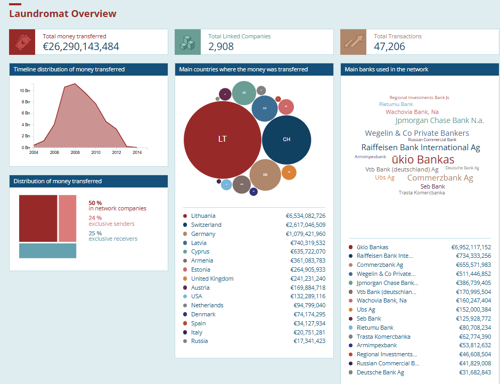
From 2006 to 2013, €26,290,143,484 was transferred through at least 75 companies established by the Russian investment bank Troika Dialogue.
The money flowed through a complex network of companies we call the Troika Laundromat, with the main purpose of channelling funds out of Russia. Note that aggregate transaction amounts in this visualisation will differ from aggregate reported amounts.
Source
- https://www.occrp.org/en/project/the-troika-laundromat?utm_source=twitter&utm_medium=social&utm_campaign=manual
- https://www.occrp.org/en/project/the-troika-laundromat
- https://carnegieendowment.org/posts/2019/03/the-troika-scandal-is-it-really-what-it-seems
- https://en.wikipedia.org/wiki/Troika_laundromat
- https://www.transparency.org/en/news/troika-laundromat-a-different-kind-of-financial-crisis
- https://everything.explained.today/Troika_laundromat/
- https://assembly.coe.int/nw/xml/XRef/Xref-XML2HTML-en.asp?fileid=27553
- [assembly.coe.int] [everything...ined.today][transparency.org][occrp.org]
The Team
Meet the team of industry experts behind Comsure
Find out moreLatest News
Keep up to date with the very latest news from Comsure
Find out moreGallery
View our latest imagery from our news and work
Find out moreContact
Think we can help you and your business? Chat to us today
Get In TouchNews Disclaimer
As well as owning and publishing Comsure's copyrighted works, Comsure wishes to use the copyright-protected works of others. To do so, Comsure is applying for exemptions in the UK copyright law. There are certain very specific situations where Comsure is permitted to do so without seeking permission from the owner. These exemptions are in the copyright sections of the Copyright, Designs and Patents Act 1988 (as amended)[www.gov.UK/government/publications/copyright-acts-and-related-laws]. Many situations allow for Comsure to apply for exemptions. These include 1] Non-commercial research and private study, 2] Criticism, review and reporting of current events, 3] the copying of works in any medium as long as the use is to illustrate a point. 4] no posting is for commercial purposes [payment]. (for a full list of exemptions, please read here www.gov.uk/guidance/exceptions-to-copyright]. Concerning the exceptions, Comsure will acknowledge the work of the source author by providing a link to the source material. Comsure claims no ownership of non-Comsure content. The non-Comsure articles posted on the Comsure website are deemed important, relevant, and newsworthy to a Comsure audience (e.g. regulated financial services and professional firms [DNFSBs]). Comsure does not wish to take any credit for the publication, and the publication can be read in full in its original form if you click the articles link that always accompanies the news item. Also, Comsure does not seek any payment for highlighting these important articles. If you want any article removed, Comsure will automatically do so on a reasonable request if you email info@comsuregroup.com.


As well as owning and publishing Comsure's copyrighted works, Comsure wishes to use the copyright-protected works of others. To do so, Comsure is applying for exemptions in the UK copyright law. There are certain very specific situations where Comsure is permitted to do so without seeking permission from the owner. These exemptions are in the copyright sections of the Copyright, Designs and Patents Act 1988 (as amended)[www.gov.UK/government/publications/copyright-acts-and-related-laws]. Many situations allow for Comsure to apply for exemptions. These include 1] Non-commercial research and private study, 2] Criticism, review and reporting of current events, 3] the copying of works in any medium as long as the use is to illustrate a point. 4] no posting is for commercial purposes [payment]. (for a full list of exemptions, please read here www.gov.uk/guidance/exceptions-to-copyright]. Concerning the exceptions, Comsure will acknowledge the work of the source author by providing a link to the source material. Comsure claims no ownership of non-Comsure content. The non-Comsure articles posted on the Comsure website are deemed important, relevant, and newsworthy to a Comsure audience (e.g. regulated financial services and professional firms [DNFSBs]). Comsure does not wish to take any credit for the publication, and the publication can be read in full in its original form if you click the articles link that always accompanies the news item. Also, Comsure does not seek any payment for highlighting these important articles. If you want any article removed, Comsure will automatically do so on a reasonable request if you email info@comsuregroup.com.