




 Published on : 20/05/2026
25 Billion Disappeared? – Ramgoolam Tears Into Mauritian Bank Supervision Failures
It has been reported that in a parliamentary response to MP Adrien Duval, Mauritius Prime Minister Navin Ramgoolam sharply criticised the Bank of Mauritius (BoM) banking supervision failures during the previous government's decade in power (2014–2024).
- He highlighted massive bad loans and losses across four institutions totalling around Rs 25 billion, which he described as funds "siphoned," written off, or turned toxic due to weak oversight.
- The PM emphasised the BoM's core mandate to safeguard financial stability through prudential supervision and anti-money-laundering efforts.
- He outlined a history of leadership turnover in the Supervision Department (including seconded Indian officials, followed by local appointments and vacancies). He announced upcoming legislative reforms to strengthen the BoM's independence, transparency, and effectiveness.
- The central bank is already reviewing internal practices and will bring in a new professional from India's Reserve Bank of India to bolster capacity and probe past shortcomings.
The intervention underscores the new government's priority to restore credibility and soundness in Mauritius' financial sector, which is a key pillar of the economy, through stronger regulation and accountability for past lapses.
Key Issues on Regulation Highlighted by the Prime Minister
1. Systemic Supervisory Failures
- The BoM's Supervision Department failed to prevent or timely address serious risks while being responsible for overseeing
- 18 banks,
- 6 non-bank financial institutions,
- 5 money changers, and
- 7 foreign exchange brokers,
- Insufficient supervision allowed risky and fraudulent lending practices to flourish, delayed corrective actions, and permitted the build-up of large volumes of toxic assets.
2. Massive Financial Losses in Specific Institutions
- Silver Bank Ltd: Rs 8.1 billion of its Rs 8.3 billion loan portfolio classified as non-performing (March 2024).
- SBM Bank (Mauritius) Ltd: Cumulative loan write-offs of Rs 14.34 billion between 2014 and 2024.
- Development Bank of Mauritius Ltd: Rs 400 million in non-performing loans as of June 2025 (including Rs 304 million linked to companies in liquidation/judicial administration).
- MauBank Holdings Ltd: Negative equity of Rs 2.95 billion due to accumulated losses since 2015.
The PM stated that these four banks alone saw approximately Rs 25 billion "disappear" from their balance sheets.
3. Governance and Oversight Shortcomings
- Dysfunctional boards of directors in some commercial banks allegedly approved toxic loans without adequate scrutiny.
- Leadership instability in the BoM Supervision Department (multiple changes, vacancies, and reliance on short-term or seconded officials) contributed to weak enforcement of international standards and slow sanctioning of non-compliance.
4. Political Context
- Ramgoolam attributed these problems to the "former kleptocratic regime," framing the issues as outcomes of a decade of inadequate regulatory vigilance rather than isolated incidents.
Government Response and Planned Reforms
- Legislative overhaul of the Bank of Mauritius Act and the Banking Act to enhance independence, transparency, and rigour of the supervisory framework.
- Internal review already underway at the BoM.
- Recruitment of an experienced professional from the Reserve Bank of India to strengthen the supervision team and investigate historical failures.
The intervention underscores the new government's priority to restore credibility and soundness in Mauritius' financial sector, which is a key pillar of the economy, through stronger regulation and accountability for past lapses.
The published L'Express story
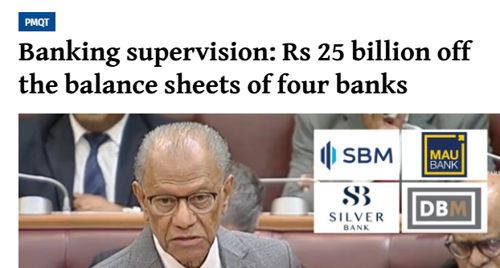
Banking supervision and the large losses recorded in several financial institutions were at the centre of a sharp intervention by the Prime Minister (PM), Navin Ramgoolam, in response to a question from MP Adrien Duval on:
- The position of Director of Supervision at the Bank of Mauritius (BoM).
The head of government recalled that one of the BoM's main missions is to ensure the stability and soundness of the financial system. To this end, the Central Bank's supervisory department is responsible for
- Prudential supervision
- As well as the fight against money laundering, terrorist financing and financial proliferation.
The supervisory directors oversee 18 banks, six non-bank financial institutions, five money changers, and seven foreign exchange brokers.
They must also ensure that financial institutions comply with international standards, recommend corrective measures and propose sanctions in the event of non-compliance.
The PM also retraced the various appointments at the head of the department between 2014 and 2024.
- Two Indian officials seconded from the Reserve Bank of India, Amar Kumar Bera and Ajay Kumar Choudhary, successively held this position before several periods of vacancy.
- Subsequently, Ramsamy Chinniah, Sudha Hurrymun and Urvashi Chuttarsing-Soobarah supervised the department at various levels.
But above all, the state of the banking sector dominated the debates.
Navin Ramgoolam claimed that several financial scandals have been discovered in recent months in institutions operating under the "former kleptocratic regime"
He cited the case of
- Silver Bank Ltd, whose Rs 8.1 billion in loans, out of a total portfolio of Rs 8.3 billion, were considered non-performing in March 2024.
- SBM Bank (Mauritius) Ltd, which is said to have written off a cumulative amount of Rs 14.34 billion in loans between 2014 and 2024.
- Development Bank of Mauritius Ltd, Rs 400 million in loans were classified as non-performing as of 30 June 2025, including Rs 304 million related to five companies in liquidation or under judicial administration.
- MauBank Holdings Ltd was also mentioned. According to the PM, the bank has negative equity of Rs 2.95 billion due to accumulated losses since its establishment in 2015.
Ramgoolam said.
- "When we look at these four banks, about Rs 25 billion disappeared from their balance sheets in the form of siphoned funds, bad loans or write-offs,"
- These situations demonstrate serious shortcomings in the supervisory role of the Bank of Mauritius during the previous government's ten-year term.
The PM argued
- That this insufficient supervision has allowed risky and fraudulent practices, delayed corrective actions and led to the accumulation of toxic assets in several financial institutions.
- He also denounced the dysfunction of the boards of directors of some commercial banks, which allegedly approved toxic loans.
Faced with this situation,
- The government plans to reform the Bank of Mauritius Act and the Banking Act to strengthen the independence, transparency and rigour of the banking supervision system.
The Bank of Mauritius
- Has already started a review of its internal practices and
- Plans to bring in a professional from the Reserve Bank of India to strengthen the capacity of the supervisory department and investigate past failures.
Sources
The Team
Meet the team of industry experts behind Comsure
Find out moreLatest News
Keep up to date with the very latest news from Comsure
Find out moreGallery
View our latest imagery from our news and work
Find out moreNews Disclaimer
As well as owning and publishing Comsure's copyrighted works, Comsure wishes to use the copyright-protected works of others. To do so, Comsure is applying for exemptions in the UK copyright law. There are certain very specific situations where Comsure is permitted to do so without seeking permission from the owner. These exemptions are in the copyright sections of the Copyright, Designs and Patents Act 1988 (as amended)[www.gov.UK/government/publications/copyright-acts-and-related-laws]. Many situations allow for Comsure to apply for exemptions. These include 1] Non-commercial research and private study, 2] Criticism, review and reporting of current events, 3] the copying of works in any medium as long as the use is to illustrate a point. 4] no posting is for commercial purposes [payment]. (for a full list of exemptions, please read here www.gov.uk/guidance/exceptions-to-copyright]. Concerning the exceptions, Comsure will acknowledge the work of the source author by providing a link to the source material. Comsure claims no ownership of non-Comsure content. The non-Comsure articles posted on the Comsure website are deemed important, relevant, and newsworthy to a Comsure audience (e.g. regulated financial services and professional firms [DNFSBs]). Comsure does not wish to take any credit for the publication, and the publication can be read in full in its original form if you click the articles link that always accompanies the news item. Also, Comsure does not seek any payment for highlighting these important articles. If you want any article removed, Comsure will automatically do so on a reasonable request if you email info@comsuregroup.com.
Archived News
To find our older articles, please click here.
View archive

To find our older articles, please click here.